

Build Your Own Trading Performance Coach
Hedge fund traders have performance coaches. Solo traders do not. Build your own coaching system using journaling, reviews, and structured feedback loops.
Hedge fund traders managing billions of dollars have a performance coach sitting in their office. That coach watches how they handle wins, losses, pressure, and uncertainty. The coach spots patterns the trader cannot see and calls out emotional drift before it becomes a blown position.
You do not have that. Most retail traders operate alone, with no structured feedback and no one to point out that they have been overtrading after wins for three weeks straight. The gap between institutional and retail is not strategy. It is accountability infrastructure.
The good news: you can build your own coaching system. It will not replace a human coach entirely, but it will catch 80% of what a coach catches, using tools you already have access to.
TL;DR
Professional traders have performance coaches. Retail traders need to build their own.
A coaching system has three layers: daily trade notes, weekly pattern reviews, and monthly strategy assessments.
The most important metric is plan adherence rate, not win rate or P&L.
Structured review processes catch behavioral drift before it costs you real money.
Data-driven self-coaching is more effective than motivational self-talk.
Why Solo Traders Fail Without Feedback
Trading alone means you are the player and the referee. You decide what counts as a valid setup. You decide whether that exit was planned or panicked. You decide whether today was a good day.
The problem: you are biased. After a profitable day, you are more generous with self-assessment. After a losing day, you are either too harsh (questioning your entire strategy) or too lenient (blaming the market). Neither response is useful.
A coaching system removes the bias by making feedback data-driven instead of feeling-driven. You do not evaluate whether the day "felt good." You evaluate whether the data shows plan adherence.
The Three-Layer Coaching System
Think of your self-coaching system as three nested loops, each running at a different speed.
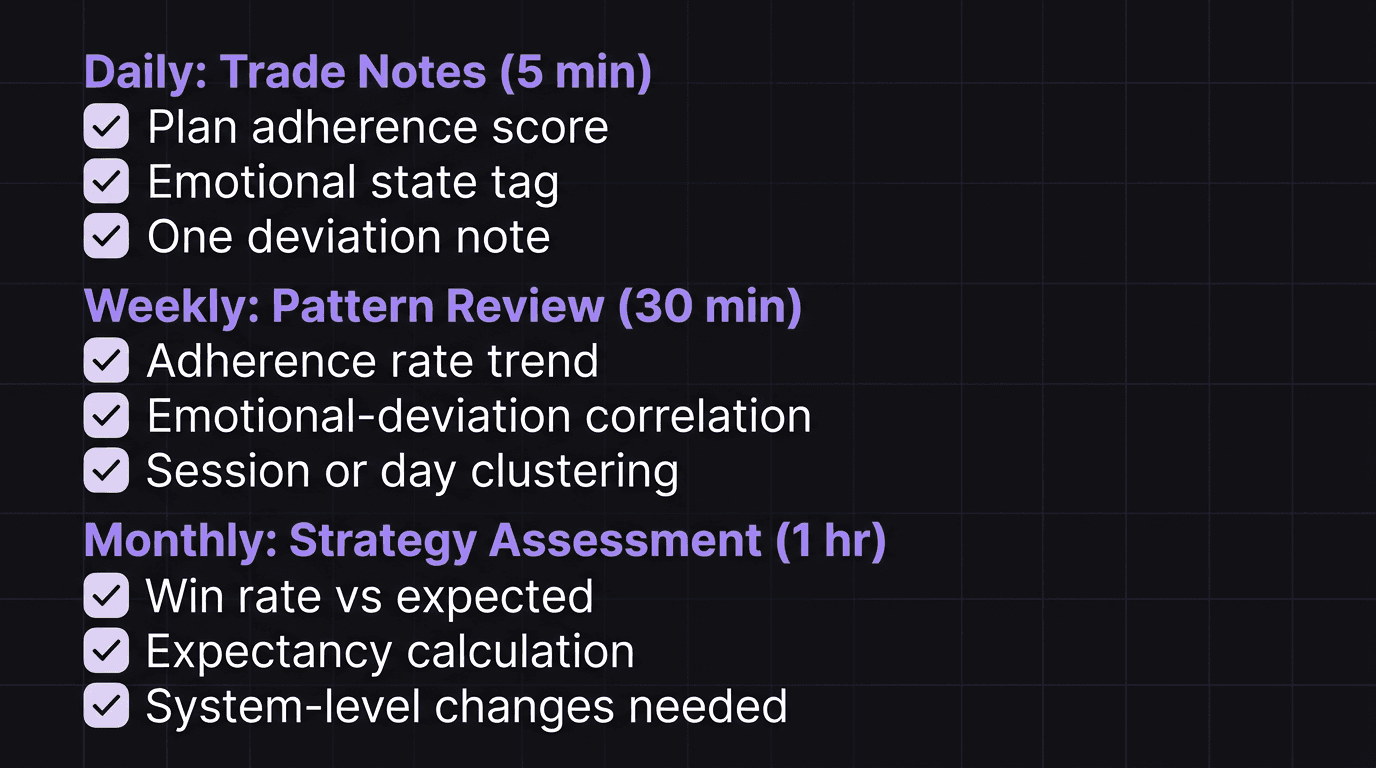
Layer 1: The Daily Trade Note (5 Minutes)
After your last trade of the day, write three things in your trading journal:
Plan adherence score. How many trades followed your plan out of total trades taken? Express it as a fraction. "3 out of 4" is clear. "Pretty good" is useless.
Emotional state tag. One word: calm, anxious, frustrated, confident, numb, rushed. Do not overthink this. First word that comes to mind.
One deviation note. If any trade deviated from your plan, write what happened in one sentence. "Closed EUR/USD 20 pips early because the pullback scared me." If all trades followed the plan, write "No deviations."
This takes less than 5 minutes. The goal is not analysis. The goal is data capture while the memory is fresh. Analysis comes later.
Layer 2: The Weekly Pattern Review (30 Minutes)
Every weekend, review your daily notes from the week. You are looking for patterns, not individual trades.
Questions to ask:
What was my plan adherence rate this week? (Total plan trades divided by total trades)
Did my emotional state tag correlate with deviation days? (Usually yes)
Was there a day of the week or session where deviations clustered?
Did I take any trades that were not in my playbook?
Walkthrough: A Weekly Review That Found the Leak
A trader reviews their week. Five trading days, 12 trades total.
Day | Trades | On-Plan | Deviation |
|---|---|---|---|
Mon | 3 | 3 | None |
Tue | 2 | 2 | None |
Wed | 3 | 2 | Closed GBP/USD early |
Thu | 2 | 1 | Added to losing AUD/USD position |
Fri | 2 | 1 | Took a setup outside playbook |
Plan adherence: 9 out of 12 trades, or 75%.
The trader also notices: Wednesday through Friday emotional tags were "frustrated," "anxious," and "rushed." Monday and Tuesday were "calm" and "focused."
A paid coach would say: "You start the week clean and degrade by midweek. What changes?" The self-coaching system surfaces the same question through data. In this case, the trader realizes they stopped doing their pre-session review after Tuesday because "they already knew the levels." The degradation followed.
Fix: commit to the pre-session review every day, not just Mondays.
Layer 3: The Monthly Strategy Assessment (1 Hour)
Once a month, zoom out. This is not about individual trades. This is about whether your overall system is working.
Monthly questions:
Is my actual win rate within 10% of my backtested win rate? If not, is the gap from strategy drift or execution failures?
What is my expectancy per trade this month compared to last month?
Are my losses concentrated in specific setups, sessions, or emotional states?
Do I need to adjust any rules, or do I need to follow existing rules better?
The monthly review prevents you from making reactive changes during a bad week. If you only review weekly, a two-loss Tuesday might convince you to change your stop loss placement. The monthly view shows that Tuesday was noise within a profitable month.
Plan Adherence Rate: The Core Metric
Win rate tells you whether your strategy works. Plan adherence rate tells you whether you are executing that strategy. A coach cares more about the second number.
If your plan adherence is 90%+ and you are still losing money, the strategy needs work. That is a mechanical problem with a mechanical fix: adjust entries, exits, or risk parameters.
If your plan adherence is below 80% and you are losing money, the strategy might be fine. You just are not following it. That is a behavioral problem, and no strategy change will fix it.
Track this number weekly. It is the single most important metric for a solo trader because it separates the two root causes of underperformance.
Walkthrough: Adherence Gap Exposed by Numbers
A trader runs a 45% win rate strategy with a 2.5:1 reward-to-risk ratio. Backtested expectancy over 200 trades: positive $75 per trade at 0.5 lots.
After one live month (40 trades), actual expectancy: negative $12 per trade. The trader concludes the strategy does not work live.
Monthly review reveals: plan adherence was 65%. Of the 14 off-plan trades, 11 were losers (early exits on winners, added to losers, skipped valid setups replaced by impulsive entries). When the off-plan trades are removed, the 26 on-plan trades had an expectancy of positive $68 per trade, close to the backtested number.
The strategy works. The execution does not. A coach would see this in the first session. The self-coaching system surfaces it in the monthly review.
How EdgeFlo Automates the Coaching System
EdgeFlo's AI-powered trading journal handles Layer 1 automatically. Trades import directly, emotion tags are captured at entry and exit, and deviation notes are prompted at the point of action rather than from memory hours later.
The weekly AI report (Plus) acts as Layer 2, surfacing patterns like "your largest losses cluster on Fridays" or "your win rate drops 20% when you tag your emotional state as rushed." This is the same insight a performance coach would deliver, generated from your own data.
Sanctuary supports the behavioral side by providing guided reset routines when your emotional state tag trends negative across multiple days. Instead of powering through frustration (which the data shows leads to worse adherence), you have structured tools to reset before the next session.
The Edge Brief
Receive Insights on trading psychology, discipline, and the behavioral patterns that create consistent traders from our Founder and the EdgeFlo team, delivered to your inbox.
Think different. Trade different.
What does a trading performance coach do?
Can you coach yourself in trading without hiring someone?
How often should you review your trading performance?
What is the most important metric for a trading performance review?

Turn discipline on.
Every session.
EdgeFlo is the environment serious traders operate inside.
Start 7-Day Free Trial
Cancel anytime.
No long-term commitment.


Think Different, Trade Different.