

Break Even Stop Loss: When to Move It
Learn when to move your stop loss to break even using market structure, and avoid the premature BE trap that kills winning trades.

Moving your stop loss to break even feels like the smartest move in trading. You entered a trade, price moved in your favor, and now you can eliminate all risk by sliding your stop to entry. Free trade, right?
Not always. Moving to break even at the wrong time is one of the fastest ways to turn winning trades into flat ones. The market needs room to breathe, and if you choke off that room too early, you will watch price tap your entry, stop you out, and then continue exactly where you expected it to go.
TL;DR
Break even stop loss means moving your SL to your entry price after price moves in your favor.
Moving too early (before structure confirms) gets you stopped out on normal pullbacks.
Wait for a confirmed higher low or lower high before shifting your stop.
Structure-based timing protects capital without sacrificing trade potential.
Trailing into profit is the next step after break even, but only when the structure supports it.
What Break Even SL Means
A break even stop loss is simple. After you enter a trade and price moves in your direction, you move your stop loss from its original position up to your entry price. If the trade reverses and hits that stop, you exit at zero loss.
The appeal is obvious. You entered at 1.0850 on EUR/USD with a stop at 1.0820 (risking 30 pips). Price climbs to 1.0890. You move your stop from 1.0820 to 1.0850. Now if it comes back down, you lose nothing instead of losing 30 pips.
This is the foundation of risk management for most beginner traders. And in principle, it works. The problem is timing.
The Premature Break Even Trap
Ever had a trade move 20 pips in your favor, moved your stop to entry, then watched it dip back to your entry, stop you out, and rally 80 more pips without you? That is the premature break even trap.
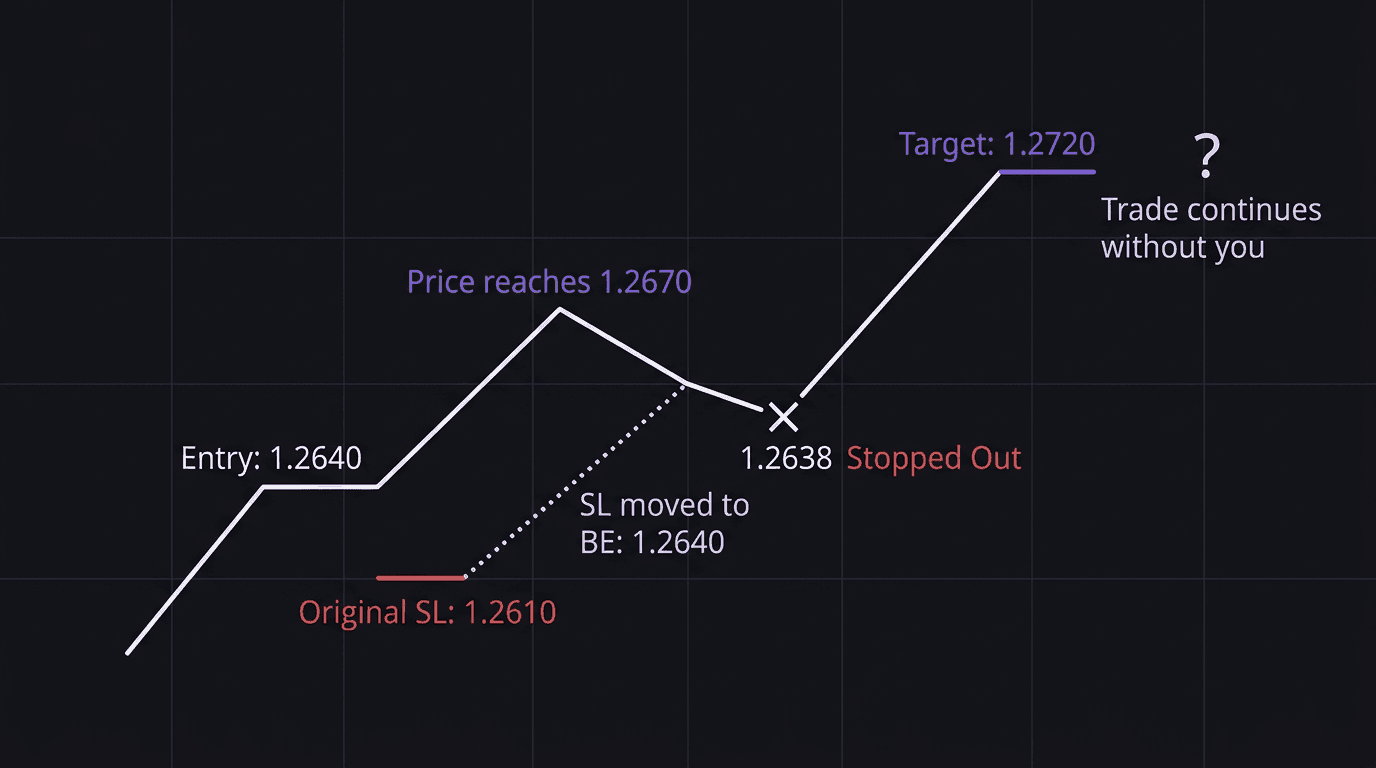
Here is what actually happens. You buy GBP/USD at 1.2640 on the 1-hour chart. Your stop loss sits at 1.2610, below the recent swing low. Price pushes up to 1.2670, and you think, "I should protect this." You move your stop to 1.2640.
Price pulls back to 1.2638. Two pips below your entry. Stopped out. Then price bounces from 1.2635 (the real support) and runs to 1.2720. You were right about the trade. You were wrong about when to protect it.
This happens because markets do not move in straight lines. Price oscillates. It pulls back to test levels. It sweeps liquidity below obvious lows before continuing. If your break even stop sits right at the point where normal price action occurs, you are guaranteeing exits on trades that would have worked.
The trap is psychological. Moving to break even makes you feel safe. But feeling safe and being safe are different things. A premature break even stop does not reduce risk so much as it reduces opportunity.
Structure-Based Break Even Timing
The fix is to let market structure tell you when to move your stop, not your emotions.
In an uptrend, price creates higher highs and higher lows. Each higher low is a structural confirmation that buyers are still in control. That higher low is where your trailing stop belongs, not at your entry price.
Here is the rule. Do not move your stop to break even until price has created a confirmed higher low above or near your entry. If the new higher low sits at or above your entry, your stop naturally lands at break even or better. If it sits below your entry, keep your original stop.
Walkthrough: GBP/USD 4-Hour Swing Trade
You enter long on GBP/USD at 1.2700 with a stop at 1.2660 (40 pips risk). Your take profit sits at 1.2820 (120 pips, a 3R trade).
Price moves to 1.2750, pulls back, and forms a higher low at 1.2715. That higher low is above your entry. Now you move your stop from 1.2660 to 1.2710 (just below the new higher low). You are effectively at break even with a small buffer.
Price then pushes to 1.2790, pulls back, and creates another higher low at 1.2760. You move your stop again to 1.2755. Now you are locked in at roughly 55 pips of profit even if the trade reverses.
Price eventually hits your take profit at 1.2820. Full 3R captured. The key was waiting for structure rather than moving to break even the moment you saw green on the screen.
What if you had moved to break even at 1.2700 when price first hit 1.2750? The pullback to 1.2715 would not have stopped you out. But in many cases, the pullback goes deeper. Maybe to 1.2695. Five pips below entry. And you would be watching from the sidelines as price runs to 1.2820.
Following consistent rules about when to adjust your stop eliminates the guesswork. Structure gives you an objective reason to move; feelings do not.
Break Even vs Trailing Into Profit
Break even is the first step. Trailing into profit is the next logical move.
Once your stop sits at break even and price continues creating structure in your favor, you can keep moving your stop loss to each new structural low (for longs) or structural high (for shorts). This is where the trailing stop loss method from the transcript comes in.
The difference between break even and trailing is intent. Break even says, "I do not want to lose money on this trade." Trailing says, "I want to lock in as much profit as possible while the trend continues."
Both require the same skill: reading market structure. And both carry the same risk. If you trail too aggressively, liquidity sweeps below recent lows can take you out before the trend resumes.
The practical approach is to use wider stops that sit below the liquidity zone rather than right at the swing low. If the recent higher low is at 1.2760, do not put your stop at 1.2760. Put it at 1.2752 or 1.2748 to give room for a quick wick below the obvious level.
This is not a perfect solution. Sometimes the sweep goes deeper. But it keeps you in more trades than a tight stop placed exactly at structure.
The real question is not "break even or trailing?" It is "what does my trading plan say?" Pick one approach, document it, and follow it every time. Switching between methods based on how you feel about a trade is how inconsistency creeps in.
How EdgeFlo Helps You Time Break Even Moves
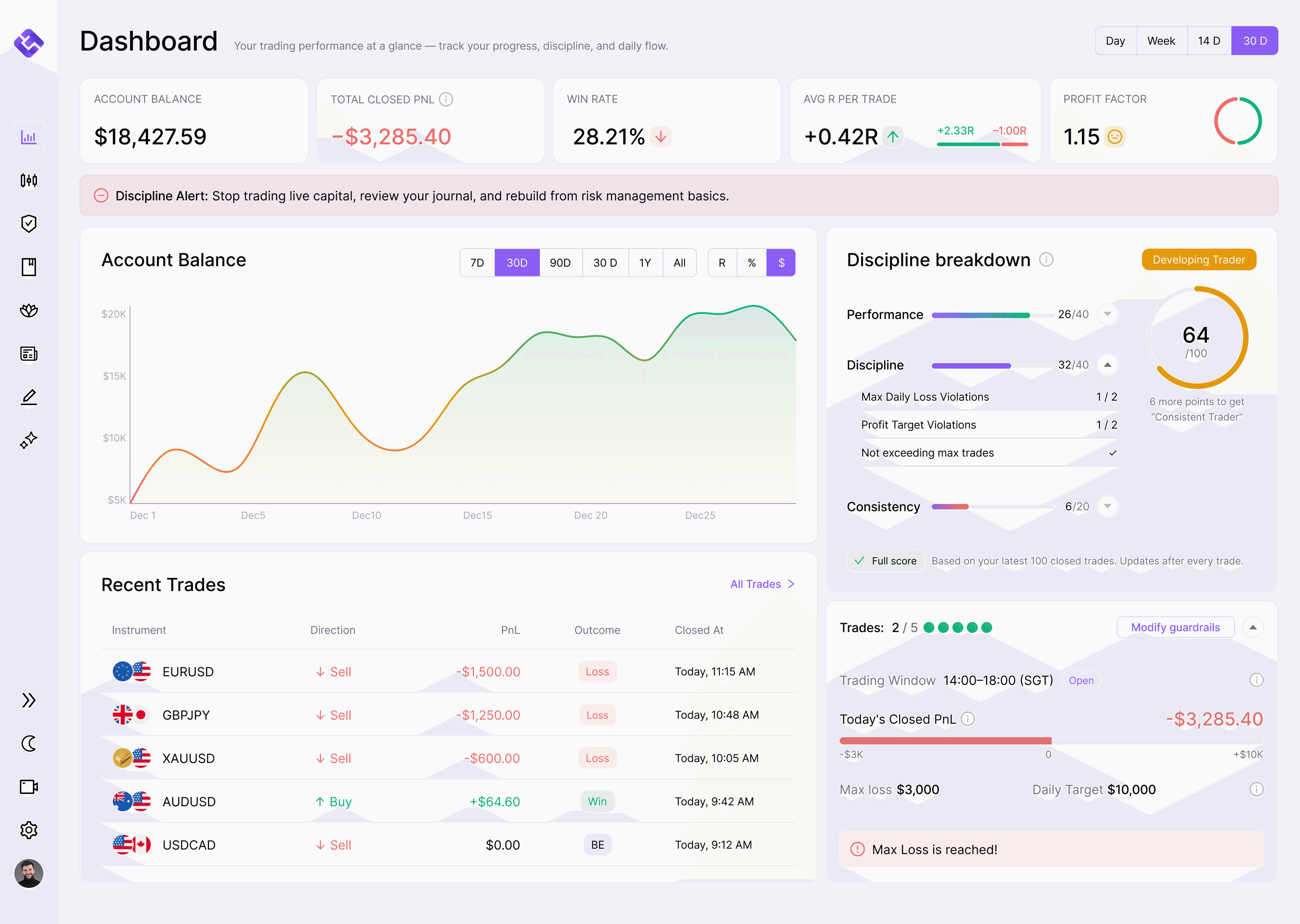
EdgeFlo's guardrails can warn you when you are approaching your daily loss limit, giving you a built-in signal to stop trading if multiple break even stops have already fired. You can override the guardrail if you choose, but having that prompt forces a conscious decision rather than an emotional one.
The structure-based approach to break even timing works best when you have clear rules documented before you sit down to trade. Write down your exact criteria: "Move to break even only after a confirmed higher low forms above my entry." Then follow it mechanically, every single trade.
The Edge Brief
Receive Insights on trading psychology, discipline, and the behavioral patterns that create consistent traders from our Founder and the EdgeFlo team, delivered to your inbox.
Think different. Trade different.
Should I always move my stop loss to break even?
When is the right time to move to break even?
What is the premature break even trap?
Is trailing into profit better than break even?

Turn discipline on.
Every session.
EdgeFlo is the environment serious traders operate inside.
Start 7-Day Free Trial
Cancel anytime.
No long-term commitment.

Think Different, Trade Different.