

How to Break the Deposit, Blow, Repeat Cycle
The deposit, blow, repeat loop is the most common pattern in retail trading. Learn the exact mechanics and concrete steps to break it for good.
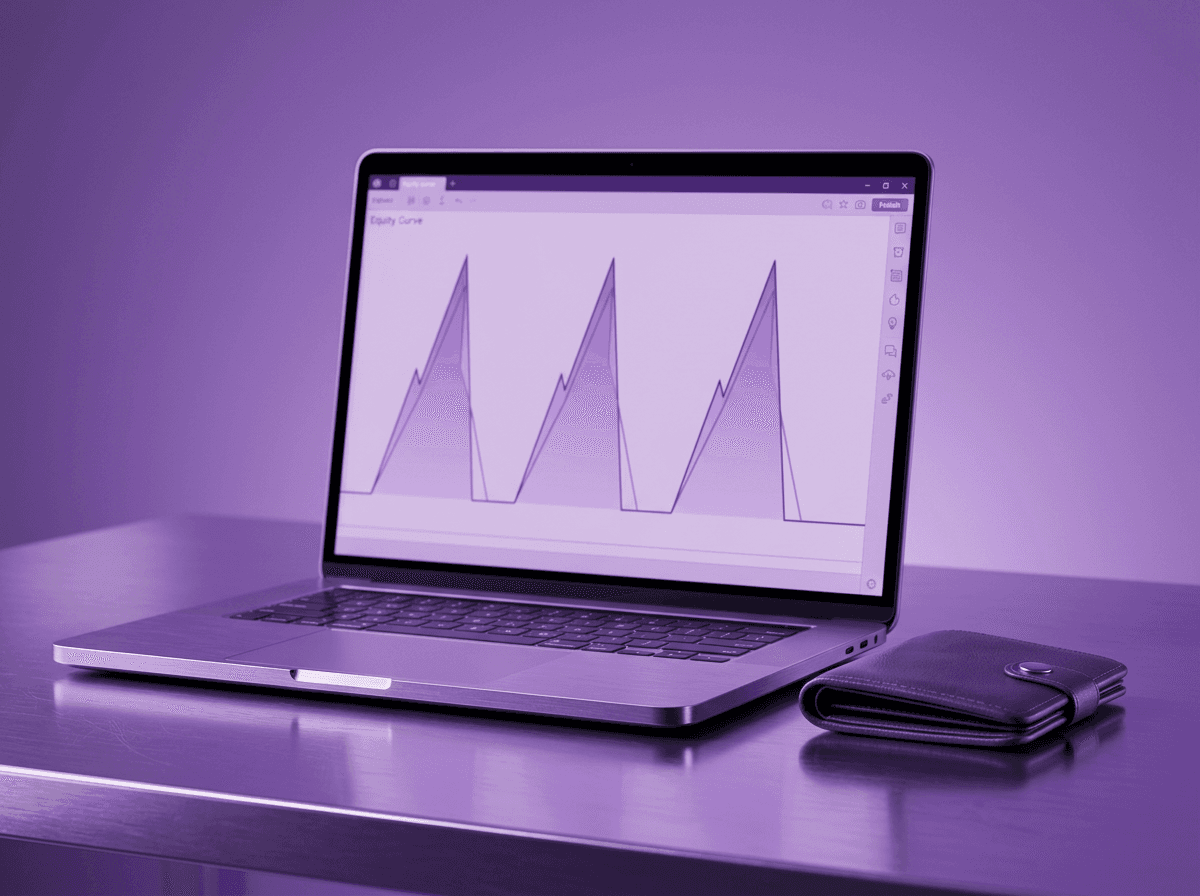
You deposit $500. You trade well for a few days, maybe a couple of weeks. The account grows to $1,500, then $2,000. You have never seen this number before. You feel invincible. Then you increase your lot size, take a few extra trades, get caught on the wrong side of a move, and by the end of the week the account is back to $200. Or zero.
So you deposit another $500. And the cycle starts again.
This pattern is so common in retail trading that it should have its own medical diagnosis. The deposit, blow, repeat loop traps thousands of traders in an expensive treadmill where they spend real money funding a cycle that never ends. Breaking it requires understanding exactly why it happens and installing the mechanical stops that prevent it.
TL;DR
The deposit-blow-repeat cycle follows a predictable path: fund, grow, overleverage, wipe, re-fund.
The motivation you feel after a blow-up is the most dangerous phase because it feels different from last time (it is not).
Overleveraging after a winning streak, not bad strategy, is what actually blows accounts.
Position sizing rules and daily loss limits physically prevent the blow-up step.
Breaking the cycle means changing the structure, not just the intention.
The Anatomy of the Deposit, Blow, Repeat Loop
The loop has four stages, and they repeat with mechanical precision.
Stage 1: The Deposit. Fresh money enters the account. Motivation is high. You have a plan this time. You are going to be disciplined. The account balance is small but clean.
Stage 2: The Growth Phase. You follow your rules (because the last blow-up scared you into discipline). Wins accumulate. The account grows. $500 becomes $1,000. Then $1,500. Then $2,000. You are doing it.
Stage 3: The Overreach. The account hits a number you have never seen before. Confidence peaks. You start making changes. Bigger lot sizes. More trades. Holding losers longer. Taking setups that are not in the plan. You are "letting the account work for you."
Stage 4: The Blow-Up. A normal series of losses arrives, but because your position size and trade frequency have ballooned, the losses are catastrophic. Three bad trades wipe out two weeks of gains. You try to recover by going bigger. It gets worse. The account hits zero or close to it.
Then Stage 1 again. Fresh deposit. Fresh determination. Same structure. Same outcome.
Walkthrough: The $500 to $2,000 to $0 Pattern
A trader deposits $500 into a EUR/USD account. He starts with 0.05 lots and a 20-pip stop loss.
Math check: 0.05 lots on EUR/USD = $0.50/pip. $0.50 times 20 pips = $10 risk per trade = 2% of $500. Reasonable.
Over 2 weeks, he wins 14 out of 20 trades. His target is also 20 pips per winner.
Math check: 14 wins at $10 each = $140. 6 losses at $10 each = $60. Net: +$80.
Wait, that only gets the account to $580. The $500 to $2,000 growth implies he was compounding and increasing size. After 3 weeks of compounding (adjusting lot size as the account grew) and catching some bigger moves, the account reaches $2,000.
Now the overreach: he jumps to 0.5 lots because "the account can handle it." Same 20-pip stop.
Math check: 0.5 lots = $5/pip. $5 times 20 pips = $100 risk per trade = 5% of $2,000. Risk per trade just went from 2% to 5%.
Three losses in a row: 3 times $100 = $300 lost. Account down to $1,700. Frustrated, he doubles to 1.0 lots.
Math check: 1.0 lots = $10/pip. $10 times 20 pips = $200 risk per trade = 11.8% of $1,700.
Two more losses: 2 times $200 = $400. Account at $1,300. One more revenge trade at 1.0 lots, wider stop (50 pips this time, holding through pain): $10 times 50 pips = $500 loss. Account at $800.
One more overlevered trade at 1.0 lots: loss of $200. Account at $600. Then $400. Then margin call. Game over.
The account went from $2,000 to $0 in 3 days. The growth took 3 weeks. That ratio, weeks to build and days to destroy, is the signature of the deposit-blow cycle.
Why Motivation After a Blow-Up Is the Most Dangerous Phase
When you hit rock bottom, a powerful emotional shift happens. You feel disgusted with yourself. Then angry. Then determined. You swear: "Never again. This time will be different."
That determination feels genuine. And it is genuine, in the moment. The problem is that it is the same determination you felt after the last blow-up, and the one before that. The emotion has not changed. The structure has not changed. And structure determines outcomes, not emotions.
The post-blow-up motivation is dangerous because it convinces you that you have learned the lesson. You feel like a different person. But feeling different is not being different. Being different means having structural rules that prevent the Stage 3 overreach regardless of how you feel.
This is why how traders blow accounts follows the same script every time. The problem is not lack of desire to succeed. The problem is that desire alone cannot prevent overleveraging under overconfidence.
Position Rules That Physically Prevent the Blow-Up
The word "physically" is important. You do not need better intentions. You need rules that mechanically block the blow-up scenario.
Rule 1: Fixed risk per trade, tied to the plan, not the feeling. Pick a percentage (1% or 2%) and calculate your lot size from that number before every trade. If your account is $1,000 and risk is 2%, maximum loss per trade is $20. If your stop is 25 pips on EUR/USD, your lot size is 0.08 lots ($0.80/pip times 25 pips = $20). The lot size comes from the formula. Always.
Math check: 0.08 lots on EUR/USD = $0.80/pip. $0.80 times 25 pips = $20 = 2% of $1,000. Correct.
Rule 2: Daily loss limit. Maximum 3% per day. On a $1,000 account, that is $30. Once you lose $30, you are done for the day. No exceptions. This single rule prevents the Stage 4 blow-up because it caps how much one bad session can cost.
Rule 3: No lot size increases mid-session. Your lot size for the day is set during pre-session preparation. It does not change, no matter what. Not after a win ("I should push it"), not after a loss ("I need to recover"). The number is locked.
Rule 4: Maximum 3 trades per day. At 2% risk per trade and 3 trades per day, your worst possible day is -6%. With the 3% daily loss limit, you actually stop at the second full loss. This cap prevents the revenge-trading spiral that accelerates blow-ups.
These four rules do not require willpower. They require pre-commitment. Write them down. Set them up in your platform. Follow them mechanically.
From Cycle to Climb: What the Turnaround Looks Like
When the position rules hold, the equity curve changes shape. Instead of the spike-and-crash pattern, you get a slow, steady climb with shallow dips.
The dips are smaller because daily loss limits cap the damage. The climbs are slower because you are not overleveraging on hot streaks. But the net effect is forward progress instead of an expensive treadmill.
Walkthrough: Same Trader, With Rules
The same $500 account. Same EUR/USD setup. But now with rules: 2% risk per trade ($10), 3% daily loss limit ($15), max 3 trades per day, no size changes mid-session.
Starting lot: 0.05 lots, 20-pip stop.
Math check: 0.05 lots = $0.50/pip. $0.50 times 20 pips = $10 = 2% of $500. Correct.
Worst possible day: 2 losses before hitting the daily limit (2 times $10 = $20, but $15 daily limit triggers after the second loss brings total to $20; in practice, the second loss closes and no third trade happens). Call it $20 on the absolute worst day (the daily limit triggers before the third trade).
Worst possible week: 5 bad days = $100 = 20% drawdown. Painful, but the account is at $400, not zero. Recoverable.
Realistic bad week: 2 bad days and 3 mixed days = roughly $30 to $50 lost = 6 to 10% drawdown. The account survives easily.
Over 3 weeks, the account grows to $700 instead of $2,000. Slower? Yes. But at $700, if a bad week hits, the account drops to $600, not zero. The growth continues.
After 3 months, the account might be at $900 or $1,000. The trader who would have deposited three more $500 chunks has instead grown one deposit into a stable, growing account. Total cost of the old approach: $1,500 in blown deposits. Total cost of the new approach: $0 in additional deposits plus a $500 account that is still alive.
The turnaround is not dramatic. It is boring. And that boring, steady growth is what capital preservation actually looks like in practice.
How EdgeFlo Blocks the Blow-Up Before It Starts
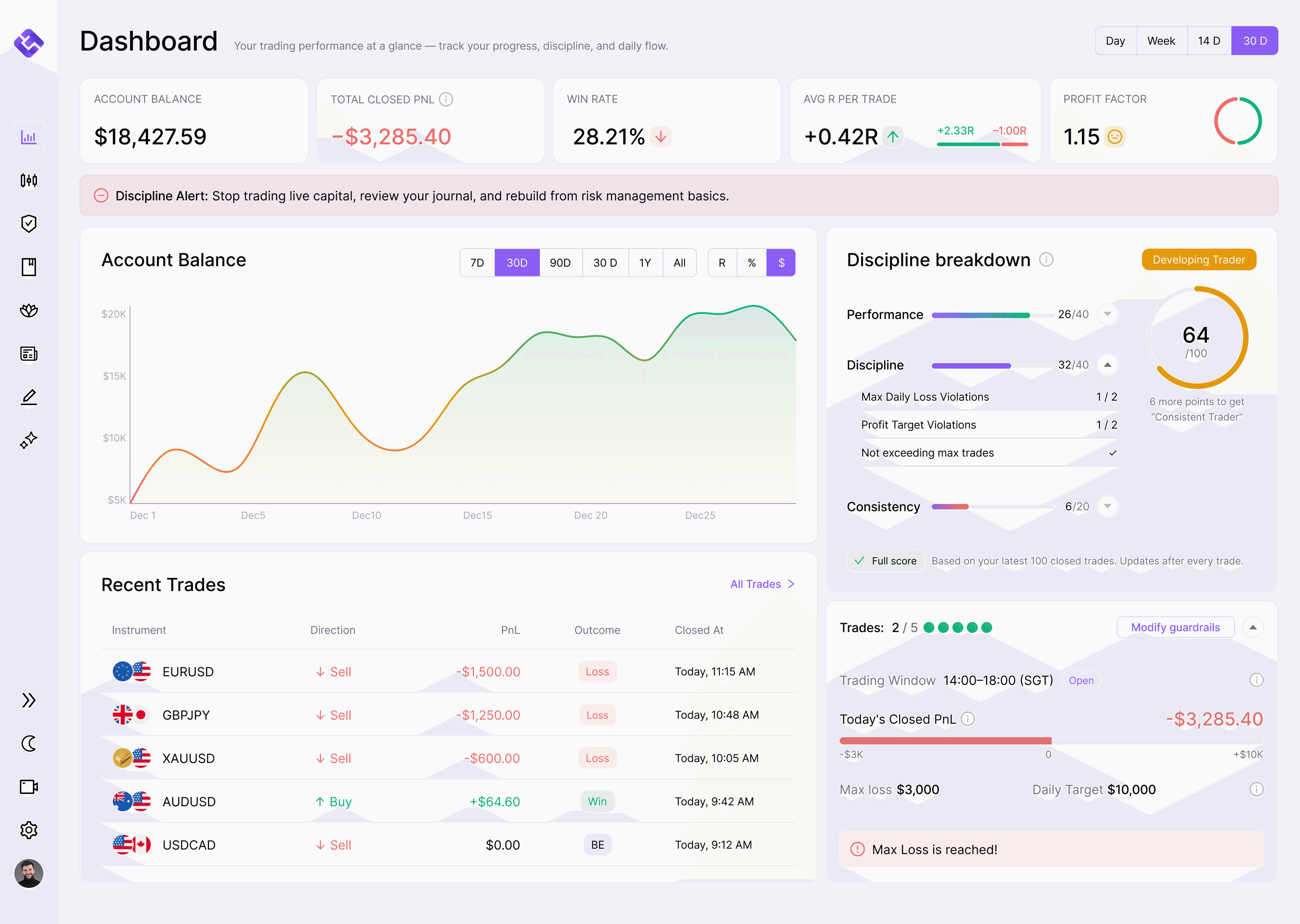
EdgeFlo's guardrail system lets you set daily loss limits and trade caps that stay active throughout the session. When you hit the limit, the system restricts trading. You can override the restriction, but you have to make a deliberate choice, which means the blow-up cannot happen on autopilot.
The smart risk calculator computes your exact lot size from your account balance, risk percentage, and stop distance. It removes the temptation to "round up" after a good day or increase size to chase a recovery. The number comes from math, not from mood.
Together, these tools replace the willpower-based approach that has failed you before with a structure-based approach that holds regardless of your emotional state. The deposit-blow-repeat cycle cannot survive in an environment where the blow-up step is mechanically blocked.
The Edge Brief
Receive Insights on trading psychology, discipline, and the behavioral patterns that create consistent traders from our Founder and the EdgeFlo team, delivered to your inbox.
Think different. Trade different.
What is the deposit, blow, repeat cycle in trading?
Why do traders keep depositing after blowing accounts?
What is the fastest way to break the deposit-blow cycle?
How many times do traders typically blow accounts before stopping?

Turn discipline on.
Every session.
EdgeFlo is the environment serious traders operate inside.
Start 7-Day Free Trial
Cancel anytime.
No long-term commitment.

Think Different, Trade Different.