

How to Become a Funded Trader Without Rushing
Learn how to become a funded trader without rushing the process, from your first six months of practice to your first payouts and scaling plan.

To become a funded trader, treat it like a long process, not a weekend challenge. Spend your first six months learning, testing, and demo trading, use months six to twelve to attempt challenges, then use year two to focus on payouts and scaling. Most traders fail because they skip straight to the challenge before they have a plan, enough screen time, or the discipline to repeat it.
TL;DR
A realistic funded trader path starts with about six months of study, testing, and demo execution.
Months six to twelve are for challenge attempts, retries, and proof that your process works under pressure.
Your first payout is not the finish line. It is the start of account management and scaling.
The fastest way to fail is to attempt a challenge too early, usually before you have a mechanical plan.
Think in phases: apprenticeship, funding, then scaling.
The Real Roadmap to Becoming a Funded Trader
The source breaks the journey into three phases, and that matters because most search results flatten the whole process into "pass a challenge." That misses the part that usually decides whether you keep the account.
Phase 1, Apprenticeship (Month 1 to Month 6)
Your job here is simple. Learn how to read price, build a mechanical plan, backtest it, forward test it, and get used to executing in simulated conditions.
That means chart study, notes, daily markups, backtesting, and demo trading. Not challenge fees. Not payout fantasies. If you need the mechanics of the evaluation itself, study how prop firm challenges work after you finish building the base.
Phase 2, Funding (Month 6 to Month 12)
Now you can start attempting a challenge. Attempt is the key word.
You may fail the first one. You may need a retry. That does not mean the process is broken. It means the market is now testing whether your plan still holds up when emotions show up.
A faster path is possible, and some traders do it sooner. But those are outliers. If you want to see what a quicker case can look like without treating it as the norm, read this funded trading timeline.
Phase 3, Scaling (Month 12 to Month 24)
Passing a challenge is only step one. The next job is keeping the account, getting your first payout, and proving you can string together positive months without sliding back into bad habits.
This is the part most traders underestimate. You do not need a new strategy at this stage. You need the same process, the same routine, and tighter control over your own behavior.
What You Need Before Your First Challenge
The fastest way to waste a challenge fee is to pay for proof before you have earned it in practice.
Use this checklist before your first attempt:
A mechanical trading plan you can explain in plain English.
Backtesting and forward testing records that show you have actually used that plan.
Demo or small-account execution practice so clicking buy and sell no longer feels new.
A routine you can repeat daily, including review and journaling.
Patience to accept retries instead of expecting the first attempt to solve your career.
If any one of those is missing, you are probably early. That is not a reason to quit. It is a reason to stay in the apprenticeship phase a little longer.
What Rushing Looks Like in Real Life
Most traders do not think they are rushing. They think they are being ambitious. There is a difference.
Walkthrough 1, The Month-Three Challenge Attempt
You have been studying for about twelve weeks. You know the basic setup names, you can spot a few clean zones, and you have a small streak of demo winners on EUR/USD.
So you buy a challenge.
On Monday, you pass on one clean setup because it feels too slow. On Tuesday, you force a GBP/USD long on the 15M chart at 1.2740 into London open, get stopped at 1.2715, and immediately look for another entry to make it back. By Thursday, your rules are already loose because the account timer feels more important than your plan.
That is what rushing looks like. The issue is not motivation. The issue is that the challenge exposed gaps you should have found in testing.
What a Patient Path Looks Like
The anti-rush version is less exciting on social media. It works better in real life.
Walkthrough 2, The Structured Attempt
You spend six full months learning, marking charts, journaling, backtesting, and forward testing one setup until your execution feels boring in a good way. You trade a small live account or a demo account long enough that pressing the button no longer spikes your emotions.
Then you take a challenge.
On the first week, EUR/USD pulls back into support at 1.0820 on the 1H. You already know your invalidation at 1.0790, your target at 1.0880, and your daily loss limit before the candle closes. The trade stops out, you log it, move on, and take the next valid setup instead of changing your whole plan after one loss.
That is what readiness looks like. Not perfection. Repeatability.
Your First Payout Is Not the Finish Line
The source is blunt here. You are playing the long game.
After you pass, the goal becomes consistency. You want positive months, clean execution, and a process that survives boredom, confidence spikes, and the urge to size up too fast. That is where funded account management starts to matter more than passing.
Once consistency is real, then scaling makes sense. If you want a practical view of how traders expand capital without raising risk just because they feel good, read this prop firm scaling plan.
Mistakes That Keep Traders Stuck
A few mistakes show up again and again:
Treating the challenge as the start of learning instead of the test of learning.
Confusing a good week on demo with proof of consistency.
Comparing yourself to outliers who got funded unusually fast.
Thinking the first payout means discipline no longer matters.
Leaving your routine the moment results improve.
The pattern is the same every time. A trader stops respecting the process right when the process starts working.
How EdgeFlo Helps You Stay Process-First
If your problem is not chart knowledge but execution drift, EdgeFlo gives you one place to store and structure your trading plan. That matters when your goal is to repeat the same rules long enough to see whether the process actually works.
If you need more accountability around behavior, guardrails can restrict or block trades when you hit limits you set. You can still override them, which matters because the tool supports your discipline, it does not replace it.
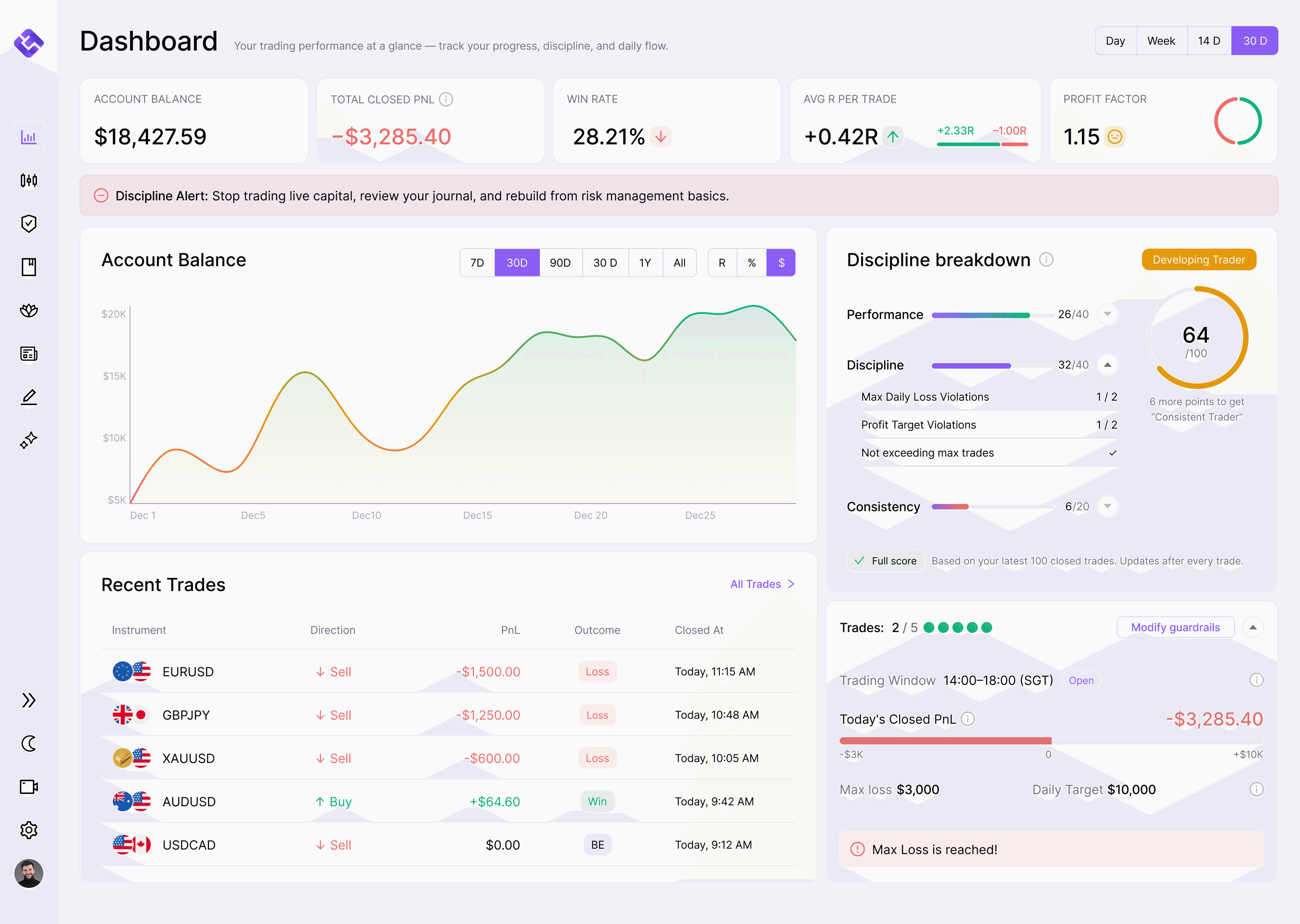
And when you review performance, the Trading Dashboard surfaces win rate, avg R, profit factor, EdgeScore, and a discipline summary. That helps you judge whether you are ready for the next phase based on data instead of emotion.
The Edge Brief
Receive Insights on trading psychology, discipline, and the behavioral patterns that create consistent traders from our Founder and the EdgeFlo team, delivered to your inbox.
Think different. Trade different.
How long does it take to become a funded trader?
Can I attempt a funded challenge after three months of trading?
What should I do after passing a funded challenge?
What is the biggest mistake aspiring funded traders make?

Turn discipline on.
Every session.
EdgeFlo is the environment serious traders operate inside.
Start 7-Day Free Trial
Cancel anytime.
No long-term commitment.

Think Different, Trade Different.