

Your Biggest Trading Enemy Is Yourself
Your biggest trading enemy is yourself. Learn how self-sabotage patterns form in trading and the accountability systems that break them.
Your Biggest Trading Enemy Is Not the Market
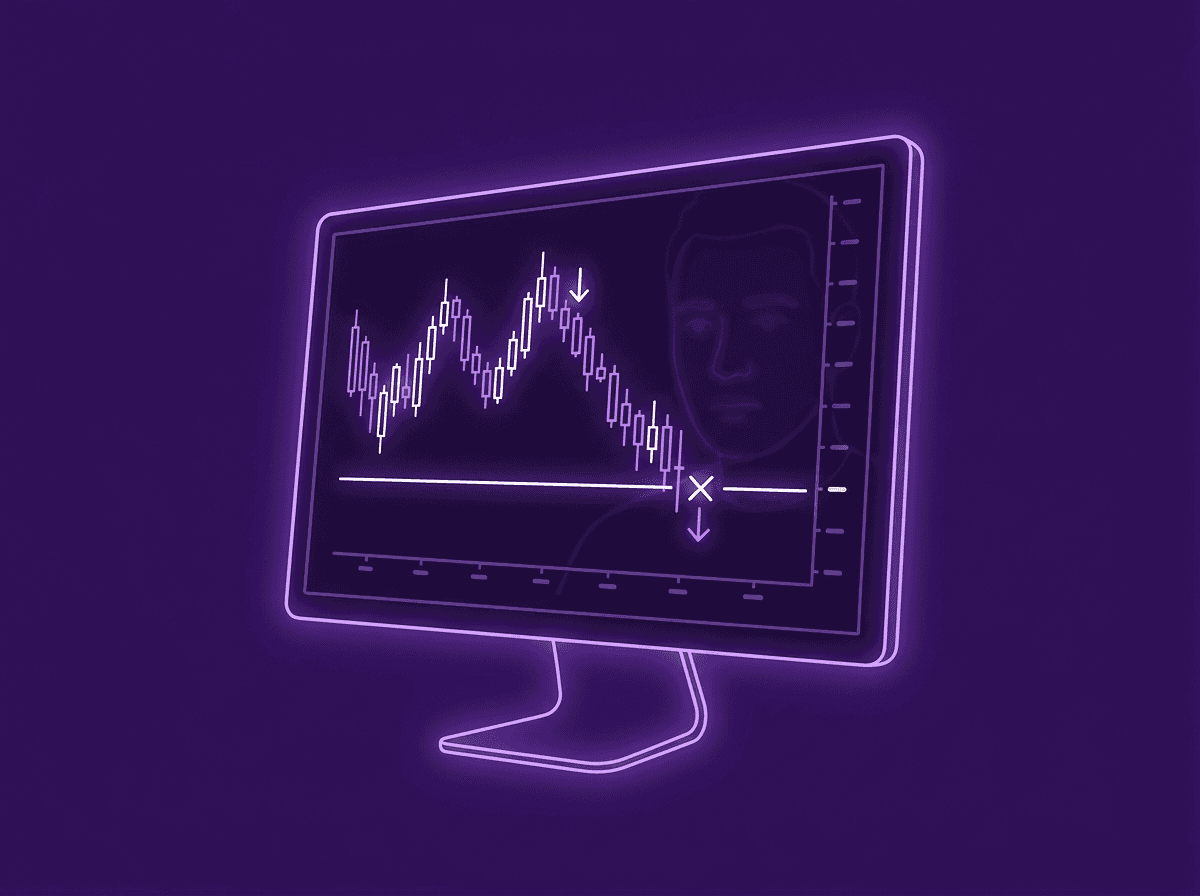
Your biggest trading enemy is yourself. Not your broker. Not institutions. Not "smart money" hunting your stop loss. The person who moves your stop, doubles your lot size after a loss, and abandons the plan at the worst possible moment is sitting in your chair.
Every trader eventually learns this. Most learn it the expensive way.
TL;DR
The market does not target you. Your own decisions cause most of your losses.
Self-sabotage patterns (revenge trading, oversizing, plan abandonment) repeat until you name them.
Your beliefs about trading create a feedback loop that shapes your actions and results.
External accountability systems break the cycle because willpower alone fails under pressure.
A journal that tracks decisions, not just P&L, makes invisible patterns visible.
The Enemy Inside
Imagine this. You are short EUR/USD with a clean setup. Price starts moving in your favor. Then it pulls back 15 pips. You feel the tension rise. Another 5-pip pullback. Now you are convinced it is going against you. You close the trade at breakeven, and 30 minutes later price drops 80 pips to your original target.
Nobody forced that exit. The market did not trick you. Your own fear of losing a winner made the decision for you.
Sound familiar?
This is the reality most traders refuse to accept. They blame the broker's spread, the "manipulation," the news event. Blaming external forces feels better than admitting the problem is internal. But the moment you accept that your account balance is a reflection of your behavior, not the market's behavior, everything changes.
You cannot control what price does. You can only control what your fingers do. That is it.
Self-Sabotage Patterns in Trading
Self-sabotage is not random. It follows predictable patterns. Once you can name the pattern, you can interrupt it. Here are the ones that drain the most accounts.
Pattern 1: Revenge Trading
You lose a trade. The loss stings. Instead of walking away, you immediately look for another entry to "get it back." The second trade is lower quality because you chose it from emotion, not from your setup criteria. It loses too. Now you take a third. Sound familiar? Revenge trading is the single fastest way to turn a small loss into a blown account.
Pattern 2: Moving the Stop Loss
You set a stop at a logical level. Price gets close. You feel the pain of an imminent loss and move the stop further away, "just to give it room." You just turned a planned 1R loss into a 2R or 3R loss. The math that made your system profitable now works against you.
Pattern 3: Oversizing After Wins
Three winners in a row. You feel confident. You double your lot size on the next trade. It loses. That single loss wipes out two of the three wins. This is not bad luck. It is a pattern where winning triggers overconfidence, which triggers reckless sizing.
Pattern 4: Abandoning the Plan During Drawdowns
Five losses in seven trades. Your plan says to continue trading the system because the sample size is too small to draw conclusions. But you "know" something is wrong. You start improvising. You skip setups. You add a new indicator. You just threw away months of testing because a normal losing streak felt unbearable.
Walkthrough: The Self-Sabotage Spiral
A trader enters a buy on AUD/USD at 0.6540 with a 25-pip stop loss and 75-pip target. Risk: 0.5% of a $10,000 account, which is $50. Position size: 0.2 lots at $10/pip per standard lot. 0.2 lots = $2/pip. $2 times 25 pips = $50 risk. $2 times 75 pips = $150 target.
Price hits the stop loss. Loss: $50. Instead of logging the trade and moving on, he immediately enters a sell on the same pair (no setup, just frustration). Sizes up to 0.5 lots ($5/pip) because he wants to "recover fast." Stop loss: 30 pips. $5 times 30 pips = $150 risk. That is 1.5% of his account on an unplanned trade.
It loses. Total damage: $50 (planned) + $150 (revenge) = $200, or 2% of the account in 20 minutes. The planned system would have cost him $50 and moved on. His self-sabotage tripled the cost.
Breaking the Cycle
Willpower does not fix self-sabotage. If willpower worked, you would have stopped breaking your trading rules the first time you noticed the pattern. The answer is building systems that make rule-breaking harder and more visible.
Step 1: Name Your Triggers
Open your trading journal and review your last 20 trades. For every loss that exceeded your planned risk, or every trade that was not in your plan, write down what you were feeling before you took it. Anger after a loss? Boredom during a slow session? Excitement after a winning streak?
Most traders find that two or three emotional states cause 80% of their bad trades. Once you know the triggers, you can create rules around them.
Step 2: Create Hard Stops
A "three loss rule" that forces you to stop trading for the day after three consecutive losses is not a limitation. It is a circuit breaker. You are removing the decision from future you, who will be emotional and irrational, and giving it to present you, who is calm and rational.
Daily loss caps, maximum trade counts, and session time limits all serve the same purpose. They make the default action "stop" instead of "continue."
Step 3: Make Patterns Visible
Self-sabotage in trading thrives in darkness. When you journal only your P&L, you see numbers. When you journal your emotional state, your decision rationale, and whether the trade was on-plan or off-plan, you see patterns.
After 30 trades, review the data. Separate your on-plan trades from your off-plan trades. Calculate the expectancy of each group separately. Almost every trader who does this exercise finds that their on-plan trades are profitable and their off-plan trades are deeply negative.
That is the proof you need. The system works. You are the variable.
External Accountability Systems
Knowing you are the problem is step one. Building accountability structures that catch you before the damage happens is step two.
A journal you review weekly forces you to confront patterns you would otherwise rationalize. A trading accountability system where you record every trade and grade it as "on plan" or "off plan" creates a number you cannot argue with: your plan adherence rate.
Post-trade reviews done within five minutes of closing a trade capture the raw emotional truth. If you wait until the weekend, your brain will rewrite the story. It will turn a revenge trade into "a reasonable entry that just didn't work out." Write it down while the sting is fresh.
Trading communities where you post your grades also help. Not for advice, but for the simple pressure of knowing someone will see whether you followed your rules.
How EdgeFlo Builds the Accountability You Cannot Build Alone
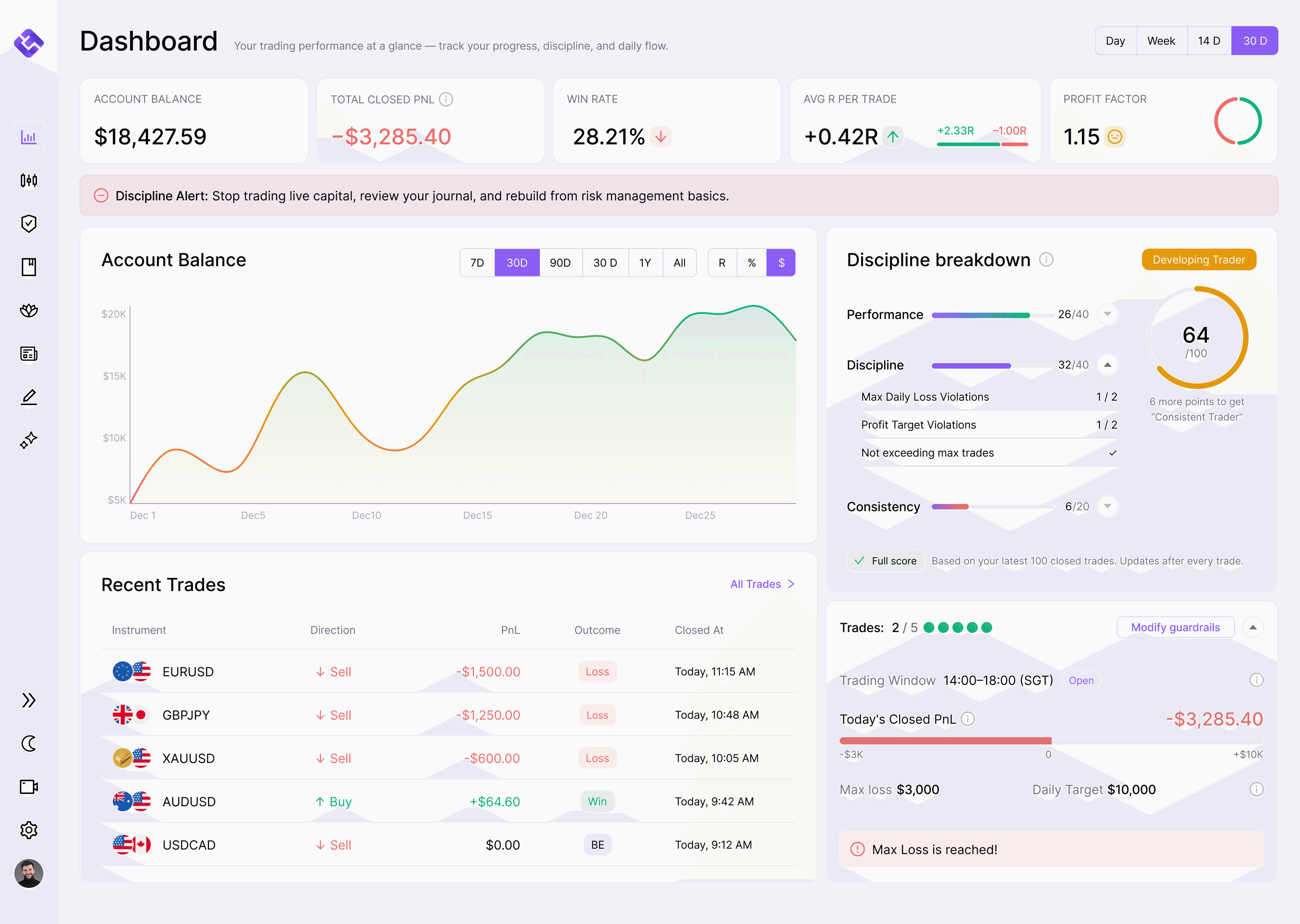
EdgeFlo turns accountability from a concept into a daily habit. The AI-powered journal auto-imports your trades and prompts you to tag your emotional state and whether you followed your plan. Over time, your dashboard separates on-plan results from off-plan results so you see exactly how much your self-sabotage costs.
Guardrails like daily loss limits and trade count caps add friction at the execution level. You can override them, but the override is a conscious choice, not an unconscious slide. Sanctuary provides guided reset routines when you recognize tilt before your next trade.
The system does not make decisions for you. It makes your decisions visible so you can stop fighting yourself and start following the process that works.
The Edge Brief
Receive Insights on trading psychology, discipline, and the behavioral patterns that create consistent traders from our Founder and the EdgeFlo team, delivered to your inbox.
Think different. Trade different.
Why am I my own worst enemy in trading?
How do I stop self-sabotaging my trades?
What are common self-sabotage patterns in trading?
Can a trading journal help with self-sabotage?

Turn discipline on.
Every session.
EdgeFlo is the environment serious traders operate inside.
Start 7-Day Free Trial
Cancel anytime.
No long-term commitment.

Think Different, Trade Different.