

Asian Session Trading: Build Your Plan in Dead Hours
Asian session price action reveals the range London will break. Use those quiet hours for markup, level identification, and session trade planning.
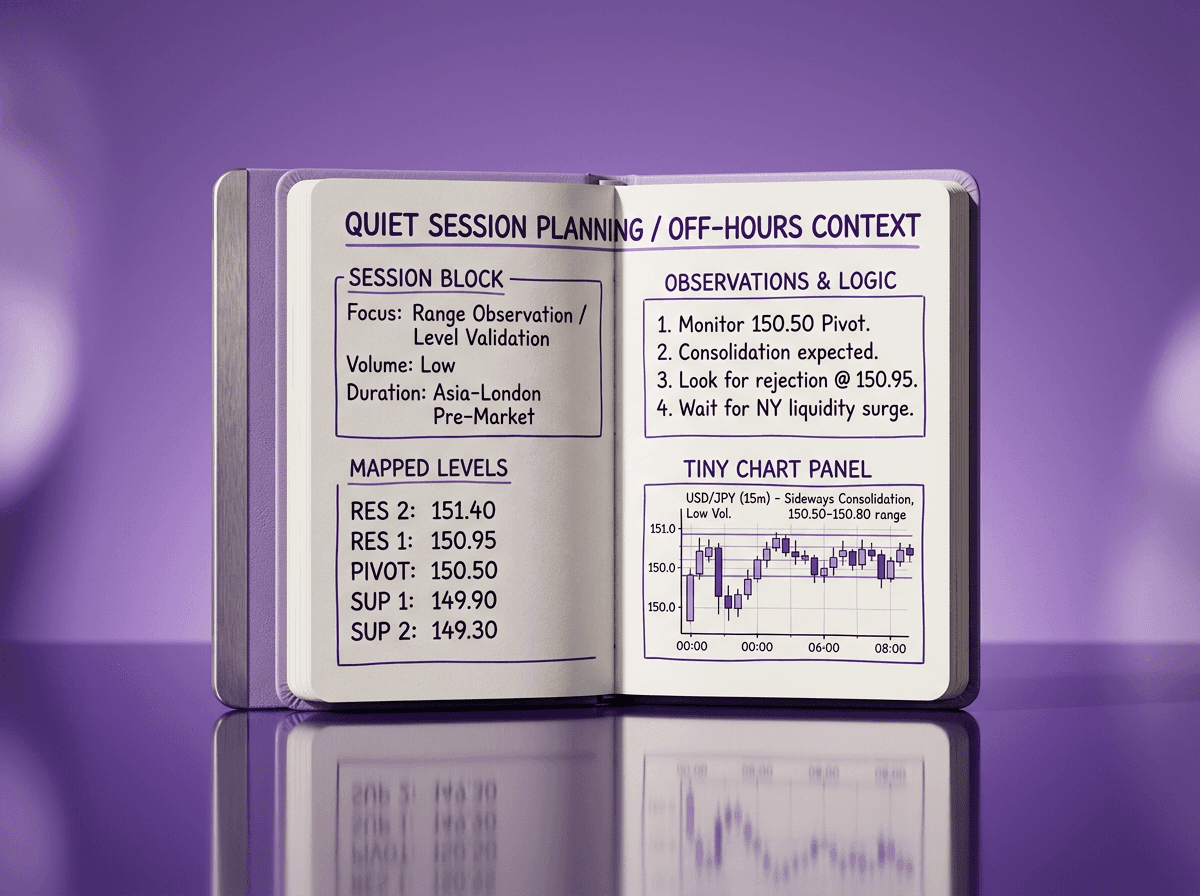
The Asian session is the quietest window in the forex market, and most content about it falls into one of two camps: "avoid it" or "here is a secret Asian session strategy." Both miss the point. The real value of Asian session hours is that they give you uninterrupted time to prepare for the sessions where money actually moves.
TL;DR
The Asian session (roughly 7:00 PM to 2:00 AM EST) has low volume and tight ranges, making active trading unprofitable for most strategies.
Those quiet hours are ideal for chart markup, level identification, and trade planning.
The Asian range itself is valuable data: London open frequently breaks it in the first 30 minutes.
Building your plan during dead hours means you react to setups during live hours instead of scrambling.
The calm before the storm is not wasted time. It is preparation time.
Why Asian Session Trading Fails for Most People
The Asian session covers the Tokyo and Sydney markets, running from roughly 7:00 PM to 2:00 AM Eastern Standard Time. During these hours, major European and US institutions are closed. Trading volume drops to its daily low.
What does low volume look like on a chart? Tiny candles. Tight ranges. Price moves 10 pips up, then 10 pips down, then 8 pips up. Nothing trends. Nothing breaks.
If you enter a directional trade during this window, two things typically happen. Either you get chopped out by the range (stopped out on noise that has nothing to do with your analysis), or you hold the trade into London open and watch price sweep your entry level before moving in your direction.
Both outcomes burn your account. And both are avoidable by simply not trading during a window with no institutional participation.
This is not some hidden insight. The data from thousands of trades confirms it. The sessions that produce consistent directional moves are London open and the London/New York overlap. The Asian session is not one of them.
The Real Value of Quiet Hours
If you should not trade the Asian session, what should you do with those hours? Use them to build the plan you will execute when volume arrives.
Think of it like a surgeon preparing for an operation. The prep happens before the patient is on the table. Instruments are laid out. The procedure is reviewed. Contingencies are considered. When the operation starts, the surgeon is not figuring things out on the fly. They are executing a plan.
Your pre-London preparation works the same way. And the Asian session gives you the perfect conditions for it: no urgency, no FOMO, no fast-moving candles pulling your attention.
The Asian Session Prep Routine
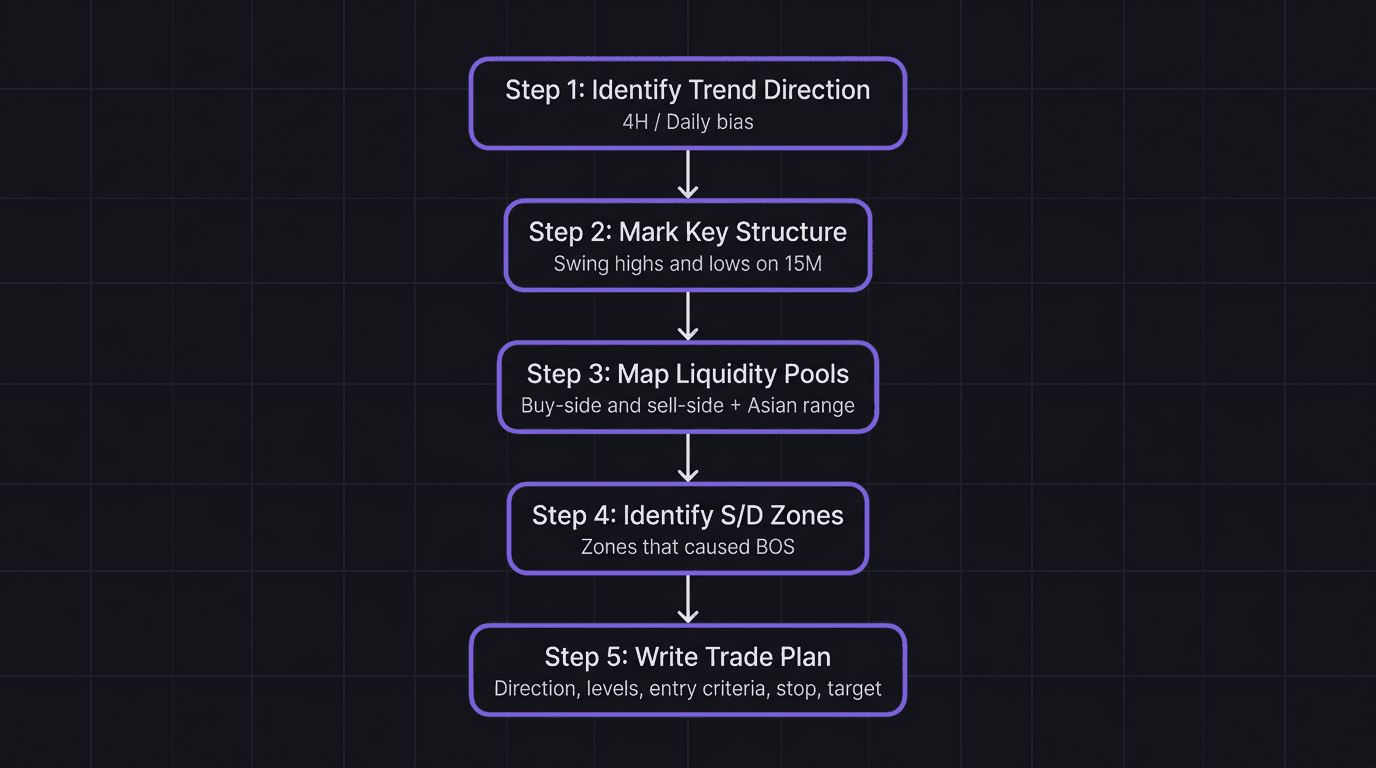
Here is a step-by-step process you can follow during the Asian session to prepare for London open. This takes about 15 to 30 minutes.
Step 1: Identify Trend Direction
Open your higher-timeframe chart (4-hour or daily). What is price doing? Making higher highs and higher lows? Lower highs and lower lows? Ranging?
Write it down. Not in your head. In your plan. "Daily bias: bearish. Price making lower highs and lower lows. Last break of structure at 1.2600."
This is your daily bias, and it determines which direction you will look for trades during London.
Step 2: Mark Key Structure
Switch to your execution timeframe (15-minute or 5-minute). Mark the most recent swing highs and swing lows. Identify the current structural pattern.
If the higher timeframe is bearish, you are looking for lower highs on the execution timeframe. Mark them. If the higher timeframe is bullish, you are looking for higher lows. Mark those.
Step 3: Map Liquidity Pools
Above each swing high, there is buy-side liquidity. Below each swing low, there is sell-side liquidity. Mark both.
Pay special attention to the Asian range itself. As price consolidates during the session, liquidity builds above and below the range. London will almost certainly sweep one side or both.
Mark the Asian range high and the Asian range low with horizontal lines. Label them. These are your first reference points when London opens.
Step 4: Identify Supply and Demand Zones
Mark the supply or demand zones that created the most recent break of structure. These are the areas where price is most likely headed after sweeping liquidity.
If your bias is bearish, you want to see price pull back into a supply zone (after sweeping buy-side liquidity) before continuing lower. Mark those zones clearly.
Check the zones against your trading playbook. Does the zone meet your criteria? Is it at the right location within the premium or discount model? If not, note the next zone that does.
Step 5: Write Your Trade Plan
Before London opens, you should be able to complete these sentences:
"I am looking for [longs/shorts]."
"Price needs to sweep liquidity at [level]."
"My point of interest is [zone]."
"I will enter if price sweeps, reacts with a V-shape, and breaks internal structure at [level]."
"My stop goes at [level]. My target is [level]."
If you cannot fill in those blanks, you do not have a plan. And trading without a plan during London is how you end up chasing price, entering late, and wondering why your checklist exists.
Walkthrough: Using Asian Session Prep for a London Trade
EUR/USD. It is 1:45 AM EST. You are in the Asian session, and price has been consolidating between 1.0840 and 1.0860 for the past three hours.
Step 1: You check the 4-hour chart. Bearish. Price has made two consecutive lower highs and lower lows. The most recent break of structure happened at 1.0830.
Step 2: On the 15-minute chart, you mark the current swing high at 1.0875 and the internal swing highs at 1.0860 and 1.0855.
Step 3: Buy-side liquidity sits above 1.0860 (the Asian range high) and above 1.0875 (the swing high). Sell-side liquidity sits below 1.0840 (the Asian range low).
Step 4: The supply zone that created the break of structure sits between 1.0870 and 1.0880. This is your primary point of interest for short entries.
Step 5: You write in your plan: "Looking for shorts. Price needs to sweep buy-side liquidity above 1.0860. Point of interest: supply zone 1.0870 to 1.0880. Enter if price sweeps, gives a V-shaped reaction, and breaks internal structure below 1.0855. Stop at 1.0885 (above supply zone). Target: 1.0810 (next demand zone)."
London opens at 3:00 AM. Price spikes up, sweeps the Asian range high at 1.0860, pushes into the supply zone at 1.0873, and then drops sharply. Internal structure breaks bearish below 1.0850.
You enter short at 1.0848. Stop at 1.0878 (30 pips). Target: 1.0810 (38 pips). That is 1.27R.
Math check: 30-pip stop on 0.2 lots (at approximately $2/pip on EUR/USD with mini lots) = $60 risk. Target: 38 pips times $2/pip times 0.2 lots = wait, let me recalculate. 0.2 standard lots on EUR/USD = $2/pip. 30 pips times $2 = $60 risk. 38 pips times $2 = $76 reward. $76 / $60 = 1.27R. Confirmed.
Not a massive winner. But the point is that every detail of this trade was planned during the dead hours. When London opened, there was no scrambling, no guessing, no emotional decision making. Just execution against a written plan.
Walkthrough: What Happens Without Prep
Same pair, same day. A different trader wakes up at 3:05 AM because their alarm was late. London has already opened. Price is spiking. They see a big bearish candle forming and think: "It is going down. I need to sell now before I miss it."
They sell at 1.0845 with a 20-pip stop at 1.0865. No zone analysis. No liquidity mapping. No plan.
Price pulls back to 1.0858 at 3:20 AM (a normal London retrace). The trader panics, moves their stop to 1.0855 to "reduce risk," and gets stopped out on the retrace.
Loss: 10 pips on the adjusted stop. But the real cost is the opportunity. If they had mapped the supply zone during Asia, they would have known the retrace was expected and held the position. Instead, they entered reactively and managed reactively.
Preparation during quiet hours prevents reactive decisions during fast hours.
Making Asian Session Prep a Habit
The biggest barrier to pre-session planning is not complexity. It is the feeling that you are "not doing anything." Sitting at your desk at 2:00 AM marking levels feels less productive than placing a trade. But the trade placed without preparation is the one that loses.
Set a routine. Same time every night (or morning, depending on your timezone). Same sequence: bias, structure, liquidity, zones, plan. Use a physical notebook or a pre-session template. The format matters less than the consistency.
If you do this for 20 sessions in a row, you will have a small data set showing how often your pre-session markup predicted the London move. That data builds conviction. And conviction is what keeps you in the plan when the candle is flying and your finger wants to click.
How EdgeFlo Supports Your Planning Habit
EdgeFlo's Edge feature (the trade plan builder) is designed for exactly this kind of pre-session work. You document your active plan, including your bias, key levels, entry criteria, and invalidation. The plan stays visible next to your chart during execution.
After the trade, EdgeFlo's self-reporting feature asks whether you followed the plan. Over time, you build a record of plan adherence that shows up in your stats. That is where you see the real pattern: trades taken from your pre-session plan versus trades taken on impulse. The difference usually shows up in your win rate, your average R, and your discipline score.
The pre-market prompts in EdgeFlo surface your plan criteria before the session opens. These are not enforced (you can trade however you want), but they act as a reminder to check your markup before clicking.
The Edge Brief
Receive Insights on trading psychology, discipline, and the behavioral patterns that create consistent traders from our Founder and the EdgeFlo team, delivered to your inbox.
Think different. Trade different.
Should I trade during the Asian session?
What should I do during the Asian session instead?
Why does the Asian range matter for London trading?
When does the Asian session start and end?

Turn discipline on.
Every session.
EdgeFlo is the environment serious traders operate inside.
Start 7-Day Free Trial
Cancel anytime.
No long-term commitment.


Think Different, Trade Different.