

After a Big Win: A 3-Step Protocol to Stay Sharp
A big win changes your identity as a trader. Learn the 3-step protocol to withdraw, reduce size, and review before complacency wipes your profits.
A big loss humbles you. A big win does something worse: it makes you feel invincible. That feeling of invincibility is one of the most dangerous states a trader can be in, because it rewires your risk tolerance, inflates your confidence beyond what the data supports, and sets you up to give back everything you just earned. Most traders have a plan for handling losses. Almost nobody has a plan for handling wins. That is a problem, because complacency after a big win has destroyed more accounts than any single losing trade.
TL;DR
Big wins change your identity and risk perception, leading to oversized positions and reckless entries.
The 3-step protocol: withdraw a portion, reduce lot size for five sessions, and review the win objectively.
Treat a big win with the same seriousness as a big loss: adjust, protect, and return to your baseline.
Increasing lot size after a win is the most common and most expensive post-win mistake.
The traders who keep their profits are the ones who refuse to let a win change how they trade.
What a Big Win Does to Your Brain
After banking a large profit, something shifts. You do not just feel good. You feel like you have figured it out. Like the market finally respects you. Like you deserve bigger positions because you have earned them.
This is the identity shift, and it is the root of post-win blowups. Before the win, you were cautious. You followed your trading rules. You sized conservatively. You took only setups that matched your criteria. After the win, you loosen the rules because you "know what you are doing now." You increase lot size because your account is bigger and you feel like you are playing with house money. You take setups you would normally skip because your confidence says they will work.
The market does not care about your last trade. It does not owe you a follow-up win. And the oversized position you just entered because you felt invincible is about to teach you that lesson the hard way.
Walkthrough: The $5,000 Win That Cost $6,000
A trader on EUR/USD catches a clean break-of-structure trade during the London session. Entry at 1.0850, stop at 1.0820, target at 1.0950. Risk: 30 pips. Reward: 100 pips. Position size: 5 standard lots.
At 5 standard lots ($50 per pip), the risk is $1,500 and the target pays $5,000. Price hits the target cleanly. The trader banks $5,000 in a single day. A 3.33R winner.
Now the trouble starts. The next day, the trader feels like scaling up is justified. Account is bigger. Confidence is high. They move to 8 lots on the next trade. The setup is not as clean (B-grade, not A-grade), but they take it anyway because "the market is moving in my favor." This is textbook impulse trading.
The trade moves against them. 40 pips to the stop at the inflated size: $3,200 loss. Frustrated, they take another trade immediately, same inflated size. Another loss. 35 pips: $2,800. In two trades, they have lost $6,000. The $5,000 win is gone, plus an extra $1,000.
The winning trade was executed perfectly. The losses were caused entirely by post-win behavior: inflated lot size, lower setup standards, and ego telling the trader they deserved to keep winning.
The 3-Step Post-Win Protocol
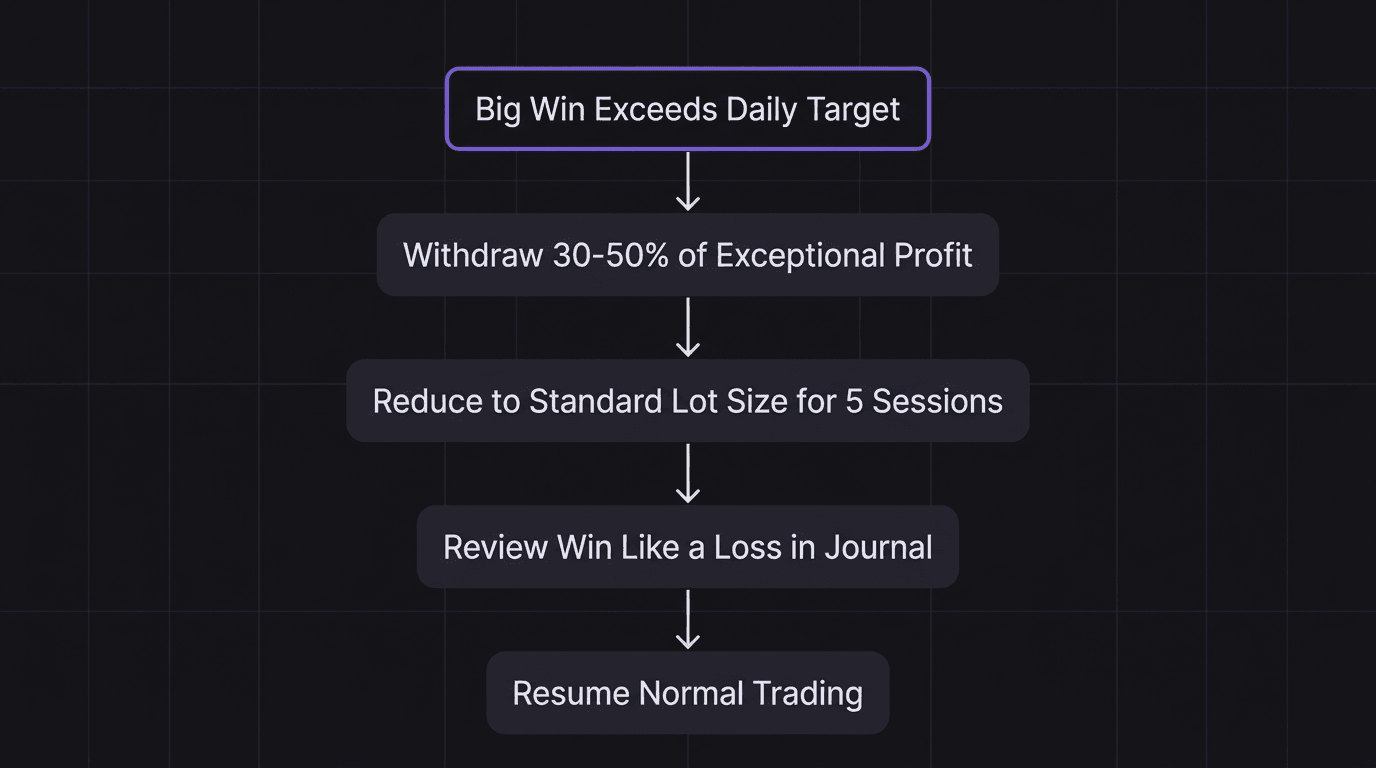
Here is a simple framework to prevent the scenario above. Execute these three steps after any win that significantly exceeds your normal daily target.
Step 1: Withdraw a Portion
Take money out of your trading account. Not all of it. A portion: 30% to 50% of the exceptional profit. Transfer it to your bank account. Buy something. Pay a bill. The point is to make the win real outside of your trading account.
Money sitting in a brokerage account feels abstract. It does not feel "yours" the same way cash in your bank does. Withdrawing converts paper profit into real-world value and removes the temptation to bet it all back the next day.
Step 2: Reduce Lot Size for Five Sessions
After a big win, drop your lot size back to standard or slightly below standard for the next five trading sessions. This serves two purposes:
It prevents the inflated-confidence position sizing that causes post-win blowups.
It resets your emotional baseline. After five sessions of normal-sized trades, the euphoria of the big win fades and you are back to making decisions from process, not emotion.
Do not increase lot size until you have completed five clean sessions at normal size. Even if every one of those five trades wins. The rule is time-based, not results-based.
Step 3: Review the Win Like a Loss
Open your journal and review the winning trade the same way you would review a loss. Ask:
Did the setup match my full A-grade criteria?
Was the lot size within my planned risk parameters?
Did I follow my entry and exit rules exactly?
Was there anything lucky about this trade that I should not expect to repeat?
If the win was a clean, rules-based execution, good. Replicate the process. If the win involved any deviation from the plan (wider stop, larger lot, impulsive entry that happened to work), acknowledge that. A win from a broken process is more dangerous than a loss from a good process, because it reinforces bad habits.
The Compounding Trap
There is a subtler version of post-win recklessness that does not involve doubling lot size overnight. It happens gradually. You have a good week. Then a good month. Your account grows. You naturally increase lot size to match the larger account. So far, so good.
But then a normal drawdown arrives. The drawdown in dollar terms is larger than anything you have experienced before, because you are trading bigger. The drawdown is exactly the same in percentage terms as previous drawdowns, but the dollar amount triggers an emotional response that your smaller-account self never dealt with.
This is the compounding trap. Your account grew, your lot size grew, but your emotional capacity to handle the new dollar-denominated swings did not grow at the same pace. The fix is to scale lot size slower than your account growth. If your account doubles, your lot size should increase by 30% to 50%, not 100%. Give your psychology time to catch up with the numbers.
Success Is Not Permission to Change the Rules
The system that produced the big win is the system you should continue to follow. That sounds obvious when you read it in an article. In the moment, sitting at your desk with a $5,000 day fresh in memory, the urge to change something (bigger lots, looser criteria, more trades) feels logical, not emotional. But it is emotional. It is the confidence shift masquerading as rational analysis.
The best traders protect their profits by refusing to let a win change how they operate. Withdraw, reduce, review, return to baseline. Every time. No exceptions.
How EdgeFlo Guards Against Post-Win Drift
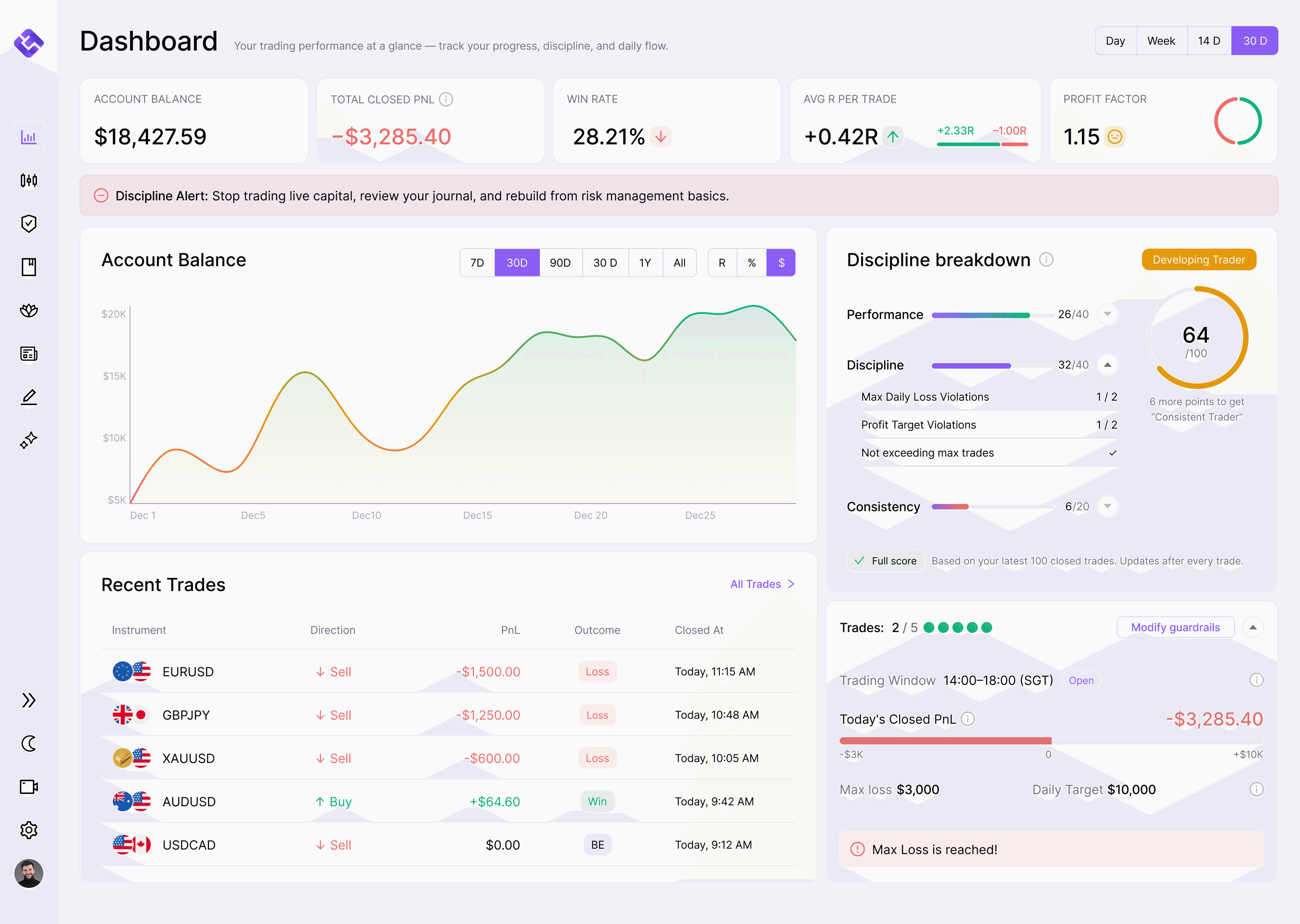
EdgeFlo's guardrails do not turn off after a winning day. Your daily loss limit, maximum trade count, and risk-per-trade settings remain active regardless of how well your last session went. This creates structural friction against the exact behaviors that cause post-win blowups: oversized lots, extra trades, and loosened rules.
The journal's emotion tagging lets you flag "overconfident" alongside your trade data, so the weekly AI report (Plus) can detect patterns like "your largest losses follow sessions tagged as overconfident." Over time, this turns the invisible post-win identity shift into a visible, trackable pattern you can guard against.
The Edge Brief
Receive Insights on trading psychology, discipline, and the behavioral patterns that create consistent traders from our Founder and the EdgeFlo team, delivered to your inbox.
Think different. Trade different.
Why are big wins dangerous in trading?
Should I withdraw profits after a big win?
How long should I reduce lot size after a big win?
What is the biggest mistake traders make after winning big?

Turn discipline on.
Every session.
EdgeFlo is the environment serious traders operate inside.
Start 7-Day Free Trial
Cancel anytime.
No long-term commitment.

Think Different, Trade Different.