

Aggressive vs Conservative Entry Styles
Three entry styles: post-liquidity sweep, post-market shift, and extreme zone. Learn which one fits your personality and when each gives the best risk to reward.
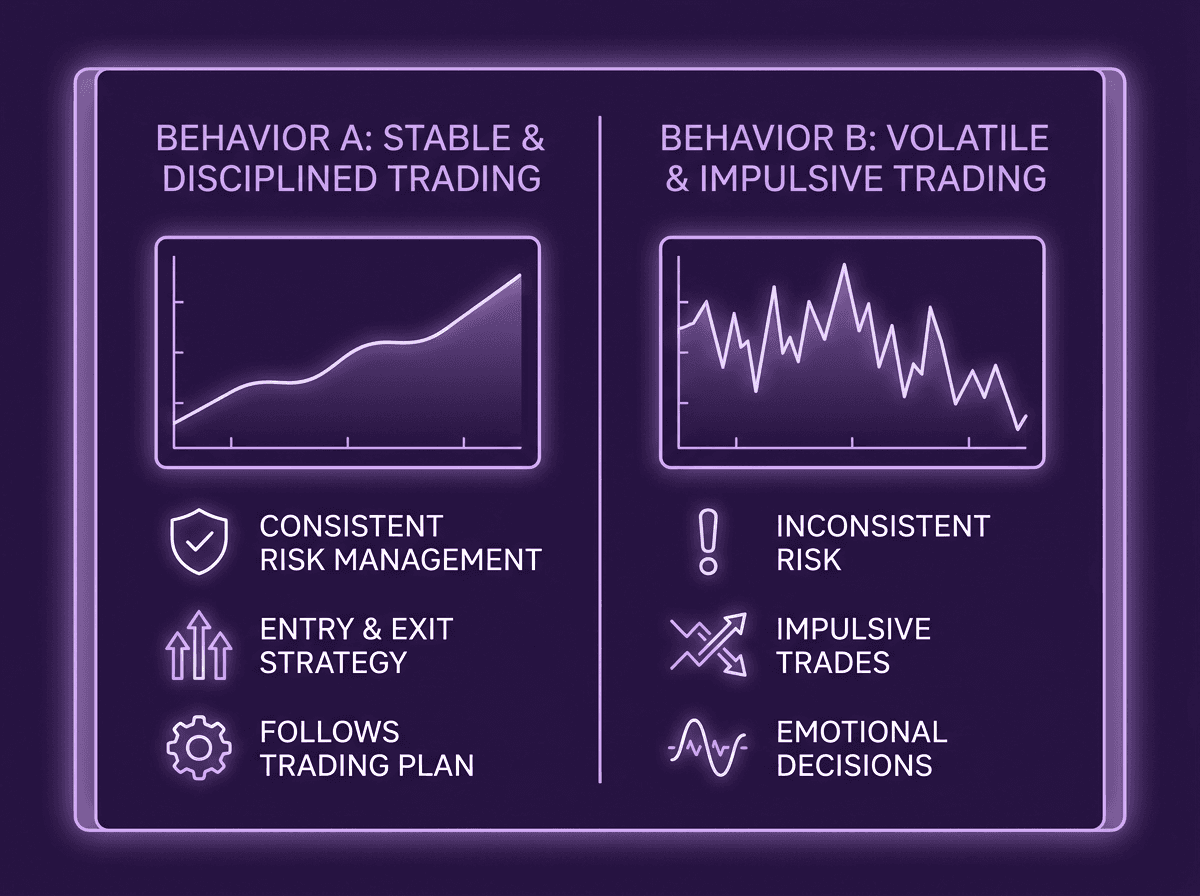
The aggressive trader enters right after the liquidity sweep. The conservative trader waits for a market structure shift. Both are looking at the same chart, the same demand zone, the same swept liquidity. The difference is timing, and that timing changes everything about your stop loss, your risk-to-reward ratio, and your win rate.
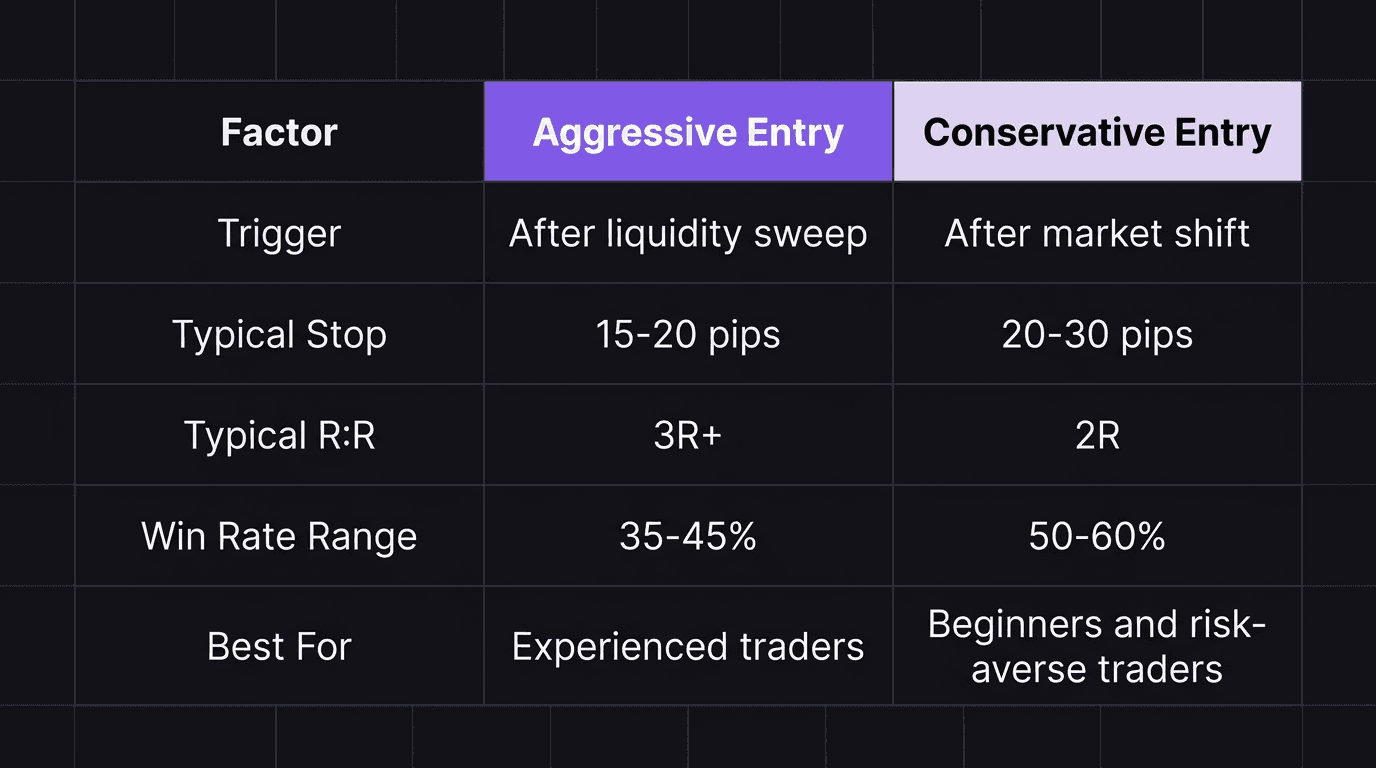
Neither style is better. They solve different problems. Aggressive entries give you tighter stops and bigger R:R but more losses. Conservative entries give you higher win rates but wider stops and smaller R:R. The right choice depends on your personality, your account size, and how you handle losing streaks.
TL;DR
Aggressive entries happen right after a liquidity sweep, before a market structure shift confirms.
Conservative entries wait for the market to break the last lower high (for buys) or last higher low (for sells).
A third option (extreme zone entry) enters at the deepest point of the demand zone after the deepest sweep.
Aggressive entries offer better R:R (3R or higher) but lower win rates (around 35 to 45%).
Conservative entries offer higher win rates (50 to 60%) but lower R:R (around 2R).
The Setup Both Styles Share
Before entry style matters, you need the same foundation. The 4-hour chart shows clear market structure, either higher highs and higher lows or lower highs and lower lows. You have identified a demand zone (for buys) or supply zone (for sells) on the 1-hour timeframe. Price has pulled back into that zone.
Up to this point, aggressive and conservative traders are doing the exact same analysis. They diverge at one question: do I enter now, or do I wait for confirmation?
If you want to understand how to identify setups that deserve either entry type, read about A-plus trade setups.
The Aggressive Entry: Enter After the Sweep
Price reaches your demand zone. It sweeps below the previous swing low, triggering retail stop losses. You enter immediately.
Why it works: The liquidity sweep clears out weak-handed longs. Institutions have absorbed those stop loss orders as fuel for their buy positions. Price has a high probability of reversing from here because the fuel has been gathered.
Why it is risky: You have no confirmation that the sweep is finished. Price could sweep one level of liquidity and then continue lower to sweep another. Your entry might be premature.
Walkthrough: Aggressive Entry on EUR/USD
The 4-hour chart shows an uptrend. Higher highs, higher lows. Price pulls back to a demand zone between 1.0845 and 1.0860 on the 1-hour chart.
Price drops to 1.0838, sweeping below the previous swing low at 1.0842. You see the sweep and enter a buy at 1.0842.
Stop loss: 1.0825 (17 pips below entry, placed below the demand zone). Take profit: 1.0893 (51 pips above entry, 3R).
Math check: 0.1 lots = $1/pip. $1 times 17 pips = $17 risk. $1 times 51 pips = $51 target. $51 / $17 = 3.0R.
The aggressive entry gets you in 10 pips lower than the conservative entry would, which translates to a tighter stop and a bigger reward relative to risk. But if price sweeps another 20 pips lower before reversing, you are stopped out while the conservative trader has not even entered yet.
The Conservative Entry: Wait for the Market Shift
Same setup. Price reaches your demand zone. It sweeps below the previous swing low. But instead of entering, you wait.
You are watching the lower timeframe (15-minute chart) for a market structure shift. In the pullback, price has been creating lower highs and lower lows on the 15-minute. You need price to break above the last lower high on the 15-minute to confirm that sellers have lost control.
When that break happens, you enter.
Why it works: You have confirmation that the pullback is over. The market structure has shifted from bearish to bullish on the lower timeframe. Your win rate goes up because you are entering in alignment with a confirmed direction change.
Why it costs more: By the time the market shift happens, price has already moved 10 to 20 pips above the sweep low. Your entry is higher, your stop is further from a logical invalidation point (or the same distance from a closer invalidation), and your R:R is smaller.
Walkthrough: Conservative Entry on EUR/USD
Same 4-hour uptrend. Same demand zone between 1.0845 and 1.0860. Price sweeps to 1.0838.
You drop to the 15-minute chart and watch. Price makes a lower high at 1.0855. Then price pushes above 1.0855, breaking the last lower high. Market shift confirmed.
You enter a buy at 1.0857.
Stop loss: 1.0835 (22 pips below entry, below the swept low). Take profit: 1.0901 (44 pips above entry, 2R).
Math check: 0.1 lots = $1/pip. $1 times 22 pips = $22 risk. $1 times 44 pips = $44 target. $44 / $22 = 2.0R.
The conservative entry cost you 15 pips of distance (entering at 1.0857 instead of 1.0842). Your R:R dropped from 3R to 2R. But your probability of the trade working is meaningfully higher because you have confirmation the reversal is underway.
The Third Option: Extreme Zone Entry
There is a middle ground that combines elements of both. When price sweeps the obvious liquidity above your demand zone and continues lower to the extreme of the zone (the very bottom of the demand area, near the origin candle), you enter there.
This entry is aggressive in timing (no market shift required) but conservative in positioning (you are at the deepest discount, where the zone must hold or the entire trade idea is invalid).
Your stop loss sits just below the extreme of the demand zone. If price breaks through, the higher timeframe trend has reversed and you want to be out anyway.
Walkthrough: Extreme Zone Entry
Same setup. Demand zone between 1.0845 and 1.0860. The extreme (bottom) of the zone is at 1.0845.
Price sweeps to 1.0838, then bounces to 1.0848, then drops again to 1.0843, touching the extreme of the zone. You enter at 1.0845.
Stop loss: 1.0830 (15 pips below, below the zone extreme). Take profit: 1.0890 (45 pips above entry, 3R).
Math check: 0.1 lots = $1/pip. $1 times 15 pips = $15 risk. $1 times 45 pips = $45 target. $45 / $15 = 3.0R.
You get the R:R of an aggressive entry with the logic of a conservative mindset: you are at the level that absolutely must hold. If it breaks, you want to be out.
Choosing Your Style
This is not a strategy decision. It is a personality decision.
You can handle losing streaks of 5 to 7 trades without changing your rules.
You have backtested your system and know your win rate at 35 to 45% is still profitable because of your 3R+ average winner.
You trade with a clear pre-trade checklist that prevents impulse entries from being labeled as "aggressive."
Losing streaks shake your confidence and make you doubt your system.
You prefer higher win rates, even at the cost of smaller individual gains.
You are newer to trading and want the confirmation before committing capital.
You understand demand zone structure well enough to identify the true extreme.
You want aggressive R:R without the timing risk of the basic aggressive entry.
You accept that price reaching the extreme zone does not always happen, which means you will miss some trades.
The mistake is not picking the wrong style. The mistake is not picking a style at all. Switching between aggressive and conservative entries based on how you feel that day is how you create an untestable system with random results.
How EdgeFlo Helps You Commit to a Style
The hardest part of entry style is consistency. When you are watching price sweep liquidity, the urge to enter immediately is real. When you are waiting for a market shift and price starts rallying without you, the urge to chase is equally real.
EdgeFlo's Edge plan builder lets you define and document your chosen entry style as part of your trade plan. You can structure your criteria for aggressive entries separately from your conservative criteria, and have both visible during execution. When the moment comes, your written rule makes the decision, not your emotions.
After each trade, you can log whether you followed your planned entry type. Over time, the AI-powered journal surfaces patterns: maybe your aggressive entries have a 38% win rate but 3.5R average, while your conservative entries hit 55% with 1.8R. That data tells you which style actually fits your execution, not which one sounds better in theory.
The Edge Brief
Receive Insights on trading psychology, discipline, and the behavioral patterns that create consistent traders from our Founder and the EdgeFlo team, delivered to your inbox.
Think different. Trade different.
What is an aggressive entry in trading?
What is a conservative entry in trading?
Which entry style is better for beginners?
Can I use both aggressive and conservative entries?

Turn discipline on.
Every session.
EdgeFlo is the environment serious traders operate inside.
Start 7-Day Free Trial
Cancel anytime.
No long-term commitment.

Think Different, Trade Different.