

Visualization for Traders: A 5-Minute Pre-Session Routine
Visualization helps traders execute under pressure by rehearsing setups mentally before the session. Five-minute routine with affirmations that work.
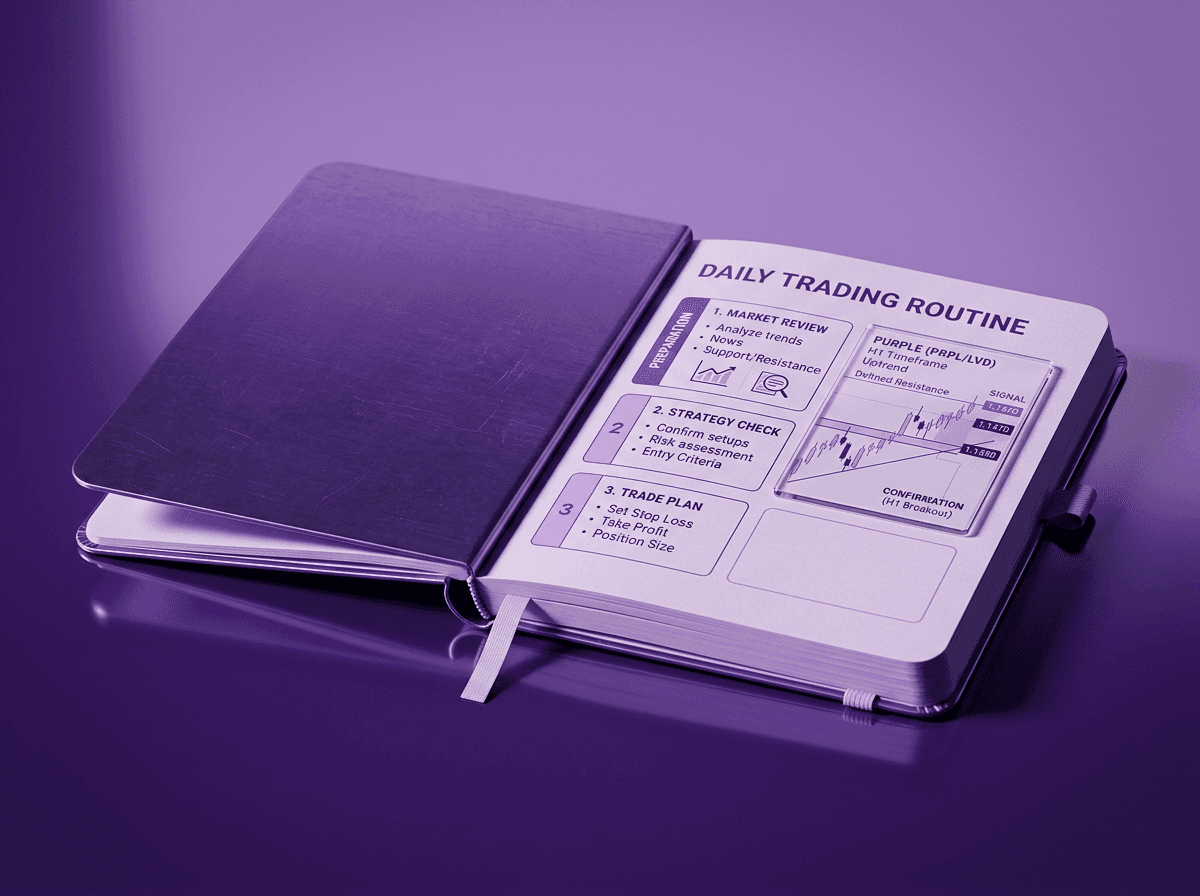
Visualization for traders is a pre-session mental rehearsal where you close your eyes and walk through your trading process before the market opens. You picture finding a setup, checking your criteria, entering the trade, managing it, and exiting. The goal is to rehearse execution when there is no money on the line so your brain treats the real session as familiar territory, not a threat.
This is not mystical. Athletes do it before every competition. Surgeons do it before complex procedures. The mechanism is simple: your brain fires the same neural pathways during vivid mental rehearsal as it does during actual performance. Repetition builds the pattern. The pattern reduces hesitation.
TL;DR
Visualization is mental rehearsal, not positive thinking. You walk through specific trade scenarios in your mind before the session starts.
Five minutes is enough. Review goals, visualize one trade from setup to exit, repeat an affirmation, set an intention.
The law of assumption says act as if you already are the trader you want to become. This changes your behavior, not your luck.
Affirmations work when they are specific and process-based. "I trust my analysis because I have a proven edge" beats "I am rich."
Visualization without action is useless. It is a supplement to your preparation, not a replacement for screen time and backtesting.
What Visualization Actually Does for Execution
The biggest problem during live trading is not analysis. It is hesitation.
You see the setup. It matches your playbook. All criteria are met. And then you freeze. You wait one more candle. Then another. Price moves without you, and now you are chasing or sitting out entirely.
Sound familiar? That hesitation comes from your brain interpreting the trade as a threat. Money is on the line. Uncertainty is high. Your fight-or-flight response kicks in, and suddenly the disciplined trader who backtested 50 examples of this exact setup cannot click the button.
Visualization addresses this by making the scenario familiar before it happens. When you have mentally walked through entering a trade at your demand zone, managing your risk, and accepting the outcome 20 times this week, the 21st time (live) feels like repetition. Not a new threat.
The Rehearsal Effect
Think of it like driving a route you take every day. The first time you drove to work, you paid attention to every turn. Now you do it on autopilot because repetition made the pattern automatic.
Visualization builds the same kind of familiarity for your trading process. You are not predicting what the market will do. You are rehearsing what you will do when the market presents a scenario you recognize.
This is why trading fear decreases with experience, but also why you can accelerate that process. Instead of waiting for 500 live trades to build pattern comfort, visualization compresses the repetition.
The Law of Assumption vs Law of Attraction
These two concepts get confused constantly. The difference matters for traders.
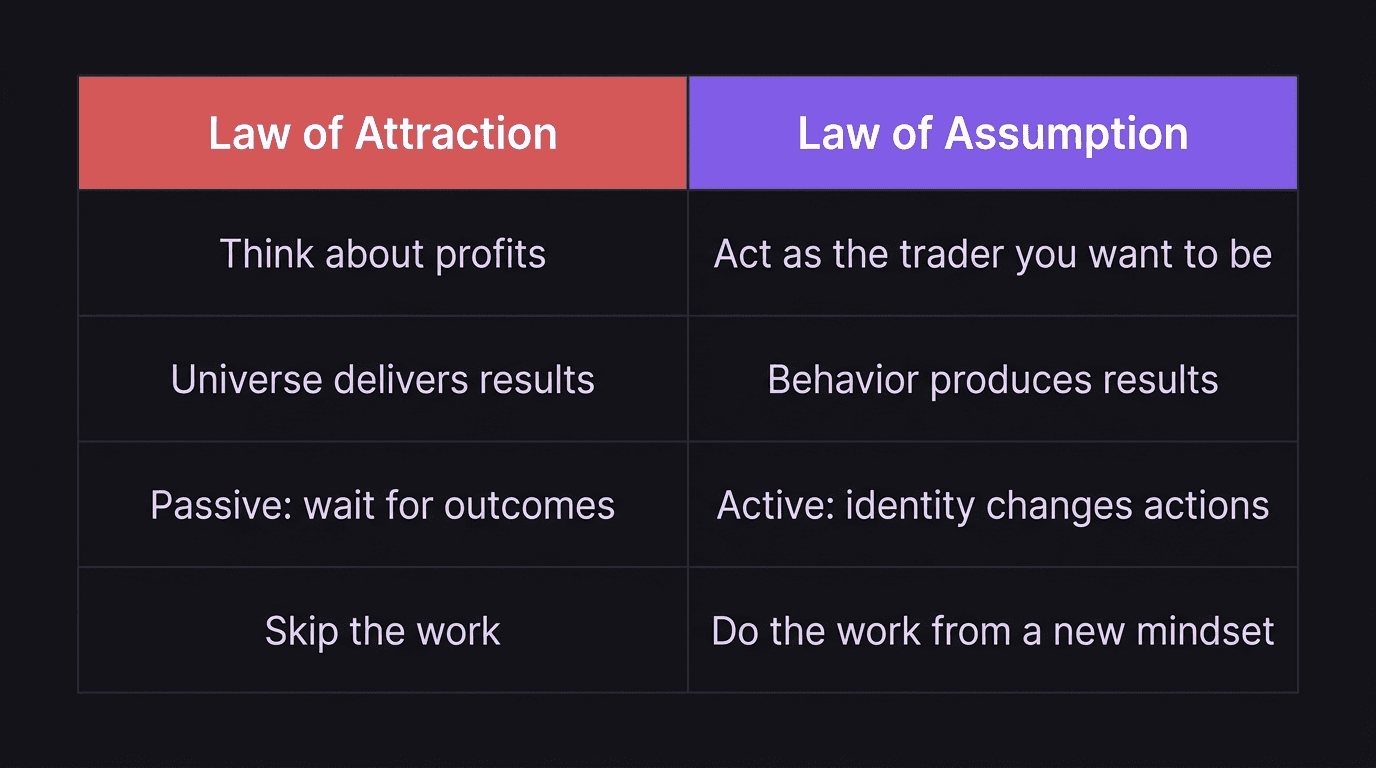
Law of attraction says: think about what you want, and the universe delivers it. This is passive. You visualize a Lamborghini and somehow it shows up. For trading, this translates to "imagine profits and they will come." Obviously, this does not work.
Law of assumption says something different: by believing the thing you want already exists in your life, you change how you act. You don't magically attract money. You start behaving like someone who already has what they want, and that behavior produces different results.
For a trader, the law of assumption works like this: instead of saying "I hope I become a disciplined trader someday," you assume you already are one. "I am a consistently profitable trader who is disciplined at all times."
Does repeating that sentence make it true? No. But it changes your next decision.
When you sit down at your charts believing you are a disciplined trader, skipping a bad setup feels natural. Following your risk rules feels like what "someone like you" does. It shifts your identity from "trying to be disciplined" to "being disciplined." The behavior follows the belief.
The catch: this only works if you combine it with real preparation. Affirmations without screen time, without backtesting, without a playbook, are just words.
A Five-Minute Visualization Routine
You do not need 30 minutes of meditation. Five minutes before your session is enough to shift your mental state from reactive to prepared.
Here is the routine, step by step:
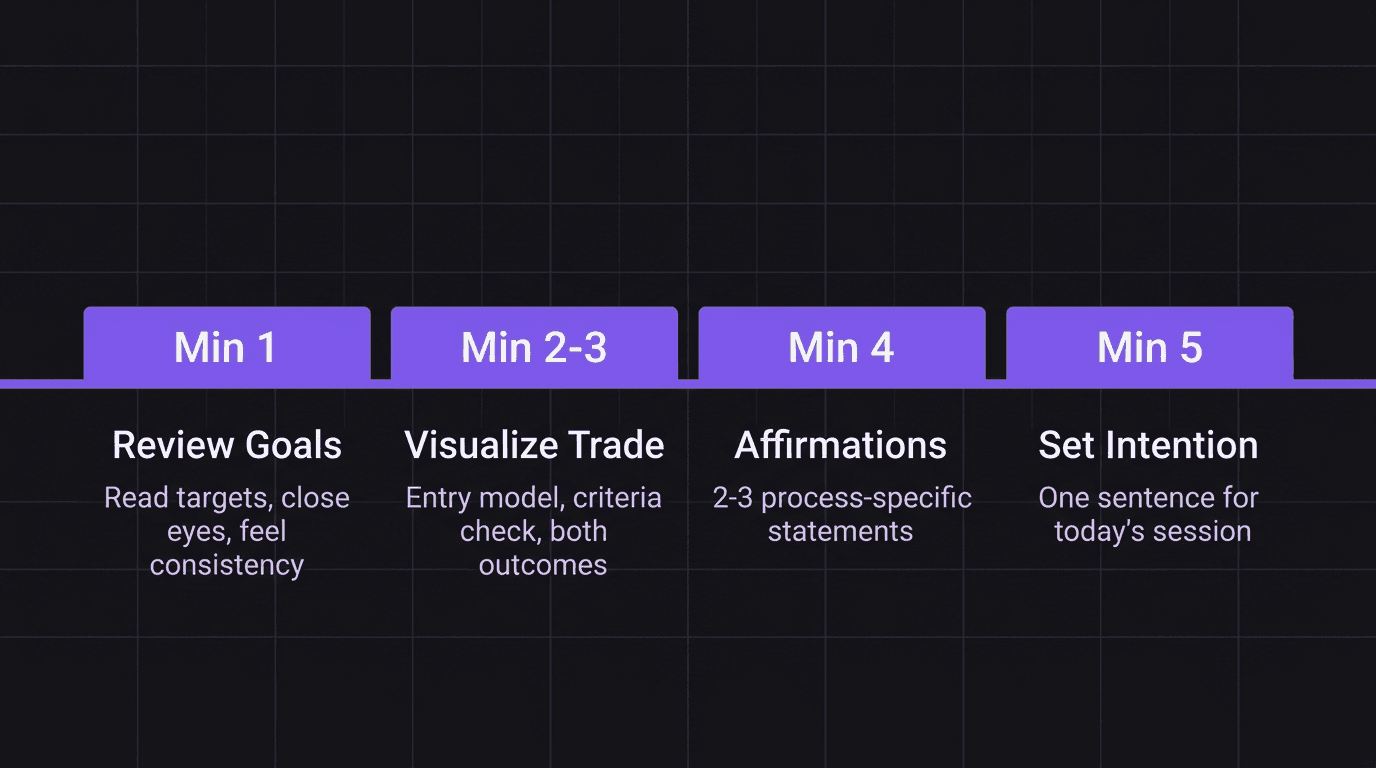
Minute 1: Review your goals. Open your dashboard or goals sheet. Read your monthly targets. Close your eyes. Picture what it feels like to hit those targets. Not the money. The feeling of consistency, the confidence of knowing your process works.
Minute 2-3: Visualize a specific trade. Pick one entry model from your playbook. Imagine the chart. See price approaching your zone. Watch the candle form at your level. See yourself checking your criteria list, confirming the setup meets minimum requirements. See yourself entering the trade, setting your stop loss, walking away. Then see two outcomes: price hits your target (you close calmly and journal the trade) or price hits your stop (you accept the loss, journal it, and move on without emotion).
Visualize both outcomes. This is critical. If you only rehearse winning trades, the first loss will feel like a surprise instead of a planned scenario.
Minute 4: Affirmations. Repeat two or three affirmations that connect to your process. Say them out loud or in your head. Make them specific (see next section).
Minute 5: Set your intention. One sentence for today's session. "Today I follow my plan on every trade." "Today I stop after two losses." "Today I wait for the candle close before entering."
That is it. Five minutes. Do it every session for two weeks and notice whether your execution under pressure changes.
Affirmations That Help (And Ones That Don't)
Not all affirmations are equal. The difference is specificity and connection to process.
Affirmations that change behavior:
"I trust my analysis because I have a proven edge."
"I am a consistently profitable trader who is disciplined at all times."
"I follow my playbook on every trade, no exceptions."
"I accept losses as part of the process because my edge plays out over 100 trades."
These work because they connect to concrete actions. When you say "I trust my analysis because I have a proven edge," the word "because" ties the belief to evidence. You trust your analysis because you have backtest data. It is not blind confidence. It is earned confidence stated as fact.
Affirmations that waste your time:
"Money flows to me easily."
"I am a millionaire trader."
"The market always moves in my favor."
"I never lose."
These fail because they describe outcomes you cannot control and facts that are not true. Your brain knows the difference. Repeating "I never lose" before a session does not reduce fear. It builds a fragile expectation that shatters at the first losing trade.
The rule: your affirmation should describe a behavior or belief you can act on today. If it describes a result that depends on the market, throw it out.
Walkthrough: How Affirmations Change a Live Session (USD/CAD, 1H)
> Pair: USD/CAD, 1-hour chart > Situation: The trader had two consecutive losing trades earlier in the week. Both were valid setups that hit stop loss. Confidence was low. Before Wednesday's session, the trader ran through the five-minute visualization routine and repeated: "I trust my analysis because I have a proven edge." > What happened: During London/New York overlap, a short setup formed at 1.3680. The setup met all criteria: bearish trend on 4H, price in premium zone, clean supply rejection on 15-minute. The trader noticed hesitation but remembered the affirmation. Entered the short. Stop at 1.3700 (20 pips). Target at 1.3620 (60 pips). > Outcome: Price dropped to 1.3625, missing the target by 5 pips. The trader moved the stop to breakeven at 1.3660 (per management rules) and was stopped out at breakeven when price retraced. > Result: Zero profit. But the trader executed without hesitation on a valid setup during a losing streak. That is the behavior change that compounds over months.
The trade did not produce profit. But the process was flawless. That is what affirmations actually do: they keep you executing your system when emotions are telling you to stop.
Why Visualization Without Action Is Useless
Here is the part that separates useful visualization from magical thinking: visualization is useless if you don't put in the work.
You cannot visualize your way to profitability without screen time. Without journaling trades. Without backtesting. Without building a playbook and following it.
Visualization is the supplement, not the meal. It takes what you have already built through real preparation and makes it more accessible under pressure. If you have not built anything, there is nothing to access.
This is where the law of assumption breaks for traders who skip the work. They assume they are disciplined without having built the habits. They affirm they have a proven edge without having tested anything. The belief has no foundation, so it collapses at the first drawdown.
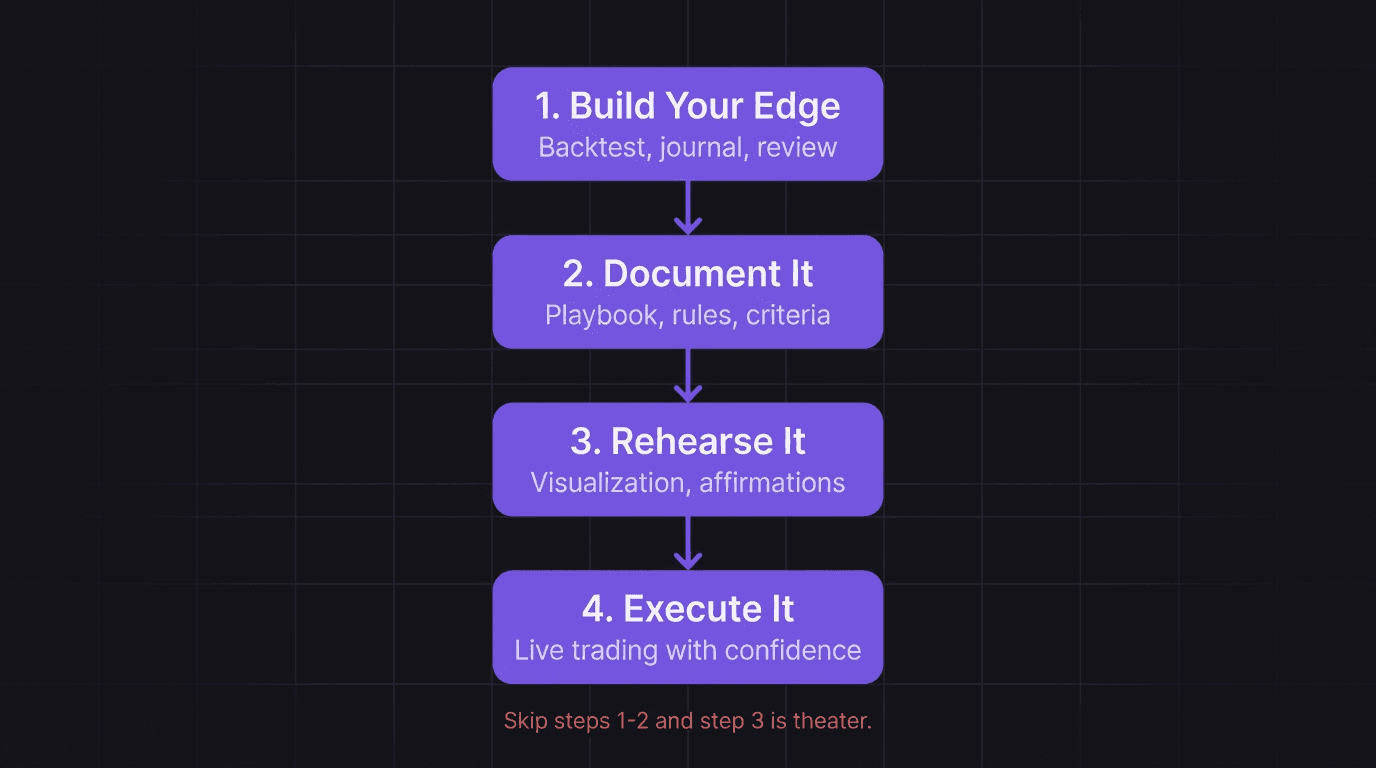
The sequence matters:
Build your edge (backtest, journal, review)
Document it (playbook, rules, criteria)
Rehearse it (visualization, affirmations)
Execute it (live trading)
Skip steps one and two, and step three is theater.
How EdgeFlo Supports Pre-Session Mindset
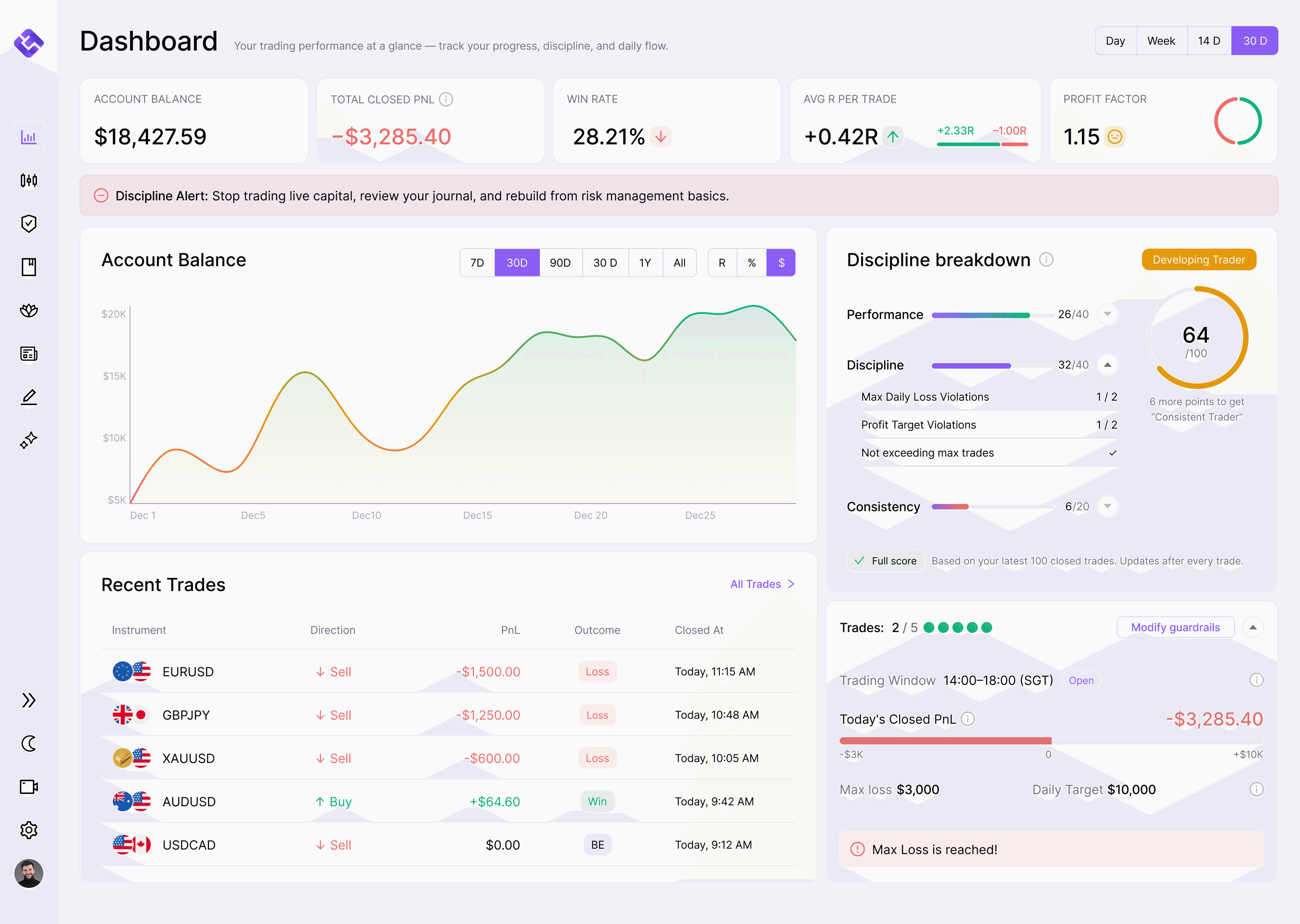
EdgeFlo's Sanctuary includes a meditation timer (adjustable from 1 to 120 minutes) with ambient sounds and guided mindset videos. You can run your five-minute visualization routine inside the platform before your session starts, with the same interface you will use for charting and journaling.
Sanctuary also has intention setting: you set a simple intention before your session so it has a clear purpose. Instead of opening your charts and reacting to whatever you see, you start with direction. "Today I only trade A+ setups." "Today I stop after my second trade." The intention stays visible during your session.
The pre-session mindset work connects to everything else in the platform. Your intention feeds into your post-session reflection. Your visualization routine becomes part of your pre-market routine. The goal is that mental preparation stops being a separate activity and becomes the first step of every trading session.
The Edge Brief
Receive Insights on trading psychology, discipline, and the behavioral patterns that create consistent traders from our Founder and the EdgeFlo team, delivered to your inbox.
Think different. Trade different.
Does visualization actually help with trading?
How long should a trading visualization session be?
What is the law of assumption in trading?
What trading affirmations actually work?

Turn discipline on.
Every session.
EdgeFlo is the environment serious traders operate inside.
Start 7-Day Free Trial
Cancel anytime.
No long-term commitment.

Think Different, Trade Different.