

Unrealistic Trading Timeline: Why Deadlines Kill
An unrealistic trading timeline forces rushed decisions and broken rules. Your goal is not wrong. Your deadline is. Here is how to fix it.
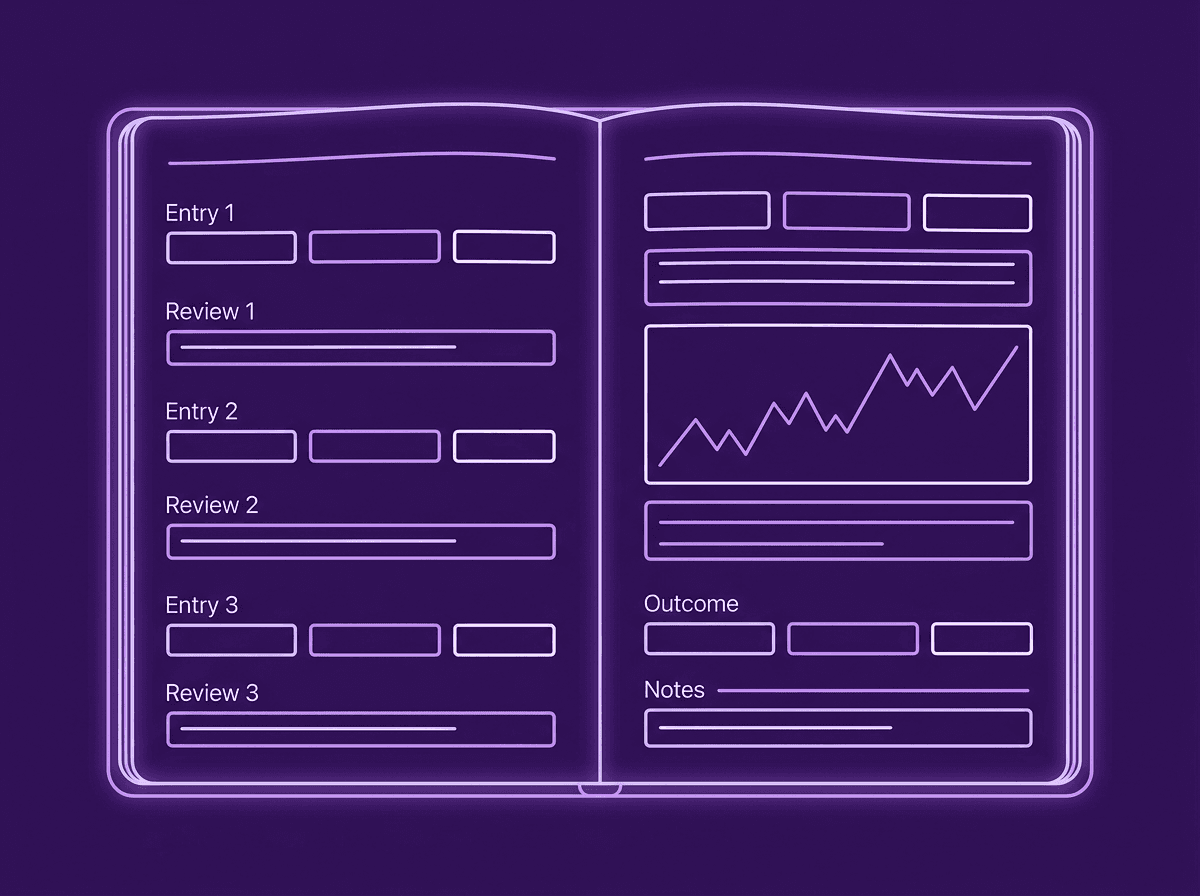
An unrealistic trading timeline is the single biggest reason traders break their own rules. The goal itself is usually fine. Wanting to get funded, wanting to hit $10,000 a month, wanting financial freedom. None of that is unrealistic. The problem is attaching a 30-day deadline to a 6-month process and then wondering why everything falls apart. When the deadline gets tight, you stop following your plan. You crank up lot sizes. You take setups that do not meet your criteria. You trade from urgency instead of conviction. The timeline, not the goal, is what destroys you.
TL;DR
Your trading goal is probably realistic. Your timeline for reaching it is probably not.
Tight deadlines cause rule breaking, oversized risk, and low-quality entries taken from desperation.
Slower timelines produce faster results because you stay focused on process instead of outcome.
Replace deadlines with milestones: track consistency, rule adherence, and risk quality weekly.
The traders who pass funded challenges treat the clock as a boundary, not a race.
Your Goal Is Fine. Your Timeline Is Not
Here is a sentence worth memorizing: it is not the goal that is unrealistic. It is the timeline.
Wanting to become a funded trader is completely reasonable. Wanting to do it in three weeks while risking 2% per trade on a 50K challenge with a 5% profit target and a 10% max drawdown? That is where the math stops working.
Think about it like training for a marathon. Nobody calls the finish line unrealistic. But signing up for a marathon and expecting to run it next Saturday when you have not trained? That is an unrealistic timeline. The goal stays the same. The schedule needs to stretch.
The moment you compress your timeline, something has to give. And it is always your rules. You start taking trades that do not meet your criteria because the clock is ticking. You bump your lot size because small gains feel too slow. You skip your pre-market routine because you "already know what to do." Sound familiar?
Every single one of those decisions feels logical in the moment. And every single one moves you further from your goal.
How Tight Deadlines Cause Rule Breaking
Here is what happens inside a trader's head when the deadline is close and the account is flat (or worse, red).
The thought process goes like this: "I need 5% in 12 trading days. That is about 0.4% per day. If I risk 2% per trade and need a 1:2 setup, I only need one winner per day." Sounds manageable, right?
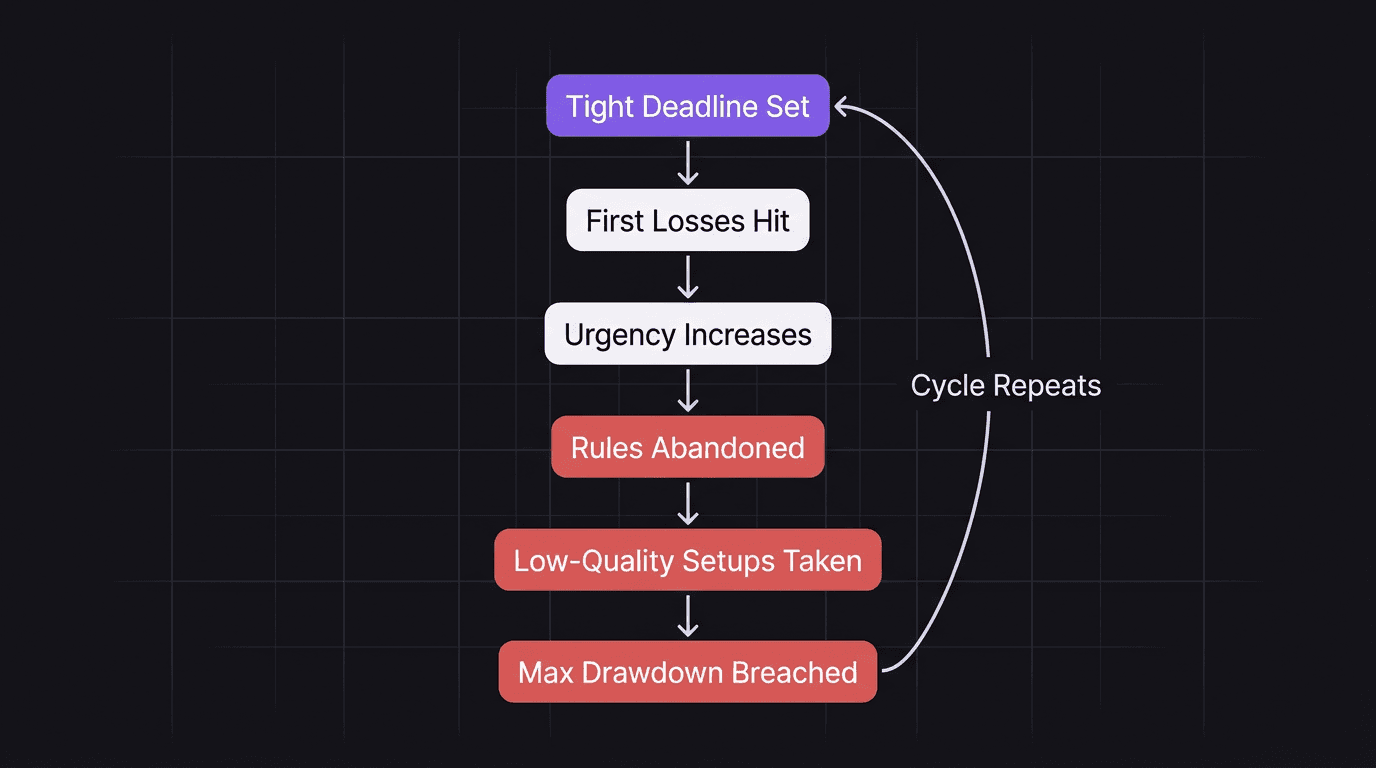
Then reality hits. You lose the first trade. Now you need 0.6% per day. You lose a second trade. Now you are down 4% and you need to gain 9% with only 6% of drawdown left before you breach. The math gets impossible, but the deadline has not moved.
This is where the spiral starts:
Lot sizes increase. You need bigger gains per trade to "catch up."
Entry criteria loosen. You start taking B and C setups because A+ setups are not showing up fast enough.
Risk management disappears. You move stops, skip stops, or average into losing positions.
Journaling stops. Who has time to journal when the account is bleeding?
Confidence collapses. Two losses become "I cannot trade" instead of "variance happened."
The deadline did not make you a worse trader. It made you abandon the process that makes you a good one.
Walkthrough: 30-Day Timeline vs 6-Month Timeline
The 30-Day Sprint
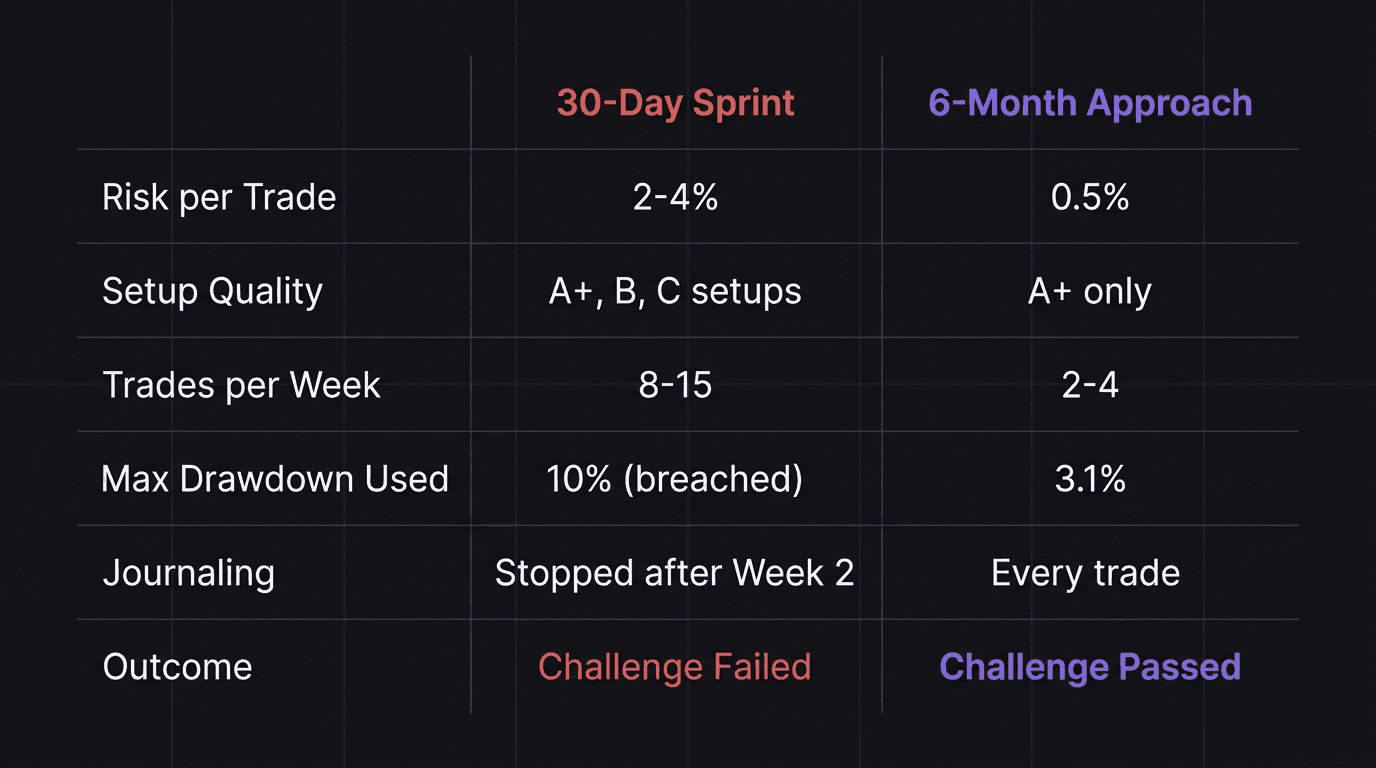
A trader buys a 50K funded challenge. The rules: 5% profit target, 10% max drawdown, 5% daily drawdown limit. The trader tells himself he will pass in 30 days.
Week 1: He risks 2% per trade on EUR/USD. First two trades lose. He is down $2,000 (4% of the account). Confidence drops. He starts second-guessing his setups.
Week 2: He increases risk to 3% per trade to "make up ground." He takes a GBP/USD trade during low-volume Asian session because he "needs the trade." It stops out. Down $3,500 total (7% of the account). Three percent of drawdown left before he is done.
Week 3: He takes four trades in one day, risking 1.5% each. Two win, two lose. Net gain: $0. He has burned 10 trading days with nothing to show. Panic sets in.
Week 4: He risks 4% on a single "make or break" trade. It loses. Max drawdown breached. Challenge over. Fee gone.
The strategy was not the problem. The timeline created the pressure that killed his process.
The 6-Month Approach
Same trader. Same 50K challenge. Same rules. But this time, no internal deadline.
Month 1: He risks 0.5% per trade. He takes only A+ setups from his playbook. Some weeks he takes two trades. Some weeks he takes zero. His account sits at $50,400 after 30 days. Barely moved. And that is fine.
Month 2: He continues the same approach. He journals every trade. He reviews his losers. He notices he performs best during London open on GBP/USD and adjusts his schedule. Account: $51,200.
Month 3: Compounding kicks in. His win rate is steady at 55%. His average R is 2.2. Small gains stack. Account: $52,800. He is more than halfway to the profit target.
Month 4: He passes the challenge with 5.6% profit and only 3.1% max drawdown used. He never had a single panic day. He never increased his lot size. He never took a trade he did not believe in.
The difference was not skill. It was time.
The Patience Paradox: Slower Timelines Produce Faster Results
This sounds contradictory, but it is true: the less you rush, the sooner you get there.
When you remove the deadline, something shifts. You stop caring whether this specific trade wins or loses. You stop chasing setups. You stop forcing entries during dead sessions. You start trading only when your criteria are met. And when your criteria are met, your edge works.
Think about compounding. Not financial compounding (though that matters too). Skill compounding. Getting 1% better at reading structure each week. Getting 1% better at waiting for confirmation. Getting 1% better at staying patient when nothing is setting up.
After a month, those improvements are invisible. After six months, they have transformed your execution. After a year, other traders cannot figure out how you got so consistent.
This is the patience paradox. The traders who give themselves the most time end up needing the least time. The traders who demand results in 30 days are still failing challenges 12 months later.
Ever noticed how the traders posting funded certificates are almost never the ones who talk about speed? They talk about process. They talk about consistency. They talk about boring, repetitive, unglamorous work done when nobody was watching.
How to Set Realistic Trading Milestones
Deadlines focus on outcomes you cannot control. Milestones focus on actions you can.
Here is a simple framework for replacing deadline pressure with milestone clarity:
Weekly Milestones (Process)
Did I follow my pre-market routine every trading day?
Did I journal every trade (wins and losses)?
Did I take only setups that met my criteria?
Did I stay within my risk parameters on every trade?
Monthly Milestones (Progress)
What is my rule adherence percentage this month?
Did my average R improve or stay stable?
Did I identify one weakness from my journal and address it?
Am I trading fewer low-quality setups than last month?
Quarterly Milestones (Growth)
Is my equity curve trending upward over 60+ trades?
Can I articulate my edge in one sentence?
Have I reduced my biggest leak from three months ago?
Notice what is missing from this list. There is no "make $X by date Y." There is no "pass challenge by week Z." Every milestone is about becoming a better trader, not hitting a number. The numbers follow the process.
Set your trading goals around what you do, not what the market gives you. You control your preparation, your risk, your discipline, and your review process. You do not control whether EUR/USD hits your take profit on Tuesday.
How EdgeFlo Keeps You on Track Without a Deadline
EdgeFlo's Edge plan tracks milestones, not deadlines. You define what a good trading day looks like (followed routine, stayed within risk, took only planned setups) and the dashboard shows your progress over flexible timeframes. No countdown timer. No pressure to perform by a date.
The journal captures timeline pressure patterns automatically. When you tag emotions after each trade, you start seeing exactly which days urgency crept in and what it cost you. That pattern recognition is worth more than any deadline because it teaches you to spot the pressure before it changes your behavior.
Your consistency is visible without being attached to a clock. Weekly discipline scores, rule adherence percentages, and process quality metrics give you real feedback on whether you are improving. The answer is always in what you did, not when you did it.
The Edge Brief
Receive Insights on trading psychology, discipline, and the behavioral patterns that create consistent traders from our Founder and the EdgeFlo team, delivered to your inbox.
Think different. Trade different.
How long does it realistically take to become a funded trader?
Why do trading deadlines cause more losses?
Should I set a deadline for my prop firm challenge?
What is the biggest mistake traders make with timelines?

Turn discipline on.
Every session.
EdgeFlo is the environment serious traders operate inside.
Start 7-Day Free Trial
Cancel anytime.
No long-term commitment.


Think Different, Trade Different.