

Trading Mindset Takes Years, Not Days
A profitable trading mindset takes years to develop. Learn the realistic timeline, what each stage looks like, and why shortcuts always backfire.
You read a book on trading psychology over the weekend. Monday morning, you feel transformed. By Wednesday, you have revenge traded twice and moved your stop loss on a winner.
Reading about discipline and having discipline are not the same thing. One takes a weekend. The other takes years.
A profitable trading mindset is not a concept you learn. It is a skill your nervous system develops through hundreds of repetitions under real pressure. You cannot download it from a book, a course, or a motivational quote. You build it trade by trade, loss by loss, over a timeline measured in years.
TL;DR
Trading mindset develops through live experience, not through reading or studying alone.
Most traders need 2 to 5 years of deliberate practice before their psychology becomes reliable.
Each stage of development (fear, overconfidence, acceptance) teaches something the previous stage could not.
Rushing the timeline leads to blown accounts and recycled mistakes.
The shift from "losses are bad" to "losses are business costs" is the turning point, and it cannot be forced.
Why Knowledge Alone Does Not Work
You can memorize every concept in trading psychology. You can explain the amygdala response, describe cognitive biases, and list ten techniques for managing emotions. None of that matters when EUR/USD drops 40 pips against your position and your account is flashing red.
Knowing what to do and doing it under pressure are completely different skills. The first lives in your prefrontal cortex (logical brain). The second lives in your nervous system. And your nervous system only learns through experience, not theory.
Think of it like public speaking. You can read every book on presentation skills. But the first time you stand in front of 200 people, your voice shakes and your mind goes blank. The twentieth time, it is uncomfortable but manageable. The hundredth time, it feels normal. That progression took time and exposure. No shortcut existed.
Trading works the same way. Your trading confidence grows through accumulated proof, not accumulated reading.
The Four Stages Every Trader Passes Through
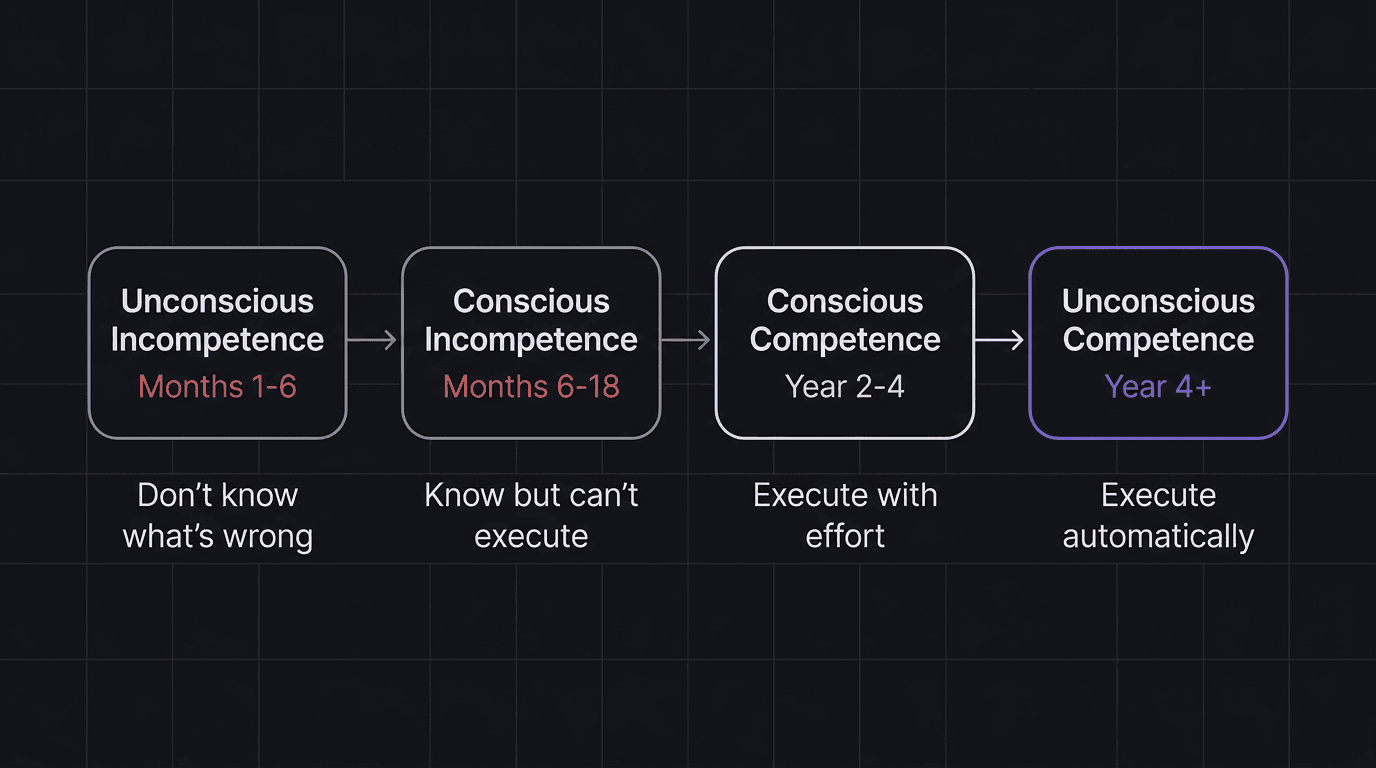
Most traders move through a predictable emotional progression. Understanding where you are helps you stop expecting to be somewhere you have not earned yet.
Stage 1: Unconscious Incompetence (Months 1 to 6)
You do not know what you do not know. Trading feels exciting. Wins feel like skill. Losses feel like bad luck. You switch strategies after every losing week. You have no journal, no plan, and no awareness that emotions are driving your decisions.
This stage ends when you blow an account or hit a drawdown painful enough to force reflection.
Stage 2: Conscious Incompetence (Months 6 to 18)
You now know that your emotions are the problem. You read about trading psychology. You start journaling. You build a plan. But you still break your rules consistently because knowing what to do is not the same as being able to do it.
This is the most frustrating stage. You can see the right decision in hindsight, but you cannot execute it in real time. Your amygdala fires, and you react before your logical mind catches up.
Most traders quit in this stage. They conclude that they are not "built for trading" when the reality is that they have not been trading long enough for their nervous system to adapt.
Stage 3: Conscious Competence (Year 2 to 4)
You can follow your plan, but it requires effort. Every trade demands active self-management. You catch yourself wanting to revenge trade and stop. You notice the urge to close early and override it. You feel the emotions, but you have built enough experience to recognize them and choose differently.
This stage is exhausting but productive. Your equity curve starts to stabilize. Your journal reveals patterns you could not see before. You begin to think in probabilities rather than outcomes.
Stage 4: Unconscious Competence (Year 4+)
Following your plan feels automatic. Losses register as costs, not failures. You do not need to actively manage your emotions on every trade because your nervous system has processed enough live data to normalize the experience.
This does not mean you never feel fear or greed. It means those feelings no longer control your execution. You feel the pull, acknowledge it, and execute your plan anyway. That gap between feeling and action is the mindset people spend years trying to develop.
The Turning Point: Losses as Business Costs
There is a single mental shift that separates struggling traders from consistent ones. It is the moment when you stop viewing losses as evidence that you are bad at trading and start viewing them as the cost of running a business.
A restaurant buys ingredients knowing some will spoil. A retailer buys inventory knowing some will not sell. These are not failures. They are expected costs built into a profitable business model.
In trading, losses are the cost of accessing winners. If your backtested strategy has a 40% win rate and a 2:1 reward-to-risk ratio, you will lose 6 out of every 10 trades. That is not a problem. That is the plan.
But here is why this shift takes years: your brain does not accept it intellectually. It accepts it after you have experienced enough losing trades where the math still worked out over a sample. You need to live through a 7-trade losing streak, stick to your plan, and then watch the next 3 winners erase the drawdown and leave you net positive. You need that experience multiple times before your nervous system stops treating every loss as a crisis.
Walkthrough: The 20-Trade Sample
A trader with a 40% win rate and a 2:1 R:R takes 20 trades, risking $100 per trade.
Wins: 8 trades at $200 each = $1,600.
Losses: 12 trades at $100 each = $1,200.
Net profit: $400.
During those 20 trades, she hit a streak of 5 consecutive losses. That streak cost $500 and lasted a week. It felt terrible. Her confidence dropped. She questioned her edge.
But she held the plan. And the math worked.
After experiencing this cycle three or four times over a year, the losing streaks stop feeling like emergencies. They feel like the cost of doing business. That is the mindset shift, and it only comes through lived experience.
Why Rushing the Timeline Backfires
Traders who try to skip stages always pay for it.
Jumping from demo to a $25,000 funded challenge without the emotional preparation leads to blown challenges and lost fees. Scaling lot size before your nervous system can handle the dollar swings leads to blown accounts.
The market has no timeline. It does not care if you "need" to be profitable by month six. Treating trading like a race creates pressure that amplifies every emotional weakness you have not yet resolved.
Warren Buffett captured this perfectly: you cannot produce a baby in one month by getting nine women pregnant. Some things just require time, and no amount of effort can compress the timeline beyond a certain point.
The traders who make it are the ones who accept this. They trade small. They journal consistently. They review their data. They build competence gradually, and they trust that the compound effect of deliberate practice will deliver results over years, not weeks.
How EdgeFlo Supports Long-Term Development
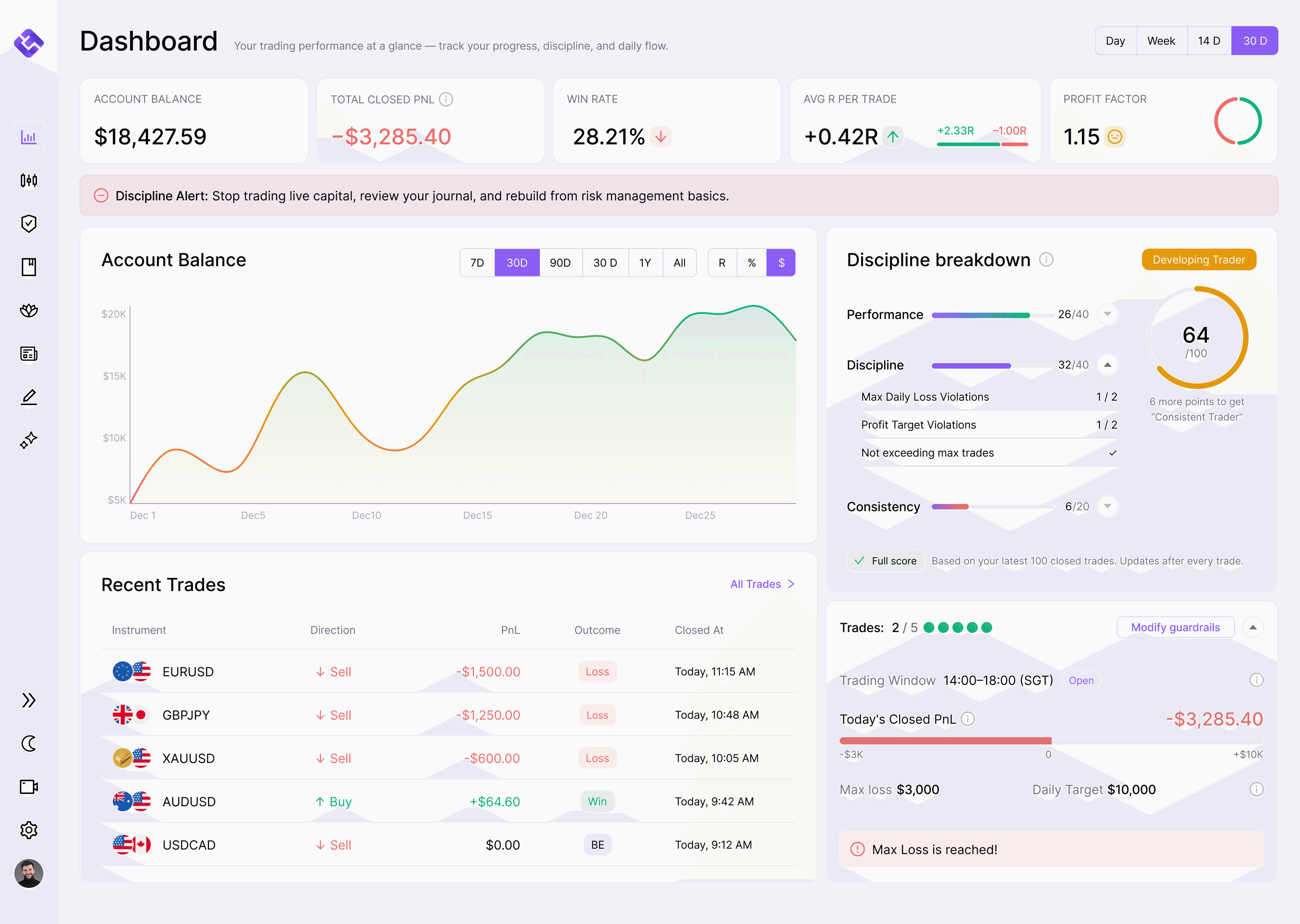
EdgeFlo is designed for the long game. The AI-powered trading journal tracks your trades, your emotions, and your plan adherence over months and years, not just today. Weekly AI reports (Plus) surface patterns you might miss on your own: which sessions cause emotional trading, which setups you deviate from most, where your discipline breaks down under specific conditions.
Sanctuary supports your reset routine when the grind of development gets heavy. It guides you through structured decompression so that a bad week does not turn into a bad month.
FloAI (Plus) highlights recurring patterns in your journal data and flags areas where your behavior drifts from your plan. This is not a shortcut through the stages. It is a way to make each stage more productive, so the years you invest in developing your mindset compound faster.
The Edge Brief
Receive Insights on trading psychology, discipline, and the behavioral patterns that create consistent traders from our Founder and the EdgeFlo team, delivered to your inbox.
Think different. Trade different.
How long does it take to develop a trading mindset?
Why can't I just read about trading psychology and be fixed?
What does a mature trading mindset look like?
Can a trading coach speed up mindset development?

Turn discipline on.
Every session.
EdgeFlo is the environment serious traders operate inside.
Start 7-Day Free Trial
Cancel anytime.
No long-term commitment.

Think Different, Trade Different.