

Trading Greed: How Winning Streaks Turn Into Losses
Greed pushes you to overtrade and oversize after wins until one bad trade erases everything. Learn three rules that cap greed before it caps your account.
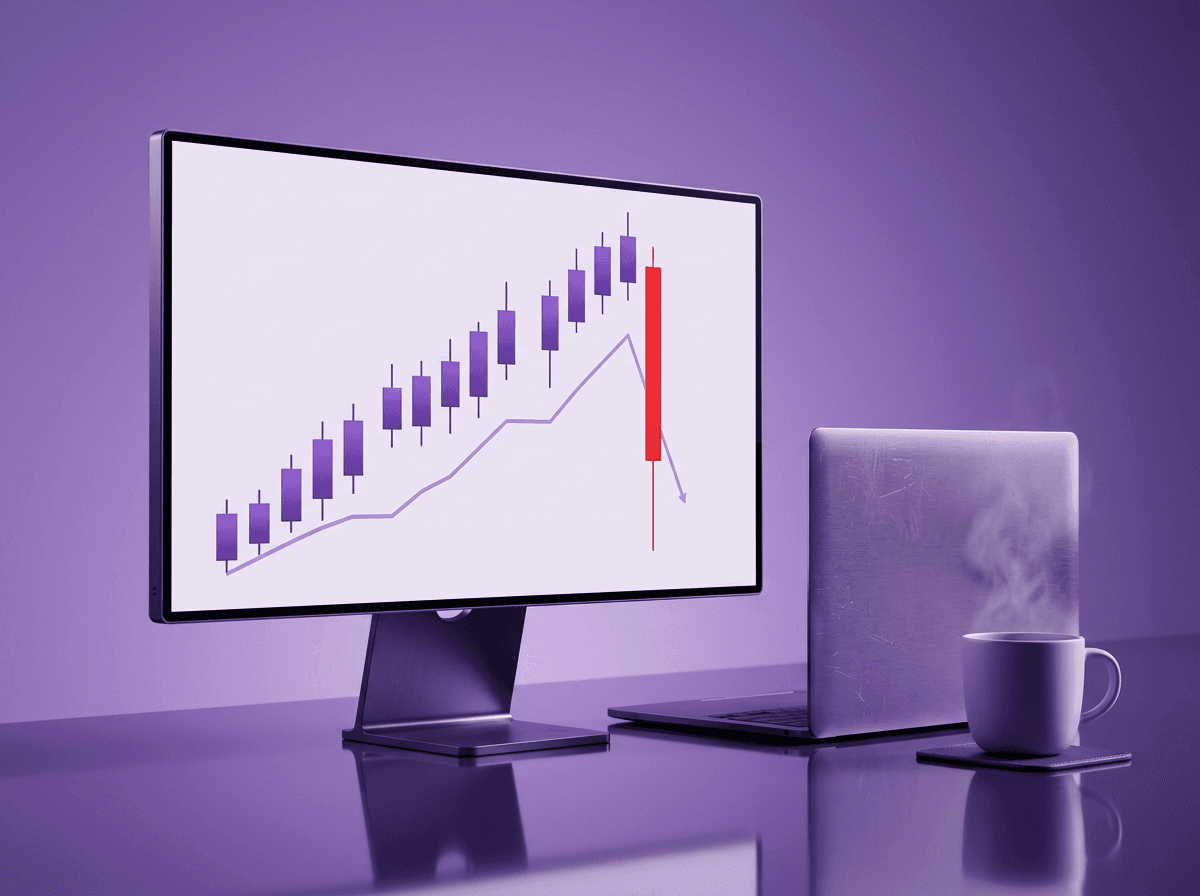
Trading greed is pushing harder than your edge allows. You win three, four, five trades in a row and something shifts. The caution that protected your account disappears. You start taking extra setups, bumping up your lot size, and treating the market like an ATM. Then one oversized loss wipes out everything you built during that streak. The real damage is not the money. It is the cycle: win, get greedy, give it all back, start over.
TL;DR
Greed is not wanting to make money. Greed is ignoring your rules because you think the winning streak will last forever.
After a run of wins, traders overtrade and oversize, compounding mistakes instead of compounding gains.
A single 5% loss erases five consecutive 1% wins if you sized up on the wrong trade.
Three rules stop the cycle: set a profit target, trade one session, and lock your risk percentage.
The goal is not to squeeze every pip from the market. It is to keep what you earned.
Why Greed Feels Like Confidence
Greed does not announce itself. It shows up disguised as confidence. You follow your plan, hit a few winners, and suddenly the plan feels optional. "I already know what the market is going to do" becomes the internal monologue. That is not confidence. That is complacency.
Real confidence comes from data. You tested your strategy over 100 trades, you know your win rate, and you execute the same way on trade 101 as you did on trade 1. Greed-fueled "confidence" comes from a hot streak. It has no data behind it. It just feels good.
The difference matters because greed does not make you take bad trades immediately. It makes you take more trades. And then slightly larger trades. And then trades that do not quite fit your checklist. Each step feels small. The total damage is not.
The Winning Streak Trap
Ever had a week where everything worked? Three wins on Monday. Two more on Tuesday. By Wednesday you are thinking about doubling your lot size because you feel untouchable.
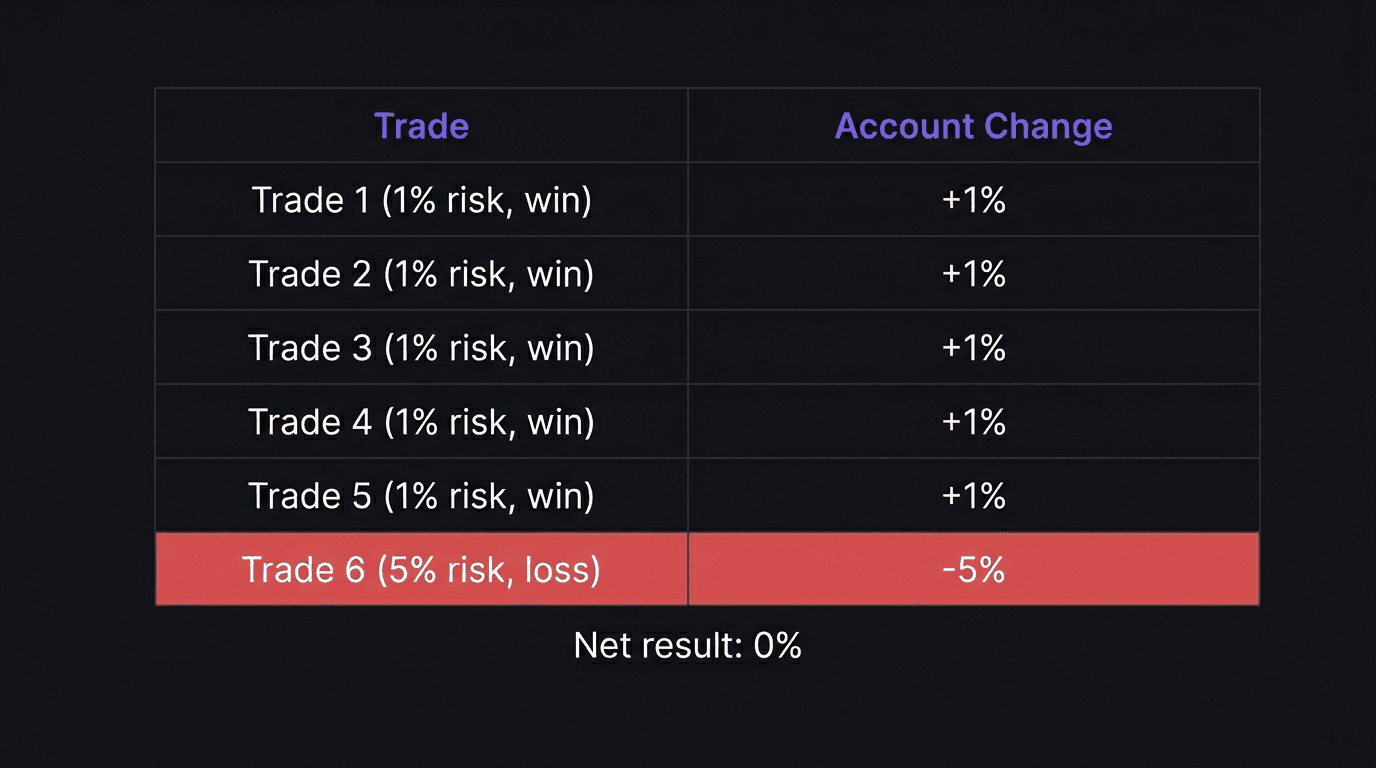
Here is what actually happens. You risk 1% per trade and win five in a row with a 1:1 reward. Your account is up 5%. Then you get bold. You risk 5% on trade six because "the streak is going to continue." That one trade loses, and your account is right back where it started.
Math check
5 wins at 1% each = +5% total.
1 loss at 5% = -5%.
Net: +5% minus 5% = 0%.
Five trades of disciplined work erased by one greedy decision.
Sound familiar? This is the most common pattern behind blown winning streaks. The problem is not the loss itself. Losses happen. The problem is the lot size was too big because the trader sized up on emotion instead of sticking to the system.
What Greed Actually Does to Your Trading
Greed changes your behavior in three specific ways, and each one compounds the damage.
You Overtrade
A winning streak feels like proof that you should keep going. You finished your London session up 2%. Why not trade New York too? The setups look decent. By the end of New York, you have given back the 2% and then some.
This is the classic one-session rule violation. Sticking to a single session caps the number of decisions you make in a day. Once you start adding sessions, you are trading on momentum, not on plan.
You Oversize
After three or four winners, the 1% risk per trade starts to feel conservative. "I know what I am doing" kicks in, and you push to 3% or 5%. But the market does not care about your streak. The next trade has the same probability of losing as the first one. The only thing that changed is how much you stand to lose.
You Lower Your Standards
This is the subtlest form of greed. You stop waiting for A+ setups. A B-minus setup "looks close enough" because you are on a roll. You skip your checklist. You enter before your criteria line up. Each trade is slightly worse than the last, and the compounding mistakes start stacking.
Three Rules That Cap Greed
These are not complicated. The hard part is following them when you are winning.
Rule 1: Set a Profit Target and Stop
Pick a realistic target for the day, the week, or the month. When you hit it, close the charts.
A monthly target of 5% is a useful starting point for beginners. If you hit 5% in the first week, you stop trading for the rest of the month. That feels painful in the moment because your brain is screaming "keep going." But consider the alternative: you trade for three more weeks, take lower-quality setups, and give back the 5% by month end.
The target is not about limiting upside. It is about protecting what you already earned.
Rule 2: Trade One Session
If you trade the London session, trade the London session. Do not carry over into New York because "there might be more." Sticking to one session forces a natural cutoff. You analyze, you execute, you close the charts.
Trading multiple sessions is one of the fastest ways to give back profits. The quality of your decisions degrades the longer you sit at the screen. By hour eight, you are not making rational choices anymore. You are reacting.
Rule 3: Keep Risk Consistent
This one is non-negotiable. If you risk 1% per trade, risk 1% on every trade. Win or lose, streak or no streak. The moment you start sizing up after wins, you have handed the steering wheel to greed.
Consistent risk means your winners and losers stay proportional. A 1% loss after five 1% wins still leaves you up 4%. A 5% loss after five 1% wins leaves you at zero.
If you are a beginner, consider sizing down after the third consecutive win. Not up. Down. This counterintuitive move protects you during the exact moment your brain is most likely to get reckless.
Walkthrough: The Wednesday Meltdown
What happened
A trader starts the week trading EUR/USD on the London session. Monday: one trade, 1% risk, 3:1 reward target. The setup hits take profit. Tuesday: same thing. One trade, 1% risk, 3:1 reward. Another winner.
By Wednesday, this trader is up 6% on the week. Two trades, two wins, each at 3:1. The plan says wait for the next A+ setup. But Wednesday morning, the trader sees a "decent" setup on GBP/USD during the Asian session (outside the normal London window). Instead of waiting, the trader enters with 3% risk because "the week is going well."
The trade loses. The 3% loss cuts the weekly gain from 6% to 3%. Frustrated, the trader takes another trade during London with 2% risk on a B-quality setup. That trade also loses. The week goes from +6% to +1%.
Math check
Monday: 1% risk, 3:1 reward = +3%.
Tuesday: 1% risk, 3:1 reward = +3%.
Running total: +6%.
Wednesday trade 1: 3% risk, loss = -3%. Running total: +3%.
Wednesday trade 2: 2% risk, loss = -2%. Running total: +1%.
Two disciplined trades earned 6%. Two greedy trades gave back 5%.
What should have happened
The trader should have followed all three rules. The profit target was not hit (assuming a monthly target above 6%), so trading was fine to continue. But the session rule was broken (Asian instead of London), the risk was tripled (3% instead of 1%), and the setup quality dropped (B-quality instead of A+). Any one of those violations alone could cause a loss. All three together guaranteed it.
Redefine What Success Looks Like
Most traders define a successful week as making the most money possible. That definition feeds greed directly.
A better definition: a successful week is one where you followed your rules on every trade you took. You waited for A+ setups. You kept your risk at 1%. You traded one session and closed the charts.
If you do those things and still lose, you had a bad variance week. That happens. It does not mean the process failed. But if you win by breaking your rules, that is the most dangerous outcome. Because you just taught yourself that rule-breaking gets rewarded. Next time you break the rules, the market will collect.
Focus on compounding growth, not compounding trades. Getting 1% better at execution each week does not sound exciting. Over a year, it completely changes your results.
How EdgeFlo Helps You Cap Greed
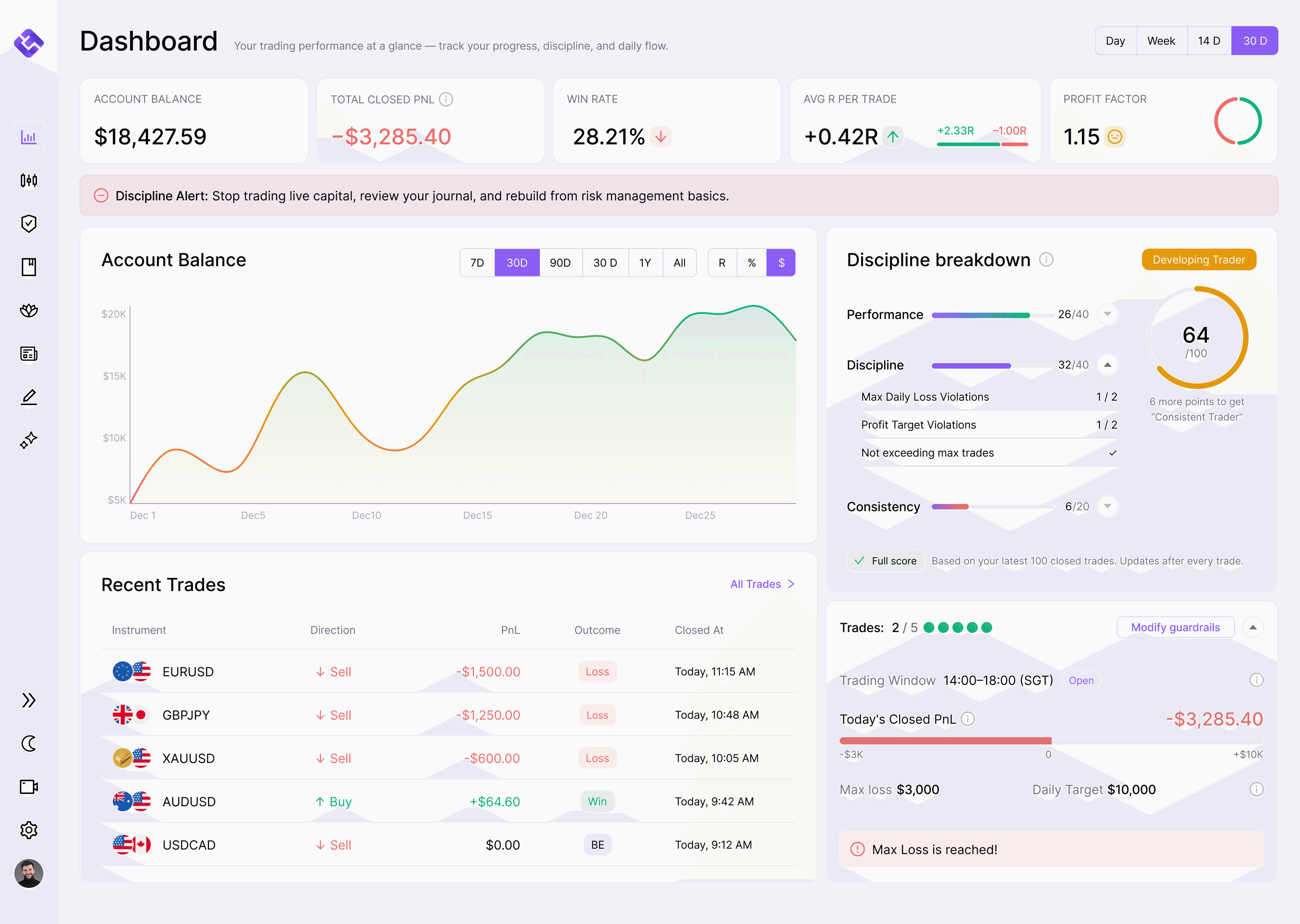
EdgeFlo's guardrails restrict the number of trades you can take per session. You set the limit based on your plan, and when you hit it, the platform makes it harder to enter another trade. You can override the restriction, but you have to make a conscious choice to do so. That pause is often enough to stop a greed-driven entry.
The trading dashboard tracks your trade frequency and lot sizes across sessions. If you start sizing up after wins or adding trades beyond your normal count, the pattern shows up in your data. You do not have to guess whether greed crept in. The numbers tell you.
EdgeFlo does not eliminate greed. Nothing does. But it makes greedy behavior visible before it costs you real money.
The Edge Brief
Receive Insights on trading psychology, discipline, and the behavioral patterns that create consistent traders from our Founder and the EdgeFlo team, delivered to your inbox.
Think different. Trade different.
What is trading greed?
How do you stop being greedy in trading?
Why do traders give back profits after a winning streak?
Does greed only affect beginner traders?

Turn discipline on.
Every session.
EdgeFlo is the environment serious traders operate inside.
Start 7-Day Free Trial
Cancel anytime.
No long-term commitment.

Think Different, Trade Different.