

Trading Frustration: When Expectations Miss Reality
Frustration hits when the market does the opposite of what you expected. Learn why fighting reality burns accounts and how journaling expectations fixes the cycle.
Trading frustration happens when your expectation about price direction collides with what the market actually does. You thought EUR/USD was heading higher based on your London session analysis, and instead it dropped 40 pips through your entry. The frustration is not really about the loss itself. It is about the gap between the move you planned for and the move you got. That gap creates an emotional charge, and if you do not manage it, it pushes you straight into revenge trading or reckless position sizing.
TL;DR
Frustration is the emotional response to the gap between what you expected and what the market delivered.
Fighting reality by forcing trades in your original direction compounds losses and clouds your judgment.
A two-column expectations journal exposes the recurring triggers behind your frustration cycle.
Taking a 10-minute break after two consecutive losses resets your mental state before the next decision.
The fix is not suppressing frustration; it is catching the mismatch before you act on it.
What Frustration Actually Is (and Why It Sticks)
Most traders describe frustration as "the market screwing me." But that framing gives the market agency it does not have. The market is not doing anything to you. It is just moving.
Frustration is the emotion you feel when your internal prediction misses. You looked at a bullish structure forming on GBP/USD during Asian consolidation, you built a bias toward longs, and then NFP data dropped the pair 60 pips in seven minutes. Your analysis was not necessarily wrong. Your timing was.
The problem is what happens next. Frustration does not just sit quietly. It tells you that you need to be right. That the market owes you the move you saw coming. And that impulse to prove yourself correct is exactly what leads to forced entries, widened stops, and doubled lot sizes.
Ever caught yourself thinking "No, it has to come back"? That is frustration talking. Not your trade plan.
The Frustration Cycle: How One Bad Trade Becomes Five
Here is how the cycle typically plays out. You enter a trade based on your plan. The trade goes against you and hits your stop. You feel the sting. Instead of stepping back, you re-enter in the same direction because you still believe your analysis is correct.
The market keeps pushing against you. You enter again. Same direction. Same conviction. Same result.
Walkthrough: Fighting a Bearish Trend on EUR/USD
You identify a bullish order block on EUR/USD at 1.0840 during the London session. You enter long with a 25-pip stop at 1.0815. Your target is 1.0890.
Price drops through 1.0815. You lose 25 pips. That is $250 on 1 standard lot at $10/pip.
You re-enter long at 1.0810, convinced the zone will hold. Another 25-pip stop at 1.0785. Price slices through again. Another $250 gone.
You enter a third time at 1.0780. This time you widen the stop to 40 pips because you are certain the selling is exhausted. Price drops to 1.0740. That is $400 on 1 lot.
Three trades. Same direction. Total damage: $900. The 4H chart showed a clear bearish structure the entire time. You just refused to see it because frustration locked you into your original bias.
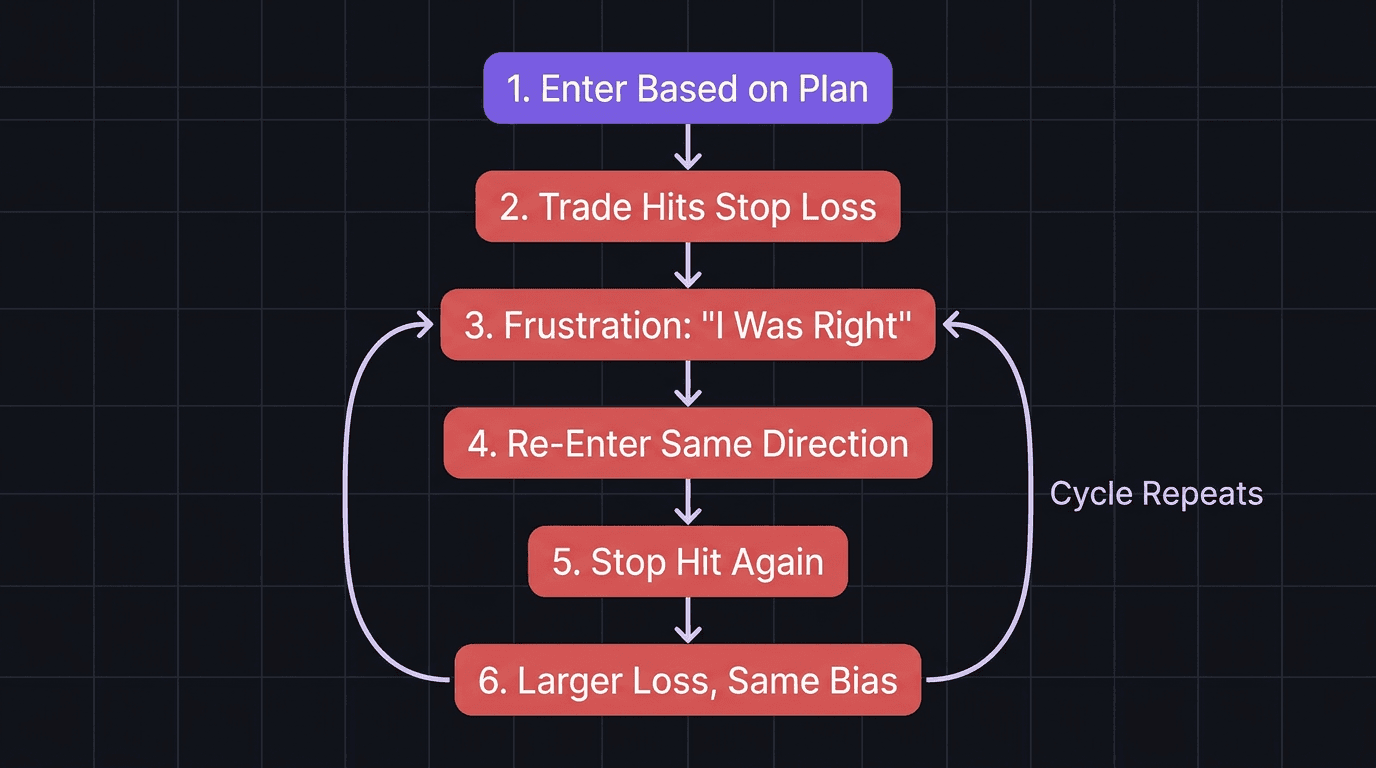
That walkthrough is not unusual. It is what happens when frustration overrides your ability to read the chart objectively. The trader was not stupid. The trader was emotional. And emotional traders stop seeing what the market is actually doing.
Why You Fight the Market (Instead of Reading It)
Frustration is rooted in your need to avoid the pain of being wrong. Accepting that your directional bias was incorrect means accepting that you wasted time on analysis, that your read was flawed, and that you need to start over. That is uncomfortable.
So instead of accepting reality, you fight it. You keep buying in a downtrend. You keep shorting in an uptrend. You tell yourself the market "has to turn." Sound familiar?
This is not a strategy problem. It is an ego problem. Your identity gets tangled with your trade idea, and admitting the idea was wrong feels like admitting you are bad at trading. So you double down.
The irony is that fighting reality creates the exact outcome you are trying to avoid. You lose more. You feel worse. And you end the session with a deeper hole than the original stopped trade would have cost you.
The 10-Minute Reset That Breaks the Loop
The simplest intervention is a hard break. After two consecutive losses in the same direction, close the platform. Set a timer for 10 minutes. Walk away from the screen.
This is not motivational advice. This is operational.
When you are frustrated, the emotional part of your brain is running the show. Your prefrontal cortex, the part responsible for planning and rational analysis, gets pushed aside. You need time for the emotional spike to come down before you look at another chart.
During those 10 minutes, do not check your phone for price updates. Do not scroll trading Twitter. Just let your system cool down. When you sit back down, open a fresh chart. Look at what the market is actually doing right now, not what you wanted it to do 30 minutes ago.
Walkthrough: Using the Break to Catch a Reversal
After two stopped longs on GBP/USD, you step away for 10 minutes. When you come back, you pull up the 1H chart with fresh eyes.
You notice price has broken below two swing lows and created a lower high at 1.2650. The structure is bearish. Your earlier bullish bias is invalidated.
Instead of entering long again, you mark a supply zone at 1.2650 and wait for a pullback. Price retraces to 1.2645, gives you a bearish engulfing on the 15-minute chart, and you enter short with a 20-pip stop at 1.2665.
Price drops to 1.2600. That is 45 pips of clean movement. On 1 standard lot, that is $450 at $10/pip.
Math check: 1 lot = $10/pip. $10 times 45 pips = $450.
The break did not give you a magical edge. It gave you clear eyes. That was enough.
Journal Expectations vs. Reality (The Framework That Fixes This)
Taking a break handles the immediate spike. But if you want to stop the frustration cycle from repeating week after week, you need a system that tracks your expectation mismatches over time.
This is a simple two-column journal entry you complete after every losing trade:
Column 1: What I Expected Write down what you thought price would do and why. Be specific. "I expected EUR/USD to bounce from 1.0840 because of the 4H order block and bullish BOS on the 15-minute."
Column 2: What Actually Happened Write down what price did. "Price broke through 1.0840, swept the lows at 1.0820, and continued dropping during NY session after worse-than-expected CPI data."
That is it. Two columns. Takes 90 seconds.
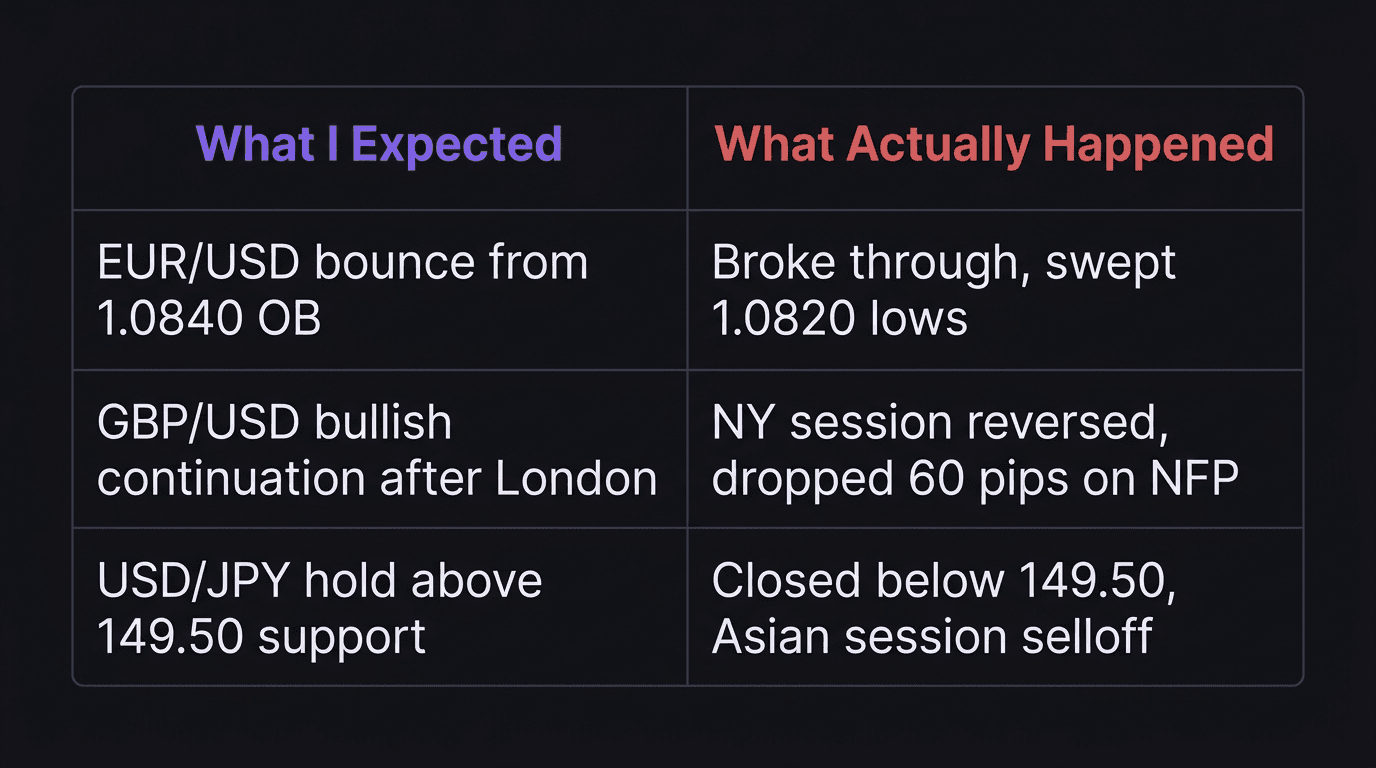
When you review these entries at the end of the week, patterns emerge. Maybe your expectations consistently miss during news events. Maybe your London session bias gets invalidated by New York every time. Maybe you are reading structure correctly on the daily but entering on the wrong timeframe.
You cannot fix what you cannot see. And you will not see the pattern until you write it down. This is the difference between being frustrated and understanding your frustration.
Common Triggers (And What They Tell You)
After a few weeks of journaling expectations versus results, most traders find that their frustration clusters around a small number of recurring situations:
News events that flip intraday bias. You build a directional bias in the London session, and then a US data release reverses the entire move. This is not a flaw in your analysis. It means your system needs a rule about holding positions through scheduled news.
Session transitions. A valid setup in London becomes invalid in New York. The liquidity profile changes, participation shifts, and the structure you were trading gets swept. The fix is choosing one session and closing before the next one starts.
Winning streaks that inflate expectations. You win four trades in a row and start expecting every trade to win. The fifth loss feels personal because you forgot that a 50% win rate means half your trades lose. This is where frustration meets overconfidence, and the combination leads to impulse entries.
Small losses that "should have" been winners. The trade came within 3 pips of your target and reversed. You feel robbed. But the market does not owe you the last 3 pips. If this happens repeatedly, your targets may be placed at resistance levels where institutional participants take profits.
Frustration vs. Feedback: Changing the Frame
Here is the mindset shift that separates traders who stay frustrated from traders who use frustration productively: every expectation mismatch is data.
When the market does the opposite of what you predicted, it is not punishing you. It is showing you where your model breaks. That information is more valuable than a winning trade because it tells you exactly what to fix.
A losing trade that confirms your strategy rules still worked (entry was valid, stop was correct, the market just moved against you) is not a reason for frustration. That is variance. It happens.
A losing trade where you deviated from your plan, ignored structure, or chased a move you missed: that is a reason to journal and adjust. But the adjustment is behavioral, not emotional. You change the rule, not the feeling.
How EdgeFlo Helps You Catch Frustration Before It Costs You
EdgeFlo's AI-powered trading journal records your expectations and results in a structured format, so the two-column review becomes automatic instead of manual. After each trade, the journal captures what you planned versus what you executed, giving you a searchable record of every expectation mismatch.
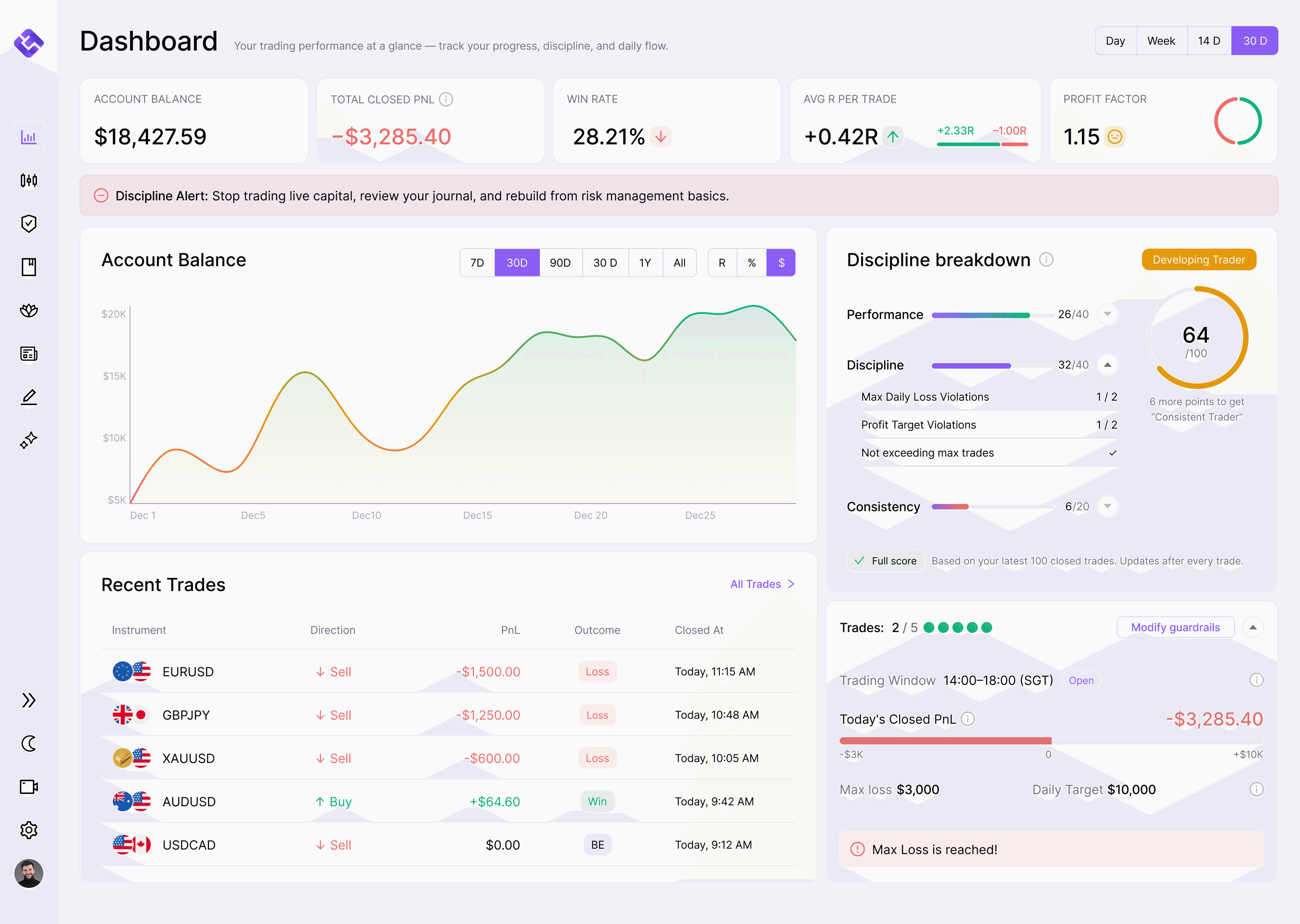
When frustration pushes you toward a third consecutive entry, EdgeFlo's guardrails surface a warning. You can still override and take the trade, but the system makes you pause and acknowledge that you are exceeding your own rules. That pause is often enough to break the cycle.
Sanctuary guides you through a reset routine between sessions. It is not a magic fix, but a structured cooldown that helps you return to the charts with a clear read instead of a lingering bias.
The Edge Brief
Receive Insights on trading psychology, discipline, and the behavioral patterns that create consistent traders from our Founder and the EdgeFlo team, delivered to your inbox.
Think different. Trade different.
Why do traders feel frustrated after a losing trade?
How do I stop frustration from leading to revenge trades?
Does journaling expectations actually reduce trading frustration?
Is it normal to feel frustrated while trading?

Turn discipline on.
Every session.
EdgeFlo is the environment serious traders operate inside.
Start 7-Day Free Trial
Cancel anytime.
No long-term commitment.

Think Different, Trade Different.