

Table Limits for Traders: Non-Negotiable Session Rules
Casinos set table limits to manage risk. Traders need session limits too. Learn how to set max losses, max trades, and session boundaries that protect your capital.
Casinos do not let players bet unlimited amounts at any table. Every game has a minimum and a maximum. Those limits exist because the casino knows something most traders ignore: even with a statistical edge, one oversized bet from one emotional player can damage the floor's daily numbers. The fix is structural. Set hard boundaries before the game starts, and enforce them regardless of what happens during play.
Trading sessions need the same structure. Table limits for traders are pre-set session rules that cap your losses, restrict your trade count, and define when you walk away. Without them, every session is an open invitation for emotional decision-making to take over.
TL;DR
Set a maximum dollar loss per session before you open your platform. Once you hit it, you are done.
Cap your trade count at a fixed number (3 to 5 for most strategies). No exceptions mid-session.
Define your session window by clock time, not by "until I find a good setup."
Three consecutive losses is a hard stop, regardless of how much room your daily cap still has.
Review every session that hits a limit. The limit did its job. Now find out what triggered it.
Why Casinos Use Table Limits (And Why It Works)
A casino with a 5.26% edge on roulette does not need to worry about any single spin. Over thousands of spins, the math plays out. But casinos still set table limits. Why?
Because the edge only works if the casino survives long enough for the math to compound. One whale betting $10 million on a single spin could wipe out a week of profits in seconds. Table limits prevent that. They cap the maximum exposure per decision so the house's edge has time to work across volume.
The same logic applies to your trading account. You might have a 55% win rate with a 2:1 reward-to-risk ratio. Over 200 trades, that edge prints money. But if you blow 8% of your account in one revenge-fueled Tuesday morning, you may never reach trade 200.
Table limits are not about limiting your upside. They are about making sure your edge survives long enough to matter.
The Three Session Limits Every Trader Needs
You need exactly three limits locked before every session. Not guidelines. Not suggestions. Hard stops that shut you down when triggered.
1. Maximum Dollar Loss Per Session
This is your daily loss cap expressed as a hard number. Pick a percentage of your account (1% to 3% is standard for intermediate traders) and convert it to dollars before you trade.
Example: You trade a $10,000 account with a 2% daily loss limit. Your session cap is $200. If your first two trades lose $100 each, you close the platform. No third trade. No "just one more to get it back."
The dollar amount matters more than the percentage in the moment. Seeing "$200" on your session plan hits differently than "2%." It is concrete.
2. Maximum Trade Count
This one catches the slow bleed. Some sessions, you do not hit your dollar cap but you take 7, 8, 9 trades chasing setups that are not there. Each trade is small, but the cumulative damage adds up, and the quality of each decision drops with every click.
Set a fixed number. For most swing and intraday strategies, 3 to 5 trades per session is the sweet spot.
Example: A GBP/USD day trader sets a 4-trade cap for the London session. Trade 1 wins. Trade 2 loses. Trade 3 loses. Trade 4 wins. Session over. Even though the P&L is flat, the trader walks away because the cap says so. No fifth trade "to end green."
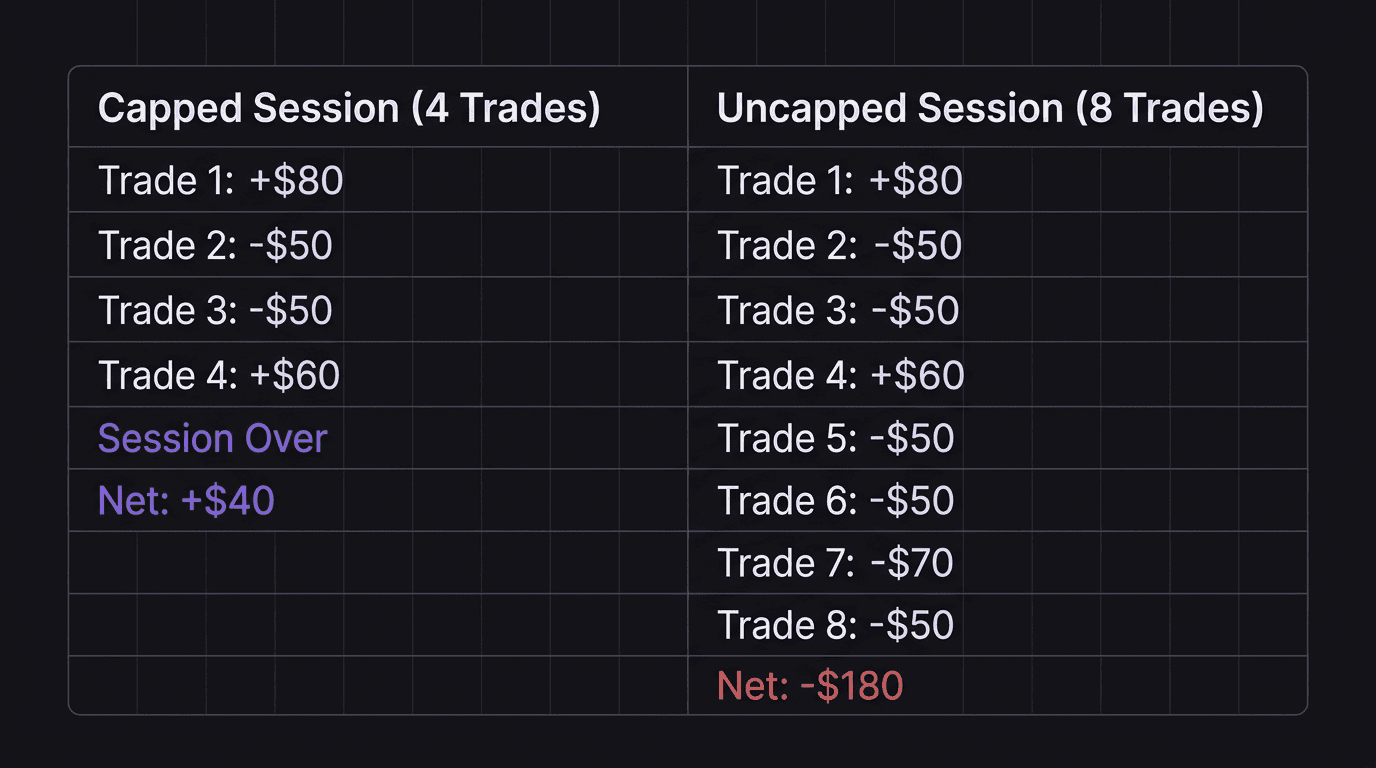
The capped trader walks away up $40. The uncapped trader chases, loses focus, and finishes down $180 on the same starting conditions. This is not a strategy problem. It is a session management problem.
3. Session Time Window
Your third limit is the clock. Define when your session starts, when it ends, and honor both boundaries.
This is especially important for forex traders who can technically trade 24 hours. "I will trade London open from 8:00 AM to 11:00 AM GMT" is a session. "I will trade until I find something" is not.
Time limits protect you from the slow fade. After 2 to 3 hours of screen time, decision quality drops. You start seeing setups that are not there. You force trades because you have been watching for so long that doing nothing feels like a waste.
What Happens When You Trade Without Limits
Ever had one of those days? You wake up, take a clean loss on your first trade. Fine. Second trade, another loss. Now you are down 1.5% and feeling the pressure. You start widening your stop. You take a third setup you would normally skip. It loses too.
Sound familiar?
By trade five, you are not following your plan anymore. You are trying to get back to breakeven. By trade seven, you have blown through 4% of your account and you should have stopped hours ago.
This is exactly how casinos profit from gamblers. The gambler has no session limits. No walk-away number. No trade cap. Every decision is reactive, driven by the last outcome instead of a pre-set plan.
Walkthrough: The Uncapped EUR/USD Session
A trader starts the New York session with a $25,000 account. No session limits set. Risk per trade: 0.5%, which is $125 per trade.
Trade 1: EUR/USD short at 1.0850, stop at 1.0865 (15 pips), target at 1.0810 (40 pips). 0.83 lots. Hits stop. Loss: $125.
Trade 2: Re-enters short at 1.0860, same setup. Stop at 1.0878 (18 pips). Target 1.0820 (40 pips). 0.69 lots. Hits stop. Loss: $125.
Trade 3: Frustrated. Goes long at 1.0880 on a "reversal." Stop at 1.0860 (20 pips), target at 1.0930 (50 pips). 0.63 lots. This was not in the plan. Hits stop. Loss: $125.
Trade 4: Doubles risk to 1% ($250). Goes short again at 1.0900. Stop at 1.0925 (25 pips). 1.0 lot. Hits stop. Loss: $250.
Trade 5: Now down $625 (2.5%). Takes one more trade, full tilt. Loss: $250.
Session total: 5 trades, $875 loss, 3.5% drawdown.
If this trader had a 3-trade cap, the session ends after trade 3 at $375 lost (1.5%). Still a bad day, but recoverable. The final two trades, which added $500 in losses, never happen.
If this trader had a $250 daily loss cap (1%), the session ends after trade 2 at $250. The four subsequent losses, the risk doubling, the tilt trades: none of it happens.
How to Build Your Session Limit Card
Write this down on a physical card or a sticky note on your monitor. Not in a document you will never open. Somewhere you will see it every single time you sit down.
Your session limit card has three lines:
Max loss: $ amount (derived from your account size and daily loss percentage)
Max trades: a fixed number (3, 4, or 5 depending on your strategy frequency)
Session window: start time and end time (clock-based, not outcome-based)
When any of these three limits is hit, the session is over. No negotiating. No "but this setup looks perfect." Done.
The Override Problem
Here is where most traders fail. They set limits, then override them. "I will just take one more." "I am only $30 from my cap, that does not really count." "The session window ended but this setup is right there."
Every override teaches your brain that the limits are optional. After three overrides, the limits stop existing. You are back to trading without structure.
This is why casinos do not let dealers negotiate table limits with players. The limit is the limit. If you want to bet bigger, go to a different table. If you want to trade more, wait for tomorrow.
Your trading rules only work if they are non-negotiable. The moment you start bending them based on how you feel, they stop being rules and become suggestions.
The Quarterly Adjustment (Not the Daily One)
One of the biggest mistakes traders make with session limits is changing them after a bad day. You lose 3% on Monday, so Tuesday you tighten your cap to 0.5%. Then you have a winning week and loosen it back to 3%.
This is the equivalent of a casino changing the table limits every time a player wins a hand. It destroys the statistical foundation your edge is built on.
Set your session limits once per quarter. Run a full quarter (roughly 60 to 80 trading sessions) with the same limits. Review your performance data. Then adjust if the data supports it.
The only mid-quarter change allowed: tightening limits during a drawdown. If your account drops 10% from its peak, reduce your session limits proportionally until you recover. This is defensive, not reactive.
How EdgeFlo Builds Session Limits Into Your Environment
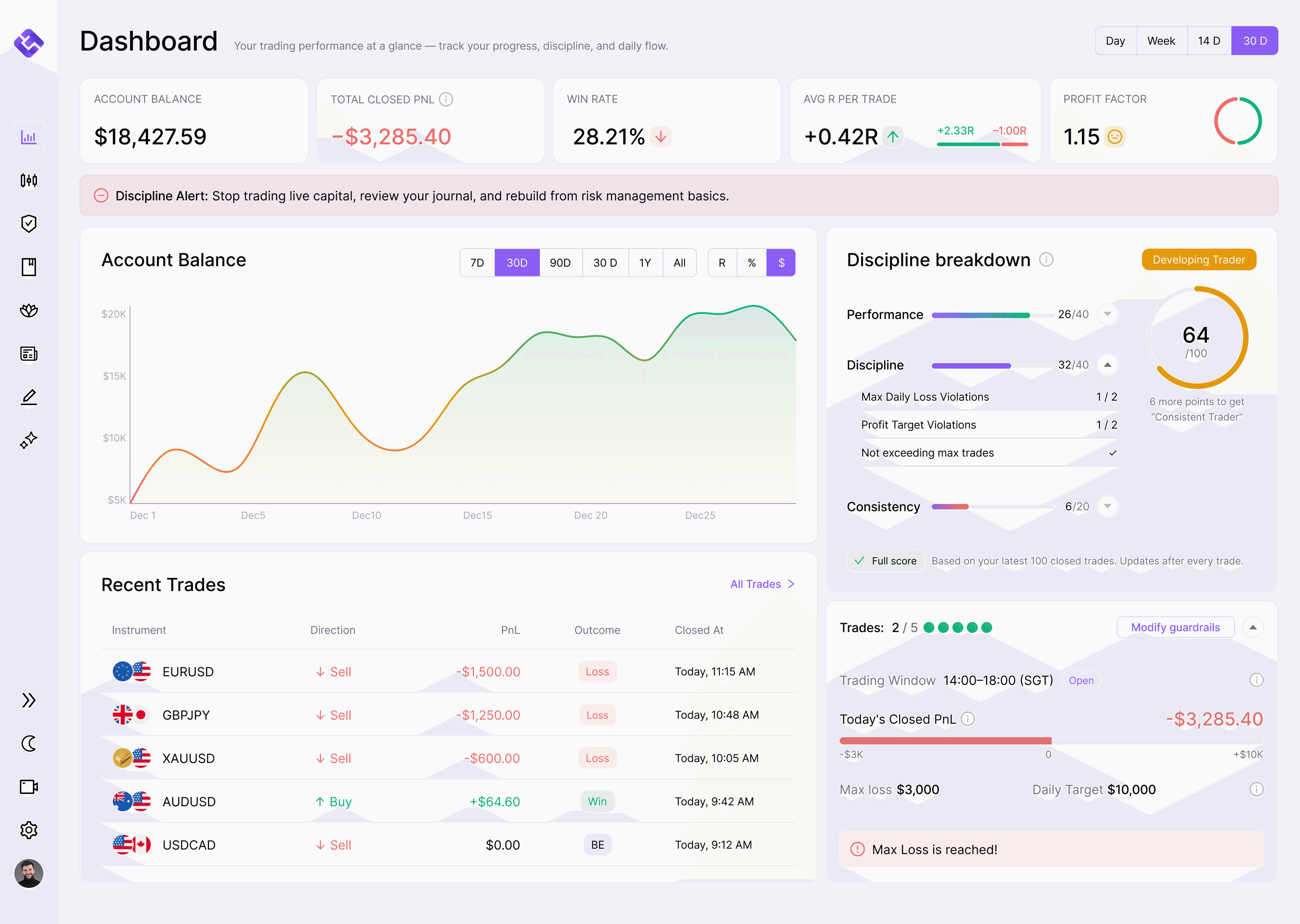
EdgeFlo lets you set guardrails that restrict trading when you hit pre-defined limits. Set a daily loss cap, a max trade count, or a session boundary, and the platform warns you when you are approaching the limit. If you hit it, EdgeFlo blocks the trade button. You can override it, but you have to make a conscious choice to do so.
That friction matters. The difference between blowing through your limit automatically and having to deliberately press "override" is the difference between unconscious self-sabotage and a conscious decision. Most traders, when forced to actively choose to break their rule, do not.
The News Block Guardrail (Plus plan) adds another layer by restricting trading during high-impact news events, which is when session limits are most likely to get tested. Combined with your own session limit card, it builds an environment where staying disciplined is the path of least resistance.
The Edge Brief
Receive Insights on trading psychology, discipline, and the behavioral patterns that create consistent traders from our Founder and the EdgeFlo team, delivered to your inbox.
Think different. Trade different.
What are table limits in trading?
How many trades should I take per session?
Should I stop trading after 3 losses in a row?
How do I set a daily loss limit for trading?

Turn discipline on.
Every session.
EdgeFlo is the environment serious traders operate inside.
Start 7-Day Free Trial
Cancel anytime.
No long-term commitment.

Think Different, Trade Different.