

How a Small Edge Compounds Into Serious Returns
A 5% statistical edge looks tiny on one trade. Over 1,000 trades it builds real wealth. Learn the math behind small-edge compounding and why patience pays.

A 5% statistical edge sounds almost embarrassing. On a single trade, it barely registers. But run that same edge across 1,000 trades and the math stops being polite. Small edges, repeated with discipline, are how every consistently profitable trader (and every casino on the planet) builds real wealth over time.
Most traders chase a massive win rate or a strategy that "never loses." That search keeps them broke. The real money lives in the boring middle: a slight, proven advantage applied over and over again until compound returns do the heavy lifting.
TL;DR
A 5% edge means winning roughly 52.5% of even-money bets, which produces $54,000 profit on every $1 million in volume.
Small edges only show up over large sample sizes, typically 100 or more trades.
Compounding works because each small gain increases the base for the next trade.
Patience is the actual skill. The math is simple. Sitting still long enough to let it work is the hard part.
Tracking your expectancy trade by trade is how you confirm your edge is real.
What a 5% Edge Actually Looks Like
Picture a roulette table. The wheel has 18 red slots, 18 black, and 2 green. If you bet on black, your odds are 18 out of 38, which is 47.3%. The house sits at 52.7%. That gap is 5.4%.
Five cents on every dollar bet. Sounds like nothing.
Now scale it up. Over 1,000 bets at $1,000 each, that 5.4% edge produces roughly $54,000 in net profit for the house. Not from any single lucky spin. From the sheer volume of repetitions grinding that small advantage into real money.
Trading works the same way. You do not need a strategy that wins 80% of the time. You need one with a modest, verified edge that you execute without deviation across enough trades for the math to take over.
The Law of Large Numbers: Why Sample Size Matters
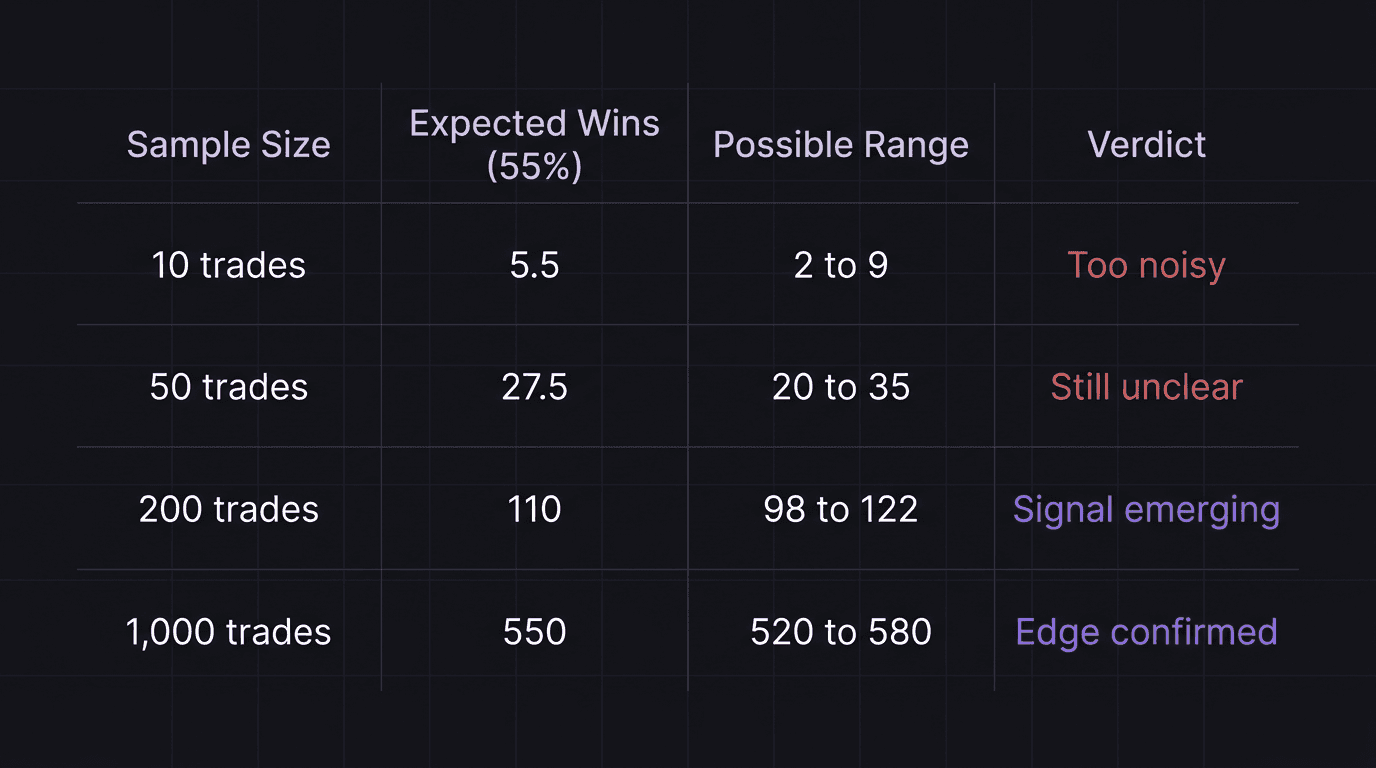
Here is why traders get confused. On 10 trades, a 55% win rate strategy can easily produce 3 wins and 7 losses. Or 8 wins and 2 losses. The sample is too small for the true odds to emerge.
This is exactly what happens when you test a strategy for two weeks, see four losses in a row, and decide "it does not work." You just killed a potentially profitable system because you expected statistical certainty from a handful of data points.
The law of large numbers says that as your sample grows, your actual results converge toward your true probability. At 50 trades, variance is still loud. At 200, the signal gets clearer. At 500 or more, your equity curve starts to tell the truth about your strategy.
Casinos understand this instinctively. They do not panic when a player goes on a hot streak. They know the math catches up. Every winning player is temporary. The house edge is permanent.
The Compounding Math Behind a Small Edge
Compounding is not just for savings accounts. It works in trading too, and the mechanism is straightforward: each winning trade increases your account balance, which means your next position (if sized as a percentage of equity) is slightly larger.
Here is a simplified example. You start with a $10,000 account and risk 1% per trade. Your strategy has a 55% win rate and a 2:1 reward to risk ratio.
Walkthrough: 20 Trades With a Small Edge
Your risk per trade is 1% of your current balance. Winners pay 2R (twice what you risked). Losers cost 1R.
Over 20 trades, you hit 11 wins and 9 losses (55% win rate).
Starting balance: $10,000.
Trade sequence (simplified):
Trade 1: Win. Risk $100 (1% of $10,000). Gain $200 (2R). Balance: $10,200.
Trade 2: Win. Risk $102. Gain $204. Balance: $10,404.
Trade 3: Loss. Risk $104.04. Balance: $10,299.96.
Trade 4: Loss. Risk $103.00. Balance: $10,196.96.
Trade 5: Win. Risk $101.97. Gain $203.94. Balance: $10,400.90.
After 20 trades at this pace, with 11 wins and 9 losses, the account grows to approximately $11,260.
That is a 12.6% return in 20 trades. Not from a home run. From 11 modest wins and 9 controlled losses on a strategy with a small, consistent edge.
Now imagine 200 trades. Then 500. The base keeps growing, and each win hits a slightly larger position. That is compounding at work.
Walkthrough: What Happens Without Compounding
Same strategy, same 55% win rate, same 2:1 ratio, but this time the trader risks a flat $100 every trade regardless of account size.
Over 20 trades: 11 wins at $200 each = $2,200 gained. 9 losses at $100 each = $900 lost. Net profit: $1,300.
With compounding (percentage-based sizing), the trader made approximately $1,260. Without compounding (flat sizing from $10,000 base), $1,300. The difference is small at 20 trades. But the gap explodes over hundreds of trades because the compounding trader's position size keeps growing while the flat trader's stays stuck.
This is why tracking your performance over time matters. Your equity curve shows you whether your edge is compounding or stagnating.
Why Patience Is the Real Skill
The math is not complicated. Multiply it out, and any edge above zero eventually produces positive returns over a large enough sample. The problem is never the arithmetic.
The problem is sitting through trade number 47, down 3% on the month, watching your account dip while you "know" your strategy works. The problem is trade 12 in a row being a loser when your win rate says you should be winning more than half.
Sound familiar?
This is where most traders break. They stop following their rules. They double their position size to "make back" what they lost. They switch strategies entirely. And in doing so, they reset the compounding clock back to zero.
Casinos do not do this. When a roulette table pays out big to a lucky player on Tuesday night, the casino does not panic and change the rules on Wednesday. The edge is the edge. The only thing required is time and volume.
Your job as a trader is the same. Backtest your strategy, confirm the edge exists, then execute it long enough to let the law of large numbers do its work.
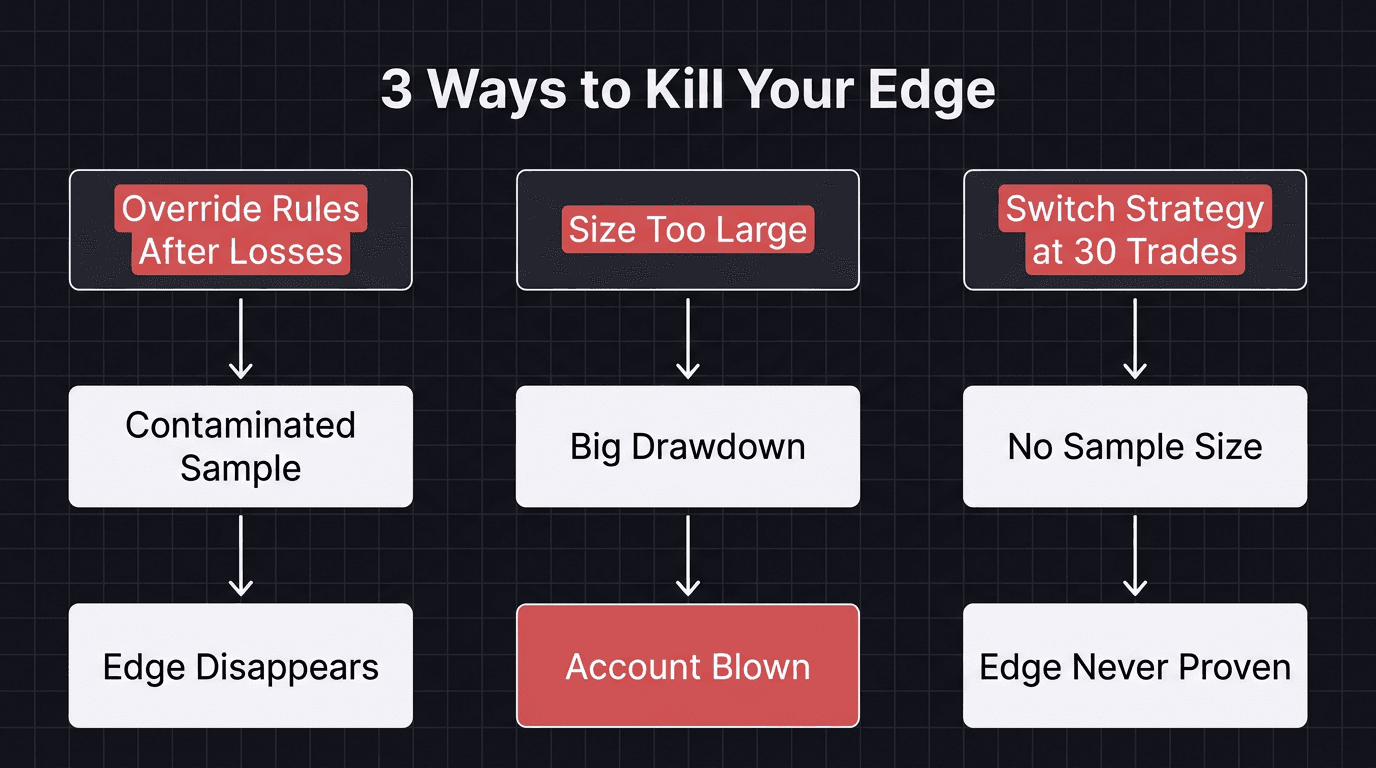
Three Things That Kill a Small Edge Before It Compounds
Even a verified edge can be destroyed if you do not protect it.
1. Overriding your rules after losses. Every time you skip a valid setup because "it feels wrong" or take an off-plan trade because "this one is different," you contaminate your sample. Your real win rate diverges from your tested win rate, and the compounding effect weakens or disappears.
2. Sizing too large. A small edge compounds beautifully at 1% risk per trade. At 5% risk, a normal losing streak (which will happen) can blow through 25% of your account before the edge has time to recover. The math works. But only if you survive the drawdowns along the way.
3. Switching strategies too early. If you abandon a system after 30 trades, you never reach the sample size where the edge becomes statistically visible. You might have thrown away a profitable strategy because you mistook short-term noise for a broken system.
How EdgeFlo Helps You Stay in the Game Long Enough
The hardest part of small edge compounding is not the math. It is the discipline to keep executing the same plan, trade after trade, month after month, while short-term results bounce around.
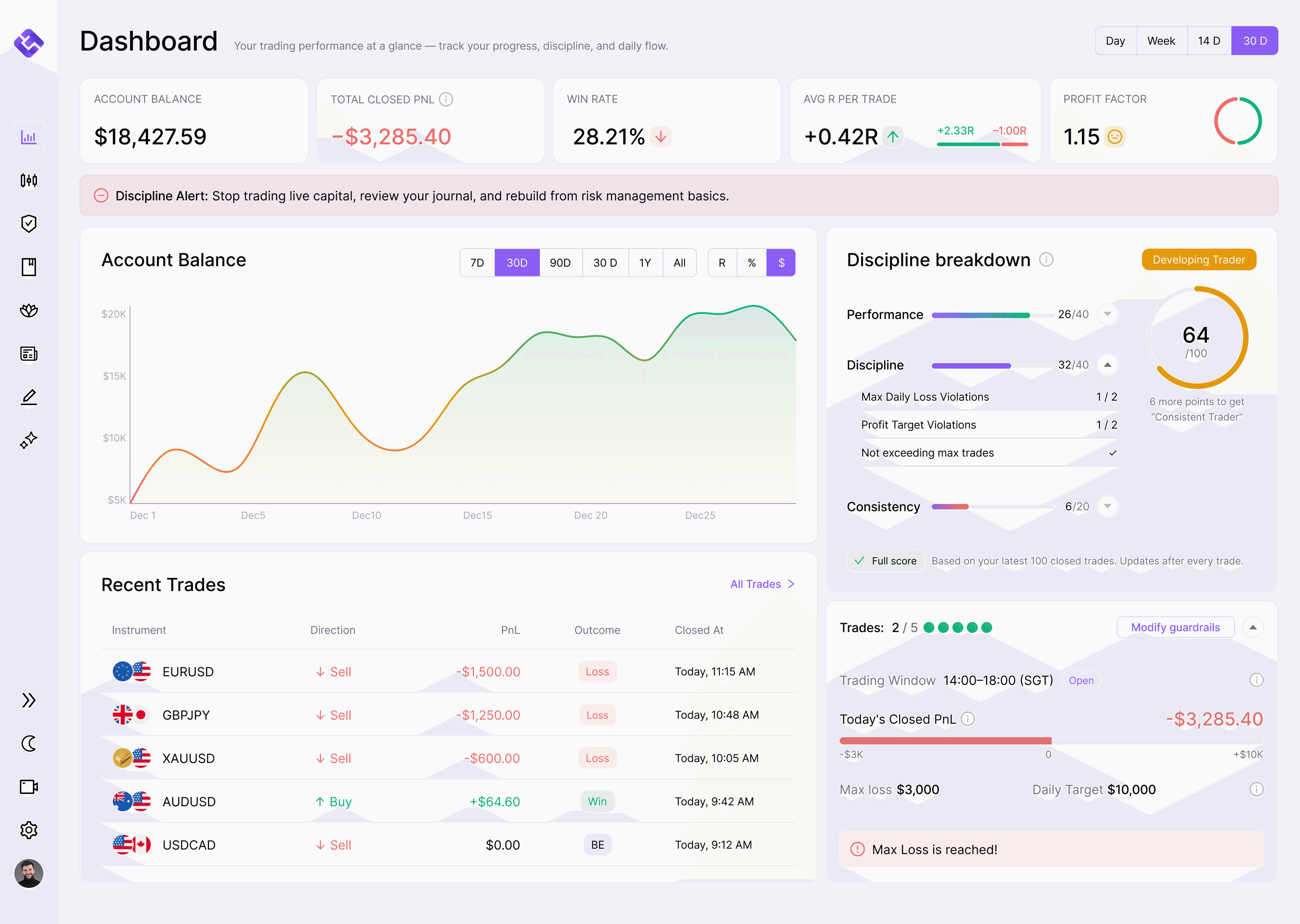
EdgeFlo's dashboard tracks your profit factor and EdgeScore across every trade, so you can see whether your edge is holding up over your actual sample. Instead of guessing if your strategy "still works" after a rough week, you look at the data. The numbers either confirm your edge or tell you something needs attention, with no emotional interpretation required.
The Edge plan builder lets you document your strategy once and keep it visible during every session. When the temptation hits to change your rules after a losing streak, your plan is right there reminding you what you already tested and verified. That structure is the difference between a trader who compounds and one who keeps restarting.
The Edge Brief
Receive Insights on trading psychology, discipline, and the behavioral patterns that create consistent traders from our Founder and the EdgeFlo team, delivered to your inbox.
Think different. Trade different.
How big does a trading edge need to be?
How many trades does it take for a small edge to show results?
Can you compound returns with a low win rate?
Why do most traders give up before their edge compounds?

Turn discipline on.
Every session.
EdgeFlo is the environment serious traders operate inside.
Start 7-Day Free Trial
Cancel anytime.
No long-term commitment.

Think Different, Trade Different.