

The Awareness Exercise: Record Your Thoughts Before Every Trade
Write down your thoughts, emotions, and physical cues before every trade. This simple awareness exercise builds the foresight to stop emotional decisions before they start.
You already know what a bad trade feels like after you take it. The sinking gut, the instant regret, the scrolling back to confirm you ignored your own rules. But here is the part most traders miss: all the warning signs were there before you clicked the button. You just were not paying attention.
The awareness exercise fixes that blind spot. Before every trade, you write down three things: what you are thinking, what you are feeling, and what your body is doing. That is it. Three categories, a few sentences each, captured before you enter. Over time, this simple habit builds the foresight to recognize emotional triggers and stop bad decisions before they cost you money.
TL;DR
Write down your thoughts, emotions, and physical cues before every trade entry.
This builds foresight (catching problems before they happen) instead of relying on hindsight (regretting them after).
Physical tells like clenched fists, rapid breathing, or restless fidgeting signal emotional states your conscious mind has not registered yet.
Review your entries weekly to spot the recurring patterns that precede your worst trades.
The goal is awareness, not elimination. You cannot remove emotions, but you can see them coming.
Why Hindsight Is Not Enough
Most traders only analyze their emotions after the damage is done. You blow up a trade, then you journal about what went wrong. That is valuable (and a solid post-trade review process catches real leaks), but it has a fundamental limitation: it only works in reverse.
Hindsight tells you what happened. Foresight prevents it from happening again.
Think about the difference. After a revenge trade, you can write "I was angry and deviated from my plan." True, useful, worth documenting. But by the time you are writing that sentence, the money is already gone. The position was already closed at a loss. The damage is done.
Foresight means catching yourself before you press the button. It means noticing that your jaw is tight, your thoughts are racing about making back the last loss, and your breathing is shallow. Those signals were present before the revenge trade. You just did not have a system for noticing them.
That is what this exercise creates: a system for noticing.
The Three Categories: Thoughts, Emotions, Actions
The awareness exercise splits your pre-trade state into three buckets. You write a few sentences in each one before you enter any position.
Thoughts
What is your mind saying right now? Not your analysis. Your internal monologue.
Examples of honest thought entries:
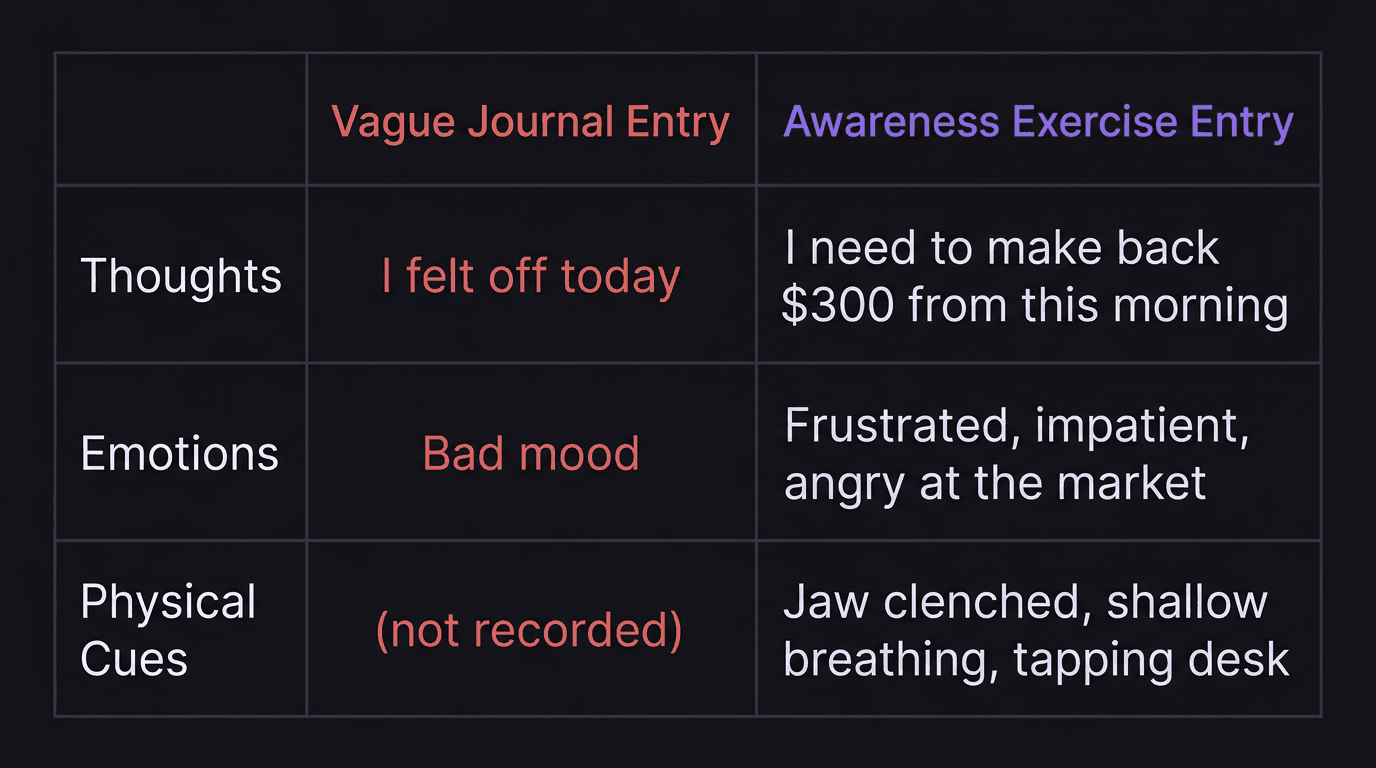
"I need to make back the $300 I lost this morning."
"This setup looks perfect. I am certain it will work."
"I am bored. Nothing has moved in two hours and I just want to trade something."
"Price is at my level. My checklist is complete. I feel neutral about the outcome."
Notice the range. Some of those thoughts are dangerous red flags. One of them is exactly where you want to be. The point is not to judge what you write. The point is to write it honestly so you can see it.
Emotions
Name the feeling. Not "good" or "bad." Be specific.
Frustration, anger, excitement, boredom, anxiety, calm, impatience, confidence, fear. These are all different emotional states, and they lead to different trading behaviors. Understanding which emotions surface during trading is the first step toward managing them.
A trader who writes "I feel impatient" before entering a trade has just given themselves a chance to pause. A trader who does not write anything enters on autopilot and wonders later why they forced a setup that was not there.
Physical Cues
This one surprises people, but it is the most reliable signal of the three.
Your body reacts to emotional states faster than your conscious mind registers them. Before you realize you are angry, your fists are already clenched. Before you realize you are anxious, your breathing has already shifted. Before you realize you are bored and fishing for action, you are already fidgeting.
Common physical tells traders report:
Clenching jaw or fists (frustration, anger)
Shallow, fast breathing (anxiety, fear)
Restless leg or tapping fingers (impatience, boredom)
Leaning forward toward the screen (urgency, FOMO)
Compulsively adjusting hair or clothing (perfectionism, indecision)
Relaxed posture, steady breathing (calm, focused)
Write down whatever your body is doing. After a few weeks, you will start recognizing your personal tells before they lead to bad entries.
How to Do the Exercise (Step by Step)
You do not need a special app or a complicated template. A blank notebook works. A notes app on your phone works. A voice memo works.
Step 1: Pause Before Entry
Your pre-trade checklist already tells you to verify the setup. Add one more step at the end: record your state. Do this after your analysis is complete and your setup criteria are met, but before you click buy or sell.
Step 2: Write Three Sections
Write one to three sentences under each heading:
Thoughts: What is my internal monologue saying right now?
Emotions: What specific emotion am I experiencing?
Physical: What is my body doing?
The whole thing takes two to three minutes. If you are in a rush and cannot spare two minutes, that urgency is itself a data point worth recording.
Step 3: Read It Back
Before you enter, read what you just wrote. Out loud if possible. This forces a pause between the emotional impulse and the action. Sometimes reading your own words back to yourself is enough to stop a bad trade.
If you wrote "I am angry and I need to make back the $300 I lost," and you read that sentence out loud, you are far less likely to press the button. The act of seeing your own state in writing creates a gap between impulse and action.
Step 4: Decide
Now enter the trade or walk away. If your notes reveal a calm, plan-aligned state, proceed. If they reveal frustration, urgency, or anger, step away from the screen.
Walkthrough: What This Looks Like in Practice
Setup: EUR/USD at London open. Price has pulled back to a demand zone at 1.0850 that lines up with your plan. Your checklist criteria are met.
Awareness entry: - Thoughts: "Clean setup. This is exactly what I was waiting for since pre-market. No attachment to the outcome." - Emotions: "Calm, slightly excited but controlled." - Physical: "Posture is relaxed. Breathing is normal. Hands are steady."
Decision: Enter. This is a plan-aligned trade with a neutral emotional state.
Setup: GBP/USD fifteen minutes later. You see momentum building and price approaching a level. It is not on your pre-market plan, but it looks like it could run.
Awareness entry: - Thoughts: "This could be a big move. I do not want to miss it. Everyone on Twitter is posting about this pair." - Emotions: "Urgency, fear of missing out." - Physical: "Leaning forward, heart rate up, hand hovering over the mouse."
Decision: Walk away. This is FOMO dressed up as opportunity. The level was not in your plan, the entry is reactive, and your body is telling you exactly how emotional this decision is.
The second example is the real power of the exercise. Without writing it down, that trader clicks buy. With the exercise, they catch themselves.
The Video Review Add-On
If you want to take the exercise further, record yourself on your phone camera during trading sessions. Point the front camera at your face and let it run.
You will not watch most of the footage. But when you have a bad trading day, rewind the tape and watch yourself in the five minutes before each entry. You will see your facial expressions shift, your posture change, and your body language telegraph the emotional state you were in.
This is not about being hard on yourself. It is about collecting data you cannot see in real time. Professional athletes review game tape to spot patterns they missed during play. Trading is no different.
The physical tells you discover through video review become the early-warning signals in your awareness journal. Once you know that you always start fidgeting before a revenge trade, you can add "fidgeting" to your physical cues checklist and catch the pattern in real time.
Weekly Review: Where the Patterns Emerge
Writing pre-trade entries is step one. Reviewing them weekly is where the real value lives.
Set aside 20 minutes at the end of each week. Read through every awareness entry from the past five trading days. Look for patterns. You are searching for the recurring combination of thoughts, emotions, and physical cues that preceded your worst trades.
Common patterns traders discover:
"Every time I write 'I need to make back' in my thoughts, the next trade is a loser."
"When I note shallow breathing, I am about to force a trade that is not on my plan."
"My best trades always have the word 'calm' or 'neutral' in the emotions section."
These patterns are invisible without the written record. You cannot spot them from memory because your memory is selective. It filters, distorts, and edits. The journal does not.
Over two to three weeks of consistent entries, you will build a personal catalog of your emotional triggers. Use your journal template to keep this organized. After a month, you will know your own warning signs so well that you can feel them coming before you even sit down to write.
Common Mistakes With This Exercise
Mistake 1: Skipping entries on "obvious" setups.
You feel confident, the setup is clean, so you skip the awareness entry and just trade. This is exactly when overconfidence creeps in. Record your state especially when you feel certain. Certainty is an emotion too, and it has its own failure patterns.
Mistake 2: Writing what you think you should feel instead of what you actually feel.
"Calm and focused" is not always the truth. If you are writing that every single session, you are performing for an audience of one. Be honest. The journal is private. Write the ugly truth so it can actually help you.
Mistake 3: Reviewing entries but not changing behavior.
Awareness without action is just observation. When you spot a pattern (for example, "I always force trades when I am bored"), create a rule: "If I write 'bored' in my emotions section, I close the charts for 30 minutes." Turn insights into operational rules.
How EdgeFlo Supports Pre-Trade Awareness
EdgeFlo's AI-powered trading journal includes voice-to-text capture, so you can speak your thoughts, emotions, and physical cues out loud and have them recorded as text automatically. No writing by hand, no typing during a fast-moving session. Just talk, and your pre-trade state is captured.
The emotion tagging feature lets you label each journal entry with specific emotional states. Over time, these tags build a searchable pattern library. You can filter your journal to show every entry tagged "frustrated" and see exactly which trades followed that emotional state. That turns weeks of manual review into a quick filter.
When you combine voice-to-text capture with emotion tagging and weekly AI reports (available on the Plus plan), you get a feedback loop that surfaces your blind spots before they cost you money.
The Edge Brief
Receive Insights on trading psychology, discipline, and the behavioral patterns that create consistent traders from our Founder and the EdgeFlo team, delivered to your inbox.
Think different. Trade different.
What is a pre-trade awareness exercise?
How long does the awareness exercise take?
Should I record awareness notes in my regular trading journal?
When will I start seeing results from pre-trade journaling?

Turn discipline on.
Every session.
EdgeFlo is the environment serious traders operate inside.
Start 7-Day Free Trial
Cancel anytime.
No long-term commitment.

Think Different, Trade Different.