

Prop Firm Patience: Stop Rushing the Challenge
Rushing a prop firm challenge is the fastest way to fail it. Patience is not waiting. It is detaching from the timeline and focusing on execution.
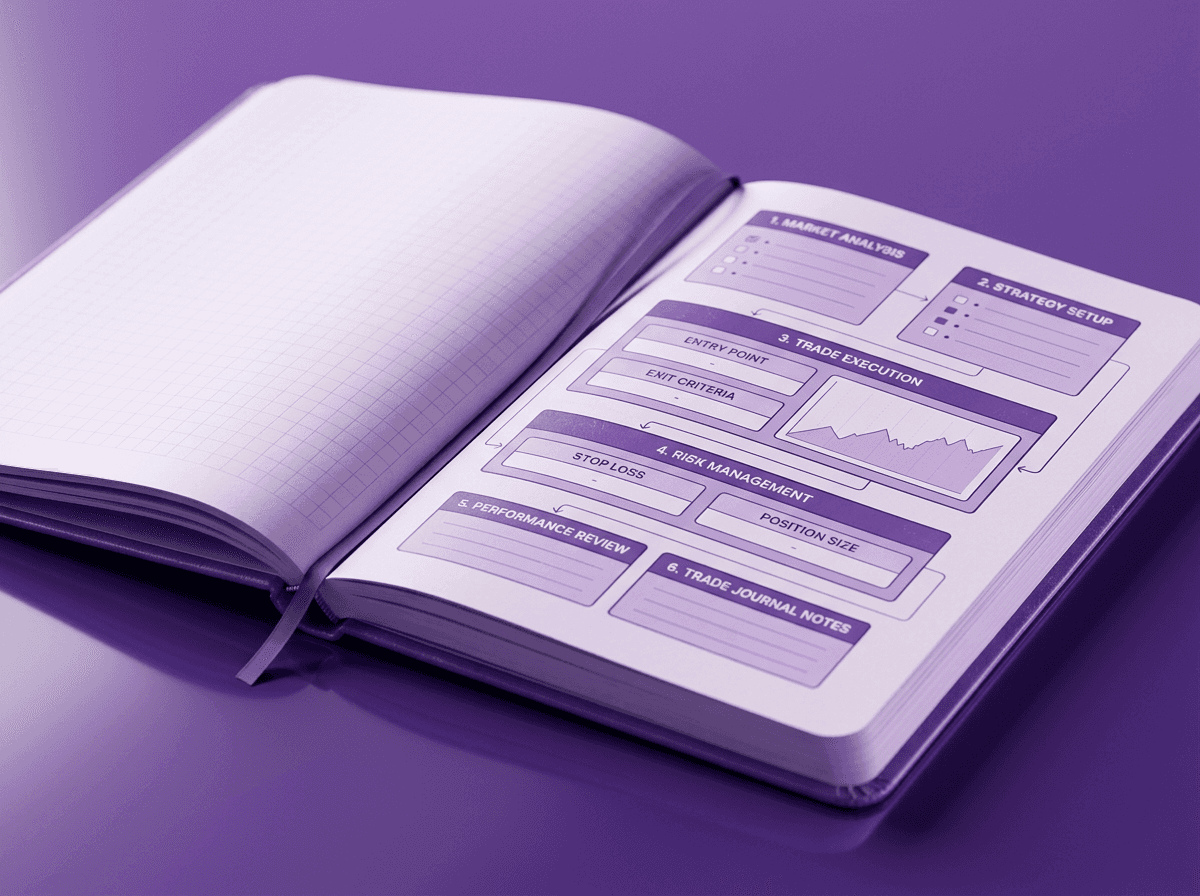
Prop firm patience means detaching from the timeline and focusing entirely on execution quality. The fastest way to fail a funded challenge is to rush it. When you fixate on passing in two weeks or three weeks, you start taking trades that do not match your plan. You increase lot sizes. You chase setups you would normally skip. Patience in a prop firm challenge is not sitting around doing nothing. It is waiting for your A+ setup, trusting your analysis while the trade runs, and journaling your losses instead of revenge trading after them. The traders who pass are not faster. They are calmer.
TL;DR
Rushing a prop firm challenge causes more failures than bad strategy does.
Patience means detaching from the outcome, not just waiting longer.
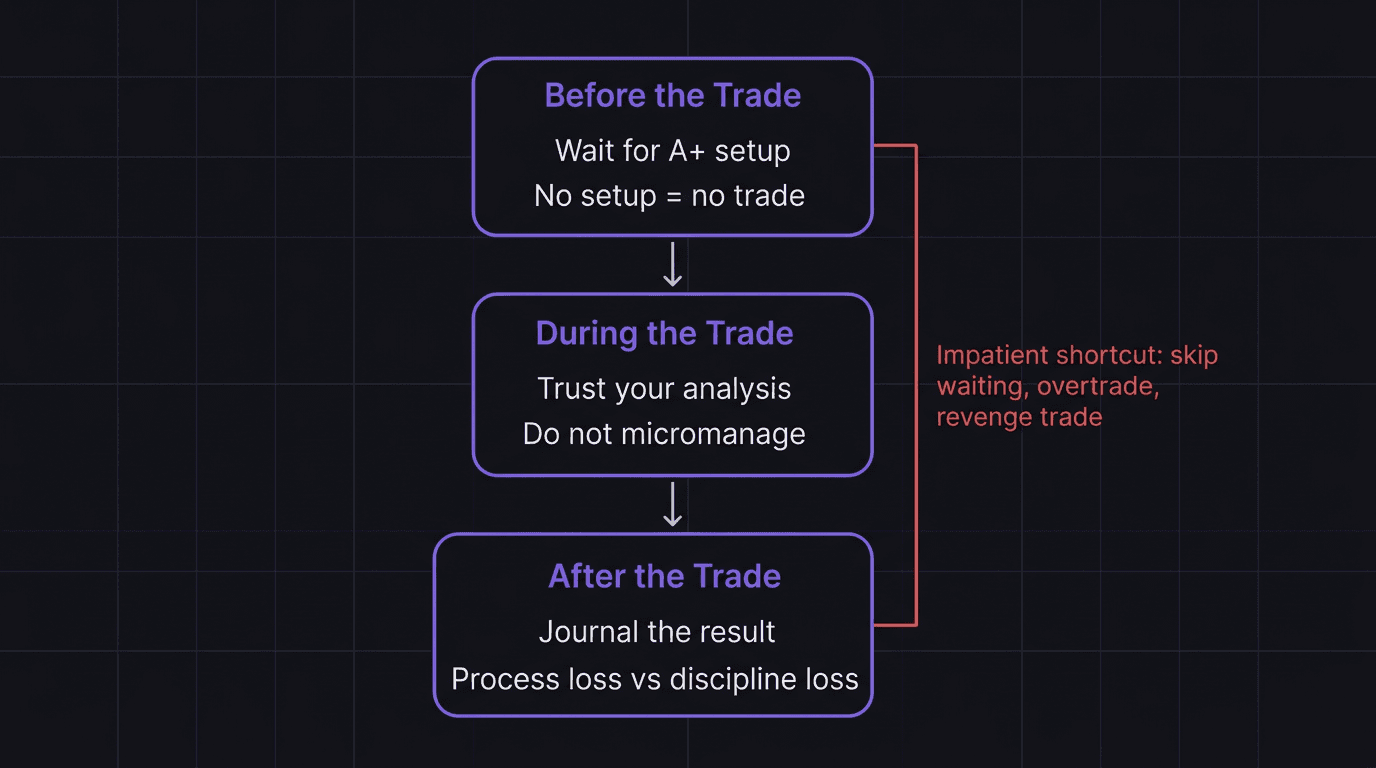
Before the trade: wait for your setup. During: trust your analysis. After: journal, do not chase.
Setting an aggressive timeline makes you break your own rules under pressure.
The bigger the goal, the longer the timeline needs to be. That actually makes it easier.
Why Impatience Kills More Challenges Than Bad Trades
Most traders who fail a prop firm challenge do not fail because their strategy is broken. They fail because they could not sit still long enough to let it work.
Here is what the pattern looks like. You buy the challenge. You see the 5% or 10% profit target. You think, "I flipped a small account before, how hard can this be?" Then you take your first trade, risk 2%, and lose. You take another. Lose again. Now you are down 4%, your confidence is shattered, and you start grabbing at low-quality setups just to claw back to breakeven.
Sound familiar?
The challenge did not beat you. Your reaction to being behind did. Two losses at 2% risk each is normal variance. But when you are mentally attached to passing quickly, those two losses feel like proof that you are failing. So you abandon your plan and start gambling.
This is why FTMO rules exist the way they do. The drawdown limits are not there to punish you. They are there to see if you can stay disciplined when things go sideways. And the traders who rush are the ones who hit those limits first.
The real problem is not the losing trades. It is the identity crisis that follows them. When your self-image depends on passing fast, every loss feels personal. You stop executing your edge and start chasing dopamine, the spike of a recovery trade, the relief of getting back to breakeven. That is not trading. That is emotional gambling.
What Patience Actually Means in Trading
Patience is not passive. It is not staring at your screen for eight hours waiting for something to happen. Real trading patience is a decision you make at every stage of the trading process.
Think of it like this. When you are hungry, you can eat whatever is in front of you, or you can wait for something worth eating. The first option is faster. The second one is better. Trading works the same way.
Patience is detachment from the outcome. You stop caring whether you win or lose this specific trade. You stop caring whether you pass this week or next month. All you care about is executing your plan correctly. When you reach that point, you do not overtrade. You do not revenge trade. You do not force setups that are not there.
Professional funded traders are boring. That is the whole point. They wait for the setup that checks every box in their plan. If no setup appears, they do nothing. They do not feel the need to "make something happen" because their identity is not tied to daily results.
This is the opposite of what most traders do. Most traders treat a funded challenge like a sprint. The top 1% treat it like a long hike where the only thing that matters is not twisting your ankle.
Before, During, and After the Trade
Patience shows up in three distinct moments. Getting it right in all three is what separates a calm challenge attempt from a blown one.
Before the Trade
You are patient enough to wait for a setup that matches your plan. Not a "kind of looks like my setup" trade. Not a "well, it is close enough" trade. The actual setup with every criterion met.
If nothing lines up today, you do not trade today. That is a win, not a wasted day. The traders who overtrade during challenges are the ones who feel like every day without a trade is a day wasted. It is not. A day with no trade and no drawdown is better than a day with three mediocre trades and a 3% hole.
During the Trade
You trust your analysis. You let the trade run. You do not move your stop loss closer because you are nervous. You do not close early because you saw one red candle. You do not sit there refreshing your P&L every 30 seconds.
This is where most traders lose the plot. They did the hard work of waiting for the right setup, they entered correctly, and then they sabotage it by micromanaging. If your analysis was good enough to enter, it is good enough to let play out.
After the Trade
Win or lose, you journal it. You write down what you saw, what you did, and what the result was. If you lost, you review whether the loss was a process loss (you followed your plan and the market did not cooperate) or a discipline loss (you broke a rule).
This is where patience gets uncomfortable. After a loss, your brain wants action. It wants a recovery trade. It wants to feel the dopamine of winning back what you lost. Patience means sitting with the discomfort instead of acting on it.
Walkthrough: Rushing vs Patient Challenge Attempts
The Rusher: $50K Challenge, Failed in 9 Days
A trader buys a $50,000 FTMO challenge. The profit target is 5%, which means $2,500. He thinks, "I have flipped small accounts before. This is easy."
Day 1: He takes a GBP/USD trade during London open, risks 2% ($1,000). The trade goes against him. He loses $1,000.
Day 2: He takes two trades to "make it back." Both are B-grade setups that he would normally skip. He loses one and wins one. Net result: down another $200. Account is now at $48,800.
Day 4: Frustration sets in. He starts trading New York session too, even though his edge only works during London. He takes four trades. Wins one, loses three. He is now down $2,400 total, sitting at $47,600.
Day 7: He is 4.8% down. One more bad trade and he hits the maximum drawdown limit. He knows this, but he takes the trade anyway because he "needs to recover." The trade loses. Challenge over.
What killed him? Not his strategy. His strategy was fine during London session. What killed him was the pressure to recover quickly, which led to FOMO trading outside his edge.
The Patient Trader: $50K Challenge, Passed in 38 Days
Same challenge, different trader. She has the same setup but risks 1% per trade instead of 2%.
Week 1: She takes two trades. Both match her plan. She wins one and loses one. Account is at $50,250. Not exciting. She journals both trades and reviews them.
Week 2: Three A+ setups appear. She takes all three. Two winners, one loser. Account climbs to $51,250. She does not increase lot size because "things are going well."
Week 3: Slow week. Only one setup appears. She takes it and wins. Account at $52,000. She spends the other four days reviewing her journal and doing nothing.
Week 5: After a couple more patient weeks, she crosses $52,500. Challenge passed.
The difference was not skill. Both traders had workable strategies. The difference was that Trader B did not care how long it took. She had no internal deadline screaming at her to speed up. Each day without a trade was not a failure. It was discipline.
How to Develop Real Patience
Patience is not a personality trait you are born with. It is a skill you build through repetition and structure.
Extend Your Timeline on Purpose
If you are thinking "I want to pass this challenge in 14 days," change it to "I will pass this challenge whenever my edge delivers the profit target." Remove the date entirely.
The bigger the goal, the bigger the timeline must be. That is not a limitation. It is a relief. When you give yourself six months instead of two weeks, every individual day carries less weight. A losing day does not feel like a catastrophe. It feels like one data point in a long sample.
Track Process, Not P&L
During the challenge, measure these daily:
Did I follow my pre-market routine?
Did I only take trades that matched my plan?
Did I journal every trade, win or lose?
Did I avoid revenge trading after a loss?
If you answered yes to all four, that was a successful day regardless of whether you made or lost money. This is what process focus looks like in practice.
Journal Your Skipped Trades
This one is counterintuitive. Write down the trades you did not take. When you see a setup that tempted you but did not meet your criteria, log it. Note what you saw, why it did not qualify, and what happened after.
Over time, this builds proof that sitting out is valuable. You will see entries like "Almost took GBP/USD at 1.2650, did not meet my confirmation criteria, price dropped 80 pips after." That kind of evidence rewires how you feel about doing nothing.
Accept That Boring Is Profitable
The top 1% of funded traders do not care about getting funded in 30 days. They focus on consistency, risk management, discipline, and mastering one mechanical system. That is boring. It is repetitive. It is mundane. And it works.
If your trading feels exciting, you are probably doing something wrong. Excitement in trading usually means you are risking too much, trading too often, or attaching your identity to individual outcomes. Calm, repetitive execution is what passes challenges.
How EdgeFlo Supports Patient Execution
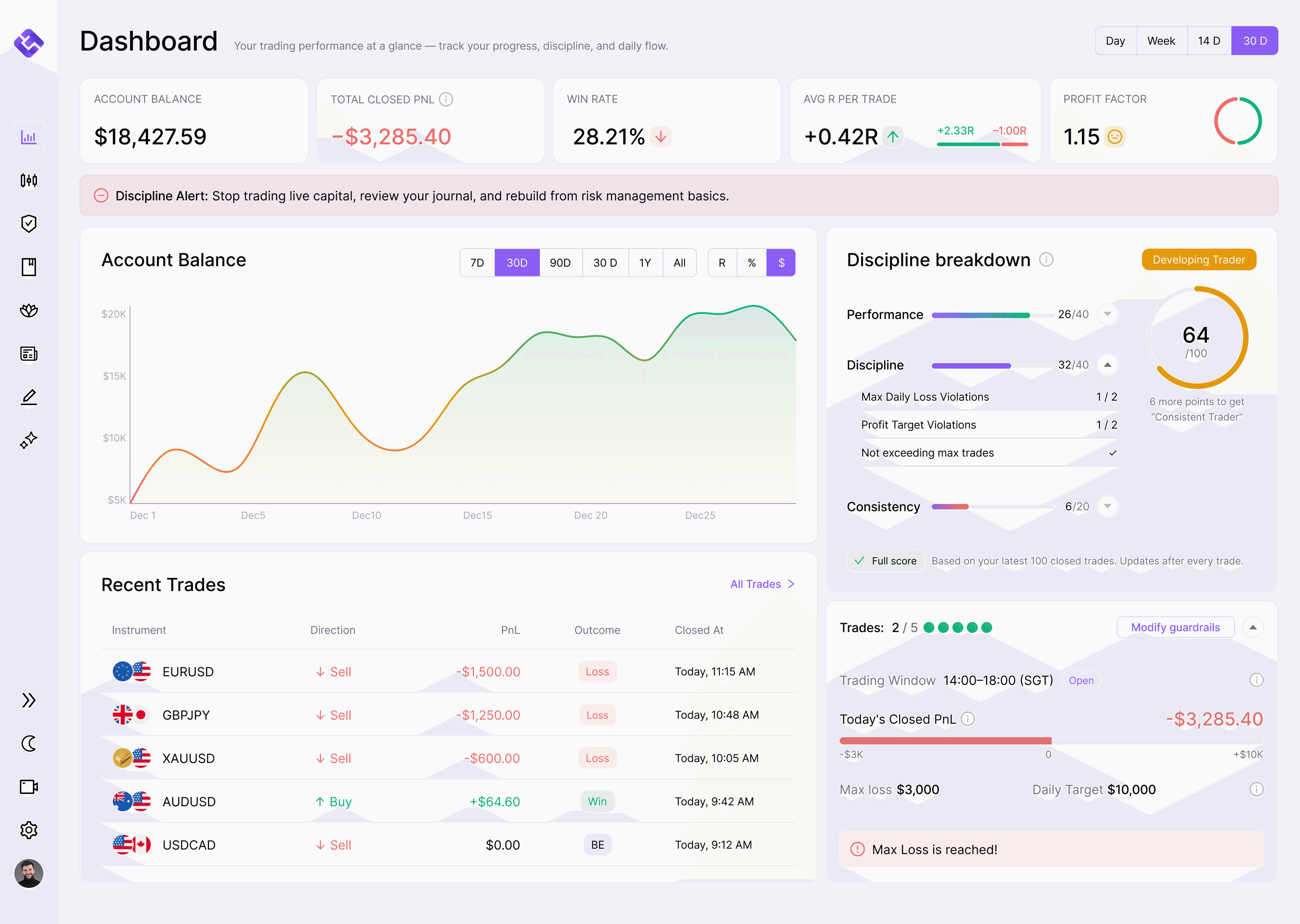
Patience is a decision, but it is easier to make that decision when your environment supports it. EdgeFlo's guardrails limit daily trades and losses, which means that even on your worst day, the platform makes it harder to blow through your drawdown in a single session. You can override the guardrails if you choose to, but the friction is intentional. It gives you a pause before the next impulsive trade.
The Edge plan keeps your rules visible during the session. When your plan is sitting next to your chart, you do not have to remember your criteria under pressure. You can see them. That removes one of the biggest triggers for impatient entries: the moment where you think "this looks close enough" because you forgot what your actual setup requires.
Your journal tracks skipped trades too, which builds the process compliance record that patience depends on. When you can look back at a week and see that you sat out three days, took two quality trades, and stayed within your risk parameters, that is the proof that patience works. Not a P&L number. A pattern of disciplined behavior.
The Edge Brief
Receive Insights on trading psychology, discipline, and the behavioral patterns that create consistent traders from our Founder and the EdgeFlo team, delivered to your inbox.
Think different. Trade different.
How long should a prop firm challenge take?
Why do traders rush funded challenges?
Can patience alone help you pass a prop firm challenge?
What is the biggest sign you are rushing a prop firm challenge?

Turn discipline on.
Every session.
EdgeFlo is the environment serious traders operate inside.
Start 7-Day Free Trial
Cancel anytime.
No long-term commitment.

Think Different, Trade Different.