

Prop Firm Account Management at Scale
How to manage multiple prop firm funded accounts. Position sizing, session discipline, and scaling from $100K to $850K without blowing drawdown limits.
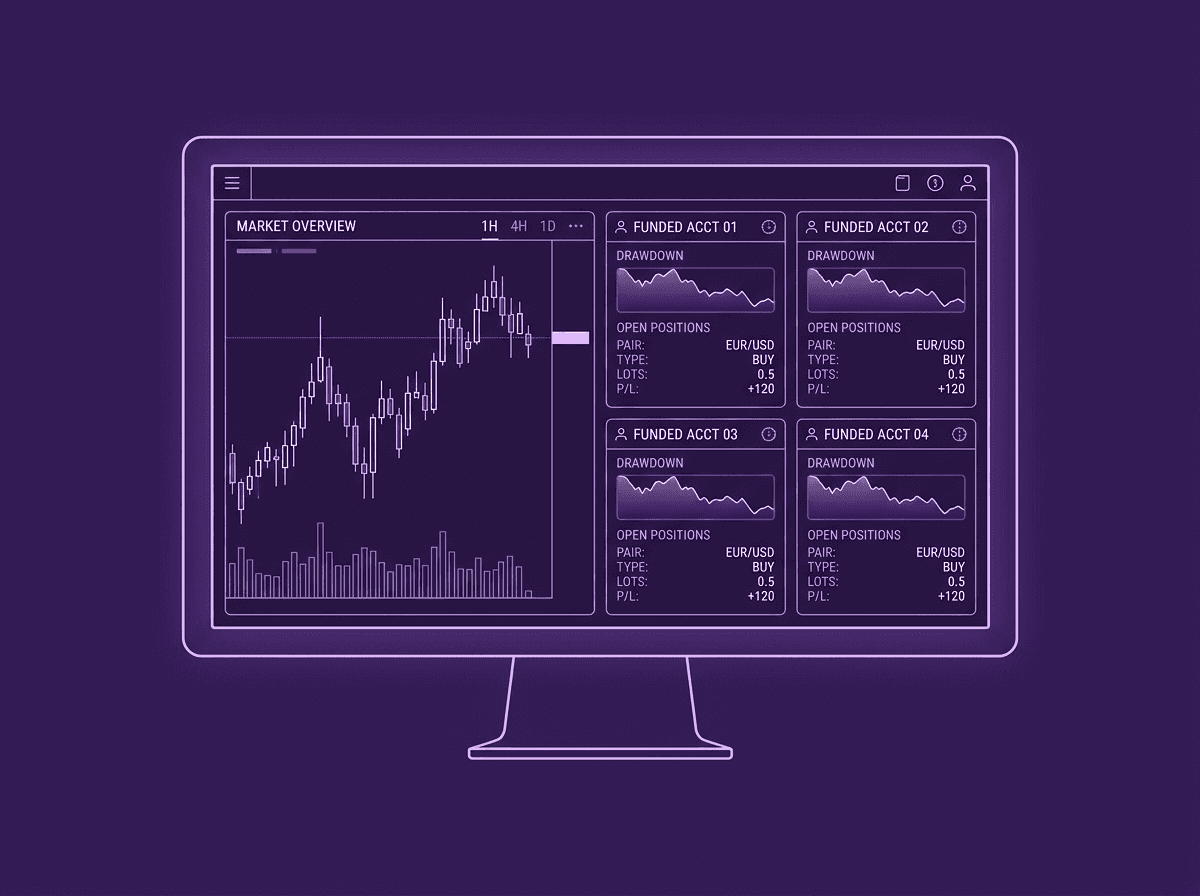
Managing one funded account is about discipline. Managing multiple funded accounts simultaneously is about systems. You need consistent position sizing across accounts, strict session boundaries that prevent fatigue-driven mistakes, and a clear framework for when to add another account versus when to consolidate. Yousef scaled from zero trading experience to $850,000 across multiple funded accounts in under 8 months. He did not do it by trading more aggressively. He did it by applying the same calm, confirmation-based process to each account independently while treating every single account's drawdown limit as a hard boundary.
TL;DR
Same trade, same criteria, different sizing per account based on individual drawdown budgets.
Track each account's drawdown buffer independently, not as a combined total.
Losing one account is expected. Replace it without changing your process.
Add a new account only when your current accounts show 4+ weeks of consistent execution.
Session discipline matters more at scale: one session, one set of trades, done.
Managing Multiple Funded Accounts
The mechanics of trading multiple funded accounts are simpler than most people think. When your confirmation criteria are met, you take the same trade on every account. You do not look for different setups on different accounts. You do not trade one account aggressively and another conservatively. Every account gets the same entry, the same stop, and the same target. The only variable is position size.
This is possible because a valid trade is a valid trade regardless of which account it sits in. If EUR/USD sweeps the Asian low, shifts structure, and pulls back to your order block, that setup does not change depending on whether you are executing on a $100K account or a $200K account.
Why Traders Overcomplicate This
The common fear with multiple accounts is "what if I make a mistake on one?" That fear leads to two bad behaviors:
Trading different strategies on different accounts to "diversify." This splits your focus and guarantees that at least one account is getting your B-game.
Hedging across accounts. Going long on one account and short on another to "protect" against loss. This is not risk management. It is paying twice the spread for no edge.
If your strategy works on one account, it works on five. The question is not whether your strategy scales. It is whether your discipline scales.
What Multiple Account Trading Actually Looks Like
You have three funded accounts: $100K, $200K, and $200K. Your daily routine starts with a pre-market markup on EUR/USD (your only pair). London session opens and you see your setup: Asian low swept at 1.0835, bullish market structure shift confirmed on the 15-minute chart, pullback into the order block at 1.0843.
Account 1 ($100K): Risk 0.5% = $500. Stop distance: 13 pips. Position size: 3.85 lots. Enter long at 1.0843, stop at 1.0830, target at 1.0880.
Account 2 ($200K): Risk 0.5% = $1,000. Stop distance: 13 pips. Position size: 7.69 lots. Same entry, same stop, same target.
Account 3 ($200K): Risk 0.5% = $1,000. Same calculation as Account 2. Same trade.
You place all three trades within 60 seconds. Price hits target at 1.0880 by 10:20 AM. You close all three positions. Session complete.
Total risk: $2,500 across $500K in funded capital. Total gain: ~$7,100. One trade, three accounts, zero drama.
Position Sizing Across Accounts
Here is where traders get into trouble. They start thinking of their funded capital as one big pool. "I have $500K funded, so I can risk $2,500 per trade." That is technically true, but it misses the point: each account has its own drawdown limit, and breaching any single account's limit kills that account regardless of what your other accounts are doing.
Size Each Account Independently
Your position sizing formula runs separately for each account:
Position Size = (Account Balance x Risk %) / (Stop Loss in Pips x Pip Value)
Do not skip this calculation. Do not eyeball it. Do not use the same lot size across accounts of different sizes.
The Drawdown Buffer Rule
Every prop firm account has a maximum drawdown limit (typically 5% to 10% of starting balance). Your position sizing should be calibrated so that even a worst-case losing streak does not approach that limit.
Here is a simple framework:
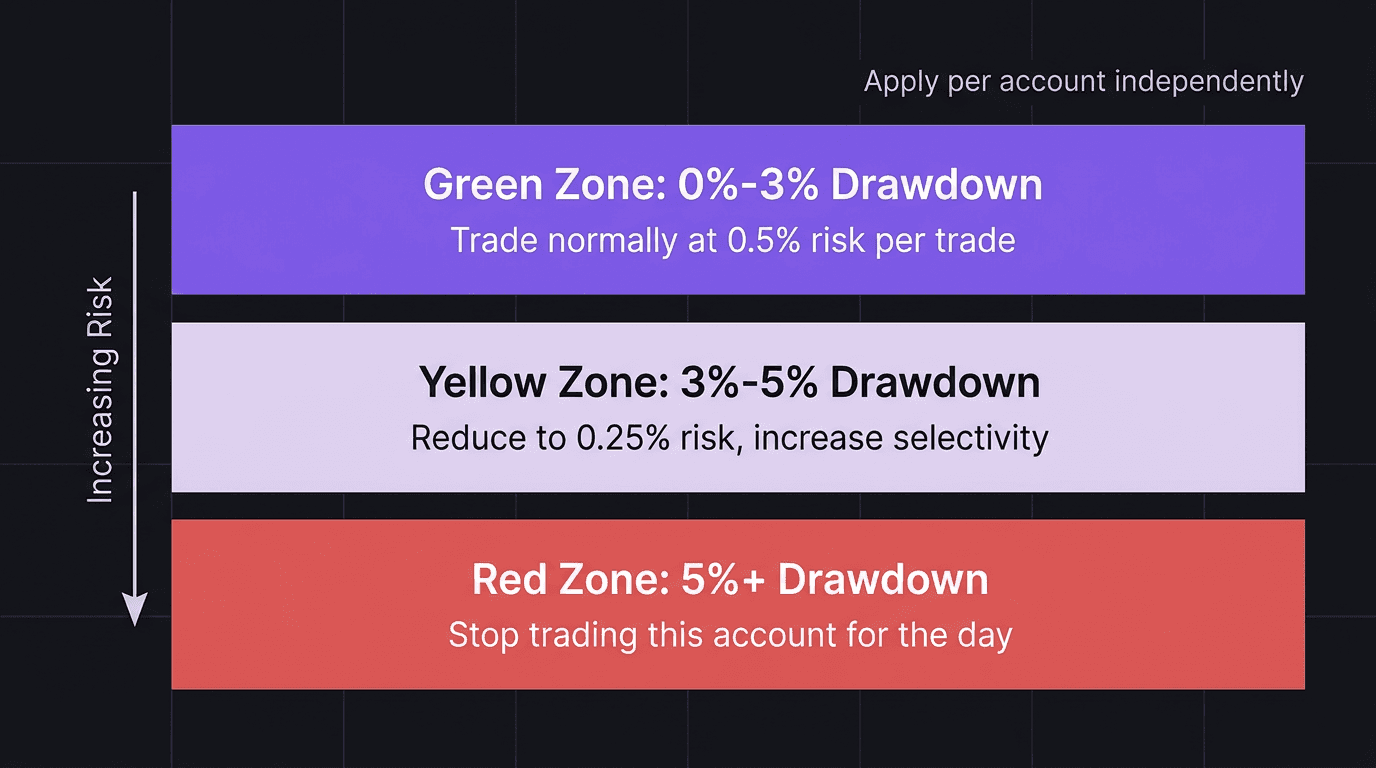
Green zone (0% to 3% drawdown): Trade normally at 0.5% risk per trade.
Yellow zone (3% to 5% drawdown): Reduce risk to 0.25% per trade. Increase selectivity.
Red zone (5%+ drawdown): Stop trading that account for the day. Re-evaluate at the start of the next session.
Apply this framework to each account individually. If Account 2 is in the yellow zone but Accounts 1 and 3 are green, you reduce size only on Account 2. Do not let one account's drawdown contaminate your decision-making on the others.
Tracking Your Drawdown Budget
Before every session, update a simple log for each account:
Starting balance today
Maximum drawdown limit
Remaining drawdown buffer
Daily loss limit (typically 1% to 2% of account balance)
Current zone (green/yellow/red)
This takes 5 minutes. It prevents the most common reason traders lose funded accounts at scale: not knowing how close they are to their drawdown limit when they place a trade.
Session Discipline at Scale
When you are managing multiple accounts, trading hours are not your friend. More screen time does not mean more profit. It means more opportunities to make mistakes, and each mistake is multiplied across every account.
One Session, One Set of Trades
Yousef's rule was non-negotiable: "If I got money from London, I don't want to give it back to New York." He picked one session and committed to it. When the session ended, he was done. Win or lose.
Your focus is concentrated. Two hours of sharp execution beats eight hours of declining attention.
Your risk exposure has a natural endpoint. If London produced a winner, that profit is locked in. No afternoon session to give it back.
Your emotional reserves are preserved. Managing three accounts during one session is draining enough. Adding a second session doubles the fatigue while adding marginal edge.
What Goes Wrong Without Session Limits
A trader with four funded accounts trades both London and New York. During London, he takes a clean 2R winner across all accounts. Up $4,000. Then New York opens and he sees "one more setup." He enters across all four accounts. The trade stops out. Down $2,000. He is now up only $2,000 and frustrated. He takes another New York trade to recover. Stopped out again. His $4,000 London profit is now a $500 gain, and one account is in the yellow drawdown zone.
Session discipline is not about leaving money on the table. It is about recognizing that the marginal return of additional trades decreases while the marginal risk increases. Your first trade of the day is your clearest-headed decision. Your fifth trade is almost never as sharp.
When Your Session Has No Setup
Some days, your session will produce zero valid setups. On a day like that with four funded accounts, you have effectively managed $400,000+ in capital by doing nothing. That is not lazy. That is professional.
Yousef described his mindset: "If I made $3K once, I can do it thousands of times. Why stress?" The confidence to skip a session comes from knowing your process works over dozens of trades, not from needing every individual session to produce.
When to Add Another Account
Scale slowly. The worst thing you can do is pass a challenge, immediately start two more challenges, and suddenly go from managing one account to managing four before you have proven that the multi-account workflow works.
The Readiness Checklist
Add another funded account only when:
Your current accounts show 4+ weeks of positive expectancy. Not just profit, but consistent execution with your confirmation criteria met on 85%+ of trades.
Your drawdown tracking is current. If you cannot tell me within 30 seconds how much drawdown buffer each account has, you are not ready for another one.
Your session discipline has not slipped. Adding an account adds execution time and mental load. If you are already trading two sessions or sneaking in "extra" trades, another account will make it worse.
You have the capital for a challenge fee without it affecting your emotional baseline. If losing $300 on a challenge fee would sting, wait.
Yousef lost one account three days after posting $400,000. He did not panic. He did not change his strategy. He passed three more challenges and jumped to $850,000. The prop firm scaling plan is not about never losing an account. It is about replacing lost accounts without emotional disruption.
What Scaling Looks Like Over Time
A realistic progression for a confirmation-based trader:
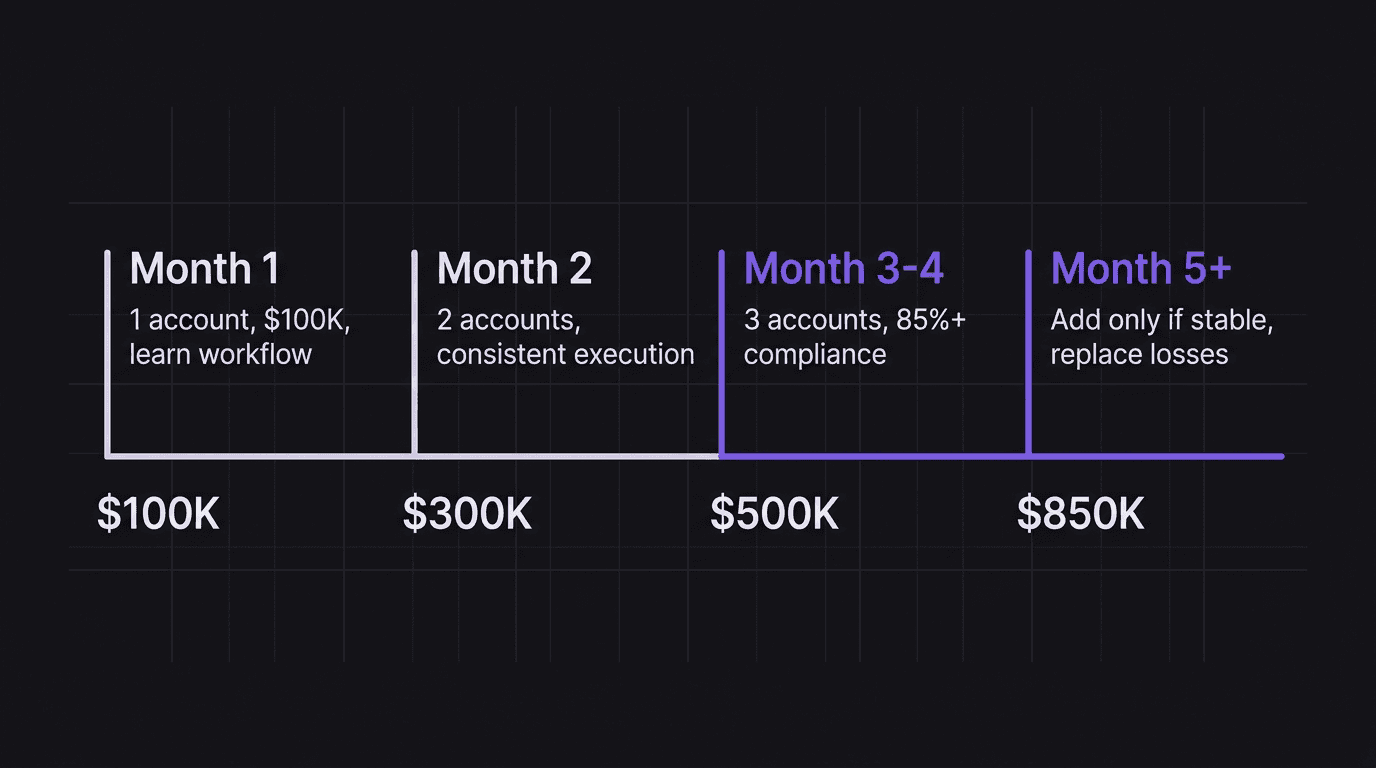
Month 1 funded: Pass one challenge. Trade one $100K account. Learn the workflow.
Month 2: If execution is consistent, pass a second challenge. Manage two accounts.
Month 3 to 4: Add a third account if the first two are profitable and your process compliance is above 85%.
Month 5+: Continue adding accounts only as existing accounts prove stable. Replace any lost accounts by passing new challenges.
The path to a prop firm challenge is the same every time. What changes at scale is your confidence in the process. Yousef did not need a new strategy for each account. He needed the same strategy, the same discipline, and the same session rules, applied consistently to a larger number of accounts.
The Account You Should Not Add
You just lost an account and feel the need to "replace it immediately"
Your current accounts are in drawdown and you think a new account will give you a fresh start
You are bored and want more action during your session
Adding an account should be a managed decision, not an emotional one. If the motivation is anything other than "my process is working and I have capacity for more," wait.
How EdgeFlo Supports Multi-Account Management
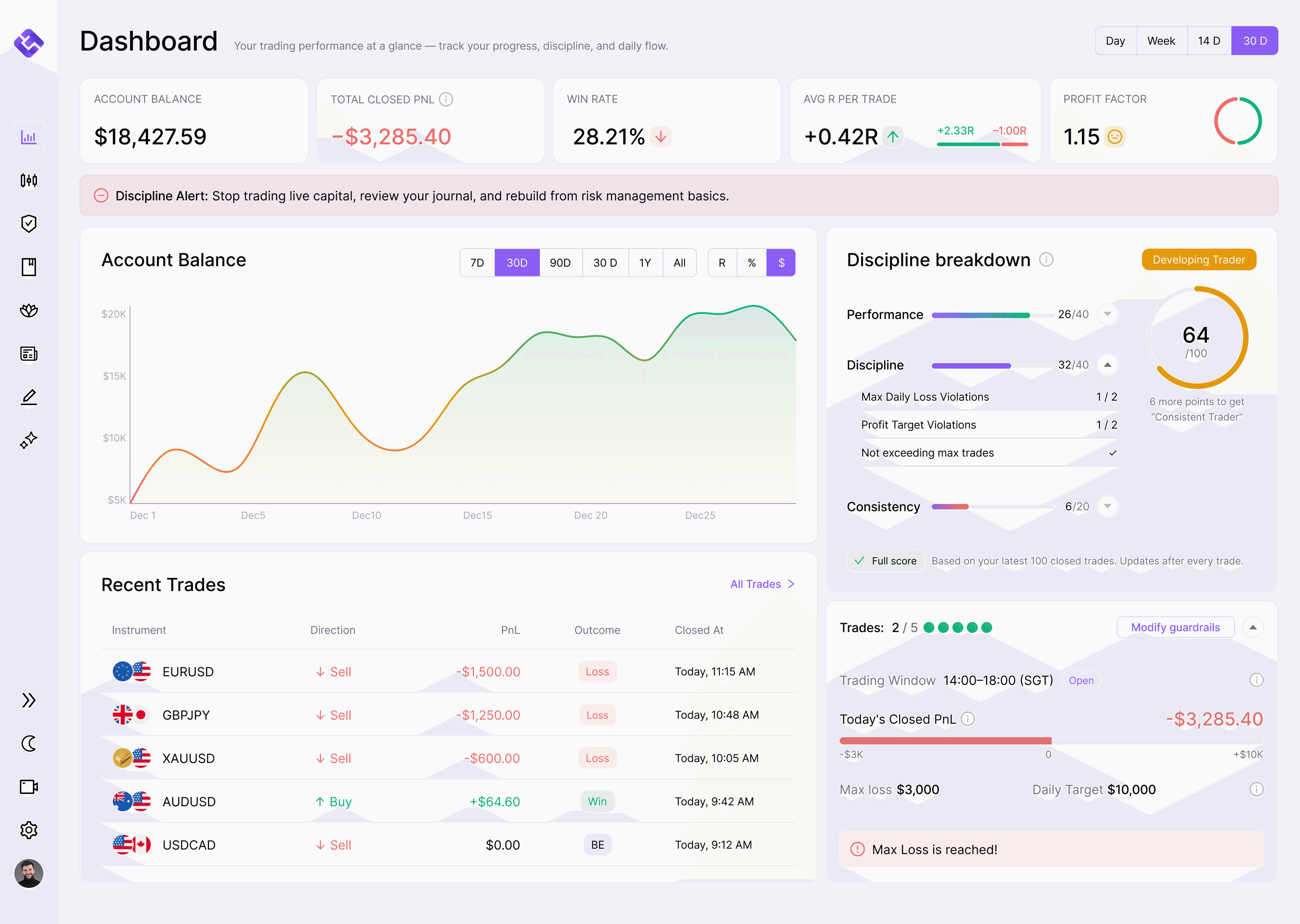
EdgeFlo connects up to three trading accounts on the Plus plan, letting you manage your funded accounts from a single workspace. Instead of logging into separate platforms and manually tracking drawdown across browser tabs, your risk data, journal entries, and trade history live in one place.
The Guardrails feature applies independently to each connected account. You set daily loss limits and trade count maximums per account, so if one account enters the yellow drawdown zone, the guardrails tighten on that account while your other accounts continue trading normally. This prevents the cross-contamination problem where one account's drawdown affects your judgment on all the others.
Weekly AI reports (Plus plan) analyze your performance across all connected accounts and identify patterns: which account produces your best trades, whether your win rate differs between accounts of different sizes, and whether your session discipline degrades as you add accounts. That feedback turns multi-account management from a juggling act into a data-driven process.
The Edge Brief
Receive Insights on trading psychology, discipline, and the behavioral patterns that create consistent traders from our Founder and the EdgeFlo team, delivered to your inbox.
Think different. Trade different.
How many prop firm accounts can you manage at once?
Should you take the same trade on all funded accounts?
What happens if you lose one funded account while managing others?
How do you track drawdown across multiple funded accounts?

Turn discipline on.
Every session.
EdgeFlo is the environment serious traders operate inside.
Start 7-Day Free Trial
Cancel anytime.
No long-term commitment.

Think Different, Trade Different.