

Never Trade the First Mitigation of a Zone
The first time price returns to a supply or demand zone, it often fails. Learn the first-mitigation rule and how to wait for the second visit for better entries.
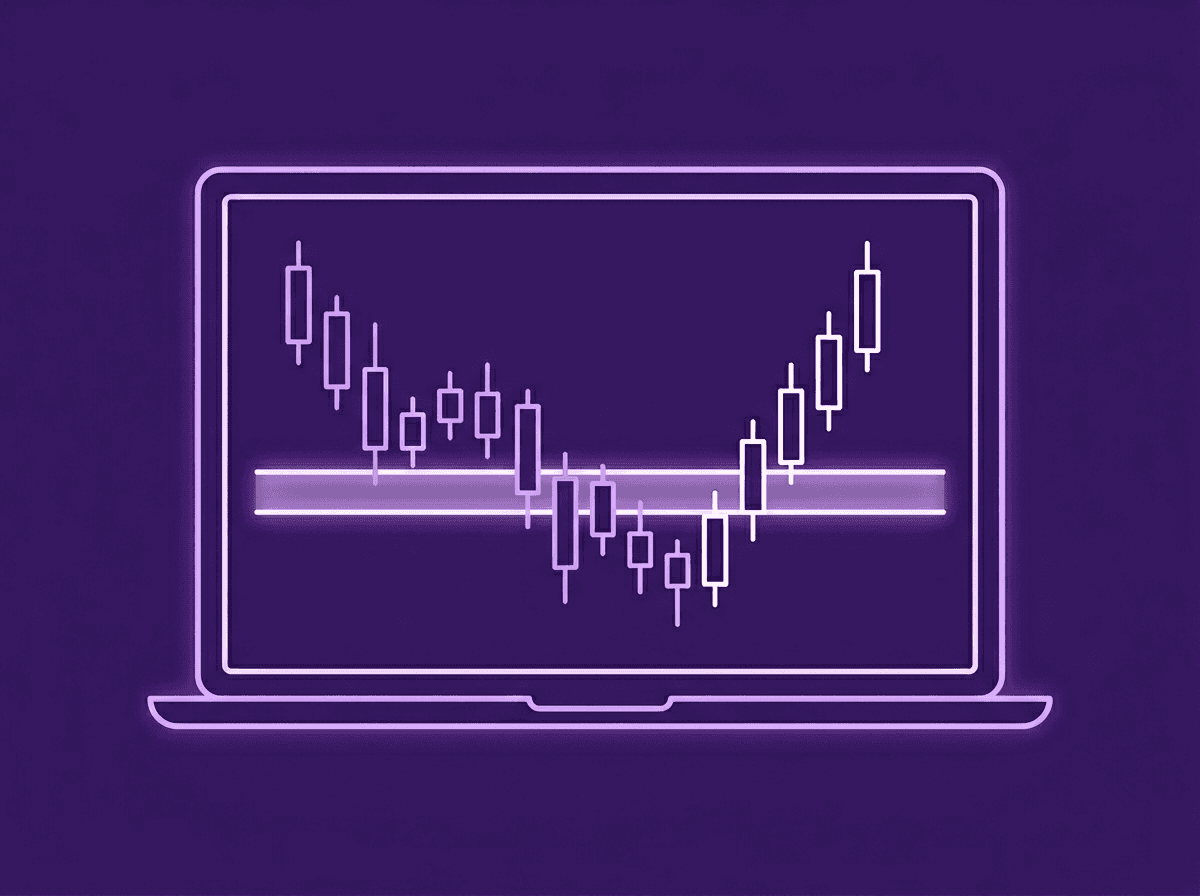
You marked a clean demand zone. Price pulled back to it. You entered on the touch. And then price sliced right through your zone like it was not there.
If this keeps happening, it is not because your zones are bad. It is because you are trading the first mitigation. And the first mitigation is where the most money gets lost.
TL;DR
The first time price returns to a zone, it often fails because residual orders and inducements are still in play.
Retail traders entering on the first touch create liquidity below the zone that institutions target.
Skipping the first mitigation and waiting for the second or third visit dramatically improves entry quality.
The rule is simple: zone identified, first touch ignored, second touch evaluated.
Adding this to your execution checklist reduces impulsive zone entries.
What Mitigation Means in Smart Money Terms
In supply and demand trading, a zone is the price range where institutional orders were filled. When price returns to that zone, it "mitigates" those orders, meaning price interacts with the remaining unfilled orders from the original move.
But mitigation is not always clean. The first time price returns, several things can interfere:
Residual sell orders from the original move may still be present, absorbing the initial buying pressure.
Inducement orders from retail traders who entered on the first touch create a new pool of stop losses just below the zone.
Insufficient liquidity for a strong bounce. Institutions may need price to sweep deeper before committing.
Think of it like a sponge. The first time you pour water on a dry sponge, it absorbs most of the liquid. The zone absorbs some of the price movement on the first mitigation, but it may not produce a strong reaction. The second time, the sponge is saturated, and the water runs off cleanly. Similarly, after the first mitigation clears residual orders and inducement liquidity, the second visit encounters a cleaner zone with stronger institutional commitment.
Why the First Touch Often Fails
The first-touch failure is one of the most frustrating experiences in supply and demand trading. You did the analysis right. The zone was valid. The trend was correct. But the entry got stopped out by a few pips before price launched in your direction.
Here is why it happens:
Retail traders are predictable. When a clean demand zone forms, every trader watching the same chart marks the same zone. They all enter on the first touch. Their stops all cluster below the zone boundary. This creates a liquidity pool that is too attractive for institutions to ignore.
Institutions need that liquidity. The first mitigation draws in retail entries. Then a small inducement sweep takes out those stops, providing additional fill liquidity for the real institutional buy. The sweep might only be 5 to 15 pips below the zone, but it is enough to stop out tight entries.
Residual counter-orders absorb the initial move. If the zone formed from a strong sell-off that reversed, some of the original sell orders may still be sitting at that price. The first return mitigates (absorbs) those residual orders, weakening the bounce. The second return encounters fewer residual orders and produces a stronger reaction.
Walkthrough: First Touch Failure on EUR/USD
EUR/USD forms a demand zone between 1.0870 and 1.0880 after a liquidity sweep below equal lows. Price rallies to 1.0940. A trader enters long at 1.0878 (first touch of the zone) with a stop at 1.0862 (16-pip risk, $160 per standard lot at $10/pip). Price enters the zone, bounces 10 pips to 1.0890, then drops through the zone to 1.0855. The trader is stopped out for $160.
Price sweeps to 1.0855 (taking out the first-touch stops), reverses, and rallies back into the zone. On the second visit, a different trader enters at 1.0872 after seeing a 5-minute structure shift bullish. Stop at 1.0850 (22-pip risk, $220). Price rallies to 1.0950, a 78-pip move. Reward: $780. R:R is 3.55.
The first trader was right about the zone. Wrong about the timing. The second trader let the zone get cleaned up and entered with more confidence and a better risk profile.
The Second Mitigation Entry: When and How
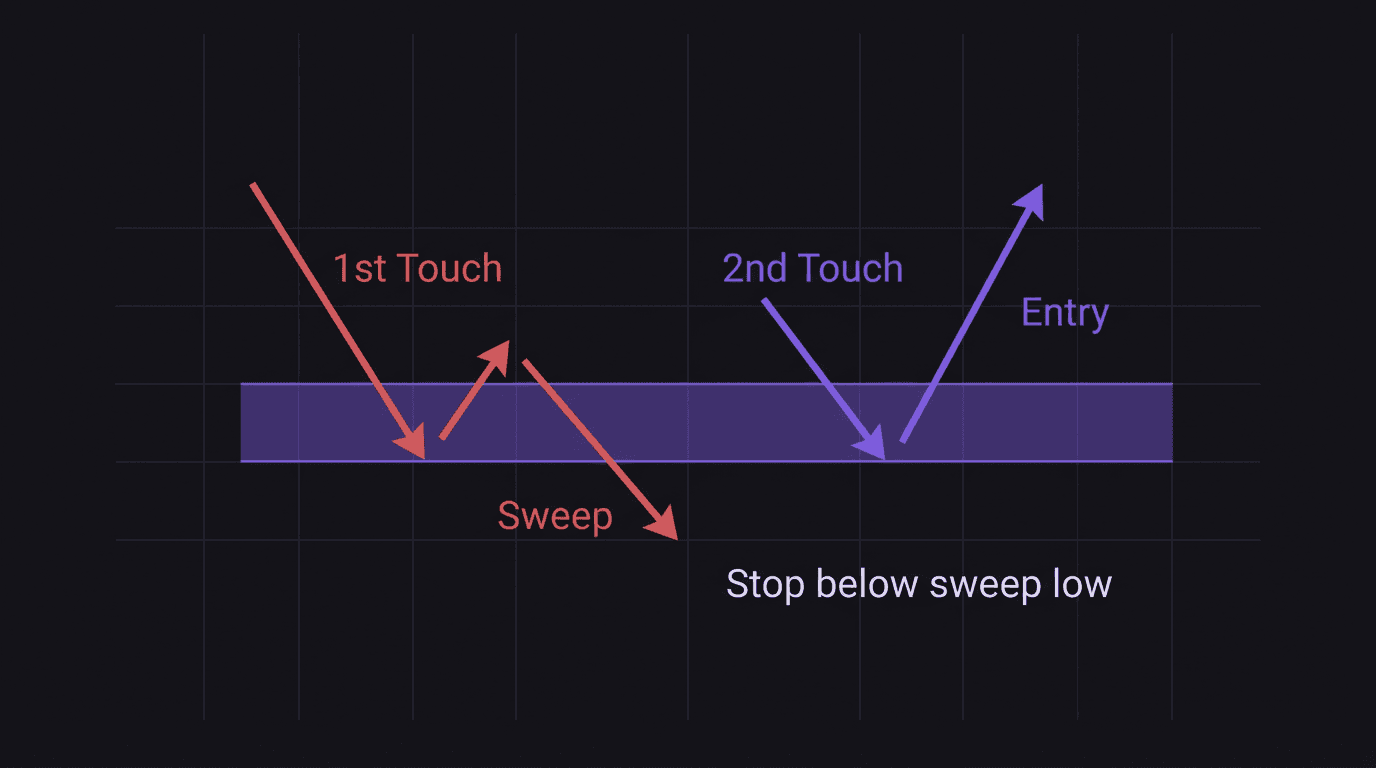
The rule is straightforward: when price first returns to a zone, do nothing. Watch what happens. If the first touch produces a weak bounce followed by a sweep below the zone, that sweep clears the inducement liquidity.
When price returns to the zone a second time (or third), the conditions are cleaner:
First-touch stop losses have been cleared.
Residual orders from the original move have been absorbed.
Institutions have seen the zone hold (or get swept and recover), confirming their interest.
How to execute the second mitigation entry:
Mark the zone after the original move.
When price first returns, watch but do not trade.
Note whether the first touch produces a sweep below the zone (bullish setup) or above it (bearish setup).
When price returns a second time, drop to a lower timeframe (5-minute or 1-minute).
Look for a reaction-based entry signal: a structure shift, a strong reversal candle, or a displacement away from the zone.
Enter with your stop below the sweep low from the first mitigation.
This approach gives you a wider stop (because you reference the first mitigation sweep low) but a much higher probability of the zone holding.
Adding This Rule to Your Execution Checklist
The hardest part is not understanding the rule. It is sitting out the first touch when your analysis is screaming "enter now."
Add this as an explicit line item in your trading rules:
Rule: No zone entries on the first mitigation. Wait for the sweep or second touch.
Exception: If the zone is a post-sweep zone (it formed after a liquidity sweep took out a prior level), the first touch may be valid because the sweep already occurred before the zone was created.
Write it on your checklist. Put it in your pre-trade mental walkthrough. The rule creates a friction point between analysis and execution, and that friction is where discipline lives.
Walkthrough: What Happens When You Follow the Rule
A trader marks a supply zone on GBP/USD at 1.2760 to 1.2775. Price rallies to the zone. The trader wants to sell but follows the first-mitigation rule. Price touches 1.2768, bounces down 12 pips, then pushes through the zone to 1.2782. Breakout traders buy. Price then reverses sharply from 1.2782.
On the second visit to the zone (from below, after the sweep above), the trader enters short at 1.2770 with a stop at 1.2788 (18-pip risk, $180 per standard lot at $10/pip). Price drops to 1.2690, an 80-pip move. Reward: $800. R:R is 4.44.
The first touch would have been a losing trade (price swept through). The second touch was a 4.4R winner. Same zone, different mitigation, completely different outcome.
How EdgeFlo Tracks Zone Mitigation Count
Tracking which zones have been mitigated once, twice, or more is cognitive overhead during live trading. You need to remember which zones are fresh and which have already been tested.
EdgeFlo's pre-market checklist prompts you to review your key zones before the session starts. Write down which zones are untested (first mitigation risk), which have been tested once (approaching tradeable), and which have been tested and swept (highest priority). This pre-session prep reduces the chance of impulsively entering a first-touch zone.
FloAI (Plus plan) can flag when price approaches a zone you are tracking, giving you a moment to check your notes before entering. It does not make the decision for you, but the prompt is enough to trigger the "first or second touch?" question.
After each session, tag your zone trades in the journal as "first mitigation," "second mitigation," or "post-sweep." Over a few weeks, compare the stats. The data will confirm what the theory predicts: second-mitigation entries outperform first-touch entries consistently. Once you see it in your own numbers, the discipline to skip the first touch becomes natural. It is not restraint anymore. It is just following your edge.
The Edge Brief
Receive Insights on trading psychology, discipline, and the behavioral patterns that create consistent traders from our Founder and the EdgeFlo team, delivered to your inbox.
Think different. Trade different.
What does mitigation mean in smart money trading?
Why does the first touch of a zone fail so often?
How many times should a zone be tested before I trade it?
Does this rule apply to both supply and demand zones?

Turn discipline on.
Every session.
EdgeFlo is the environment serious traders operate inside.
Start 7-Day Free Trial
Cancel anytime.
No long-term commitment.

Think Different, Trade Different.