

Missed Trade Journal: Log the Trades You Didn't Take
The trades you skip teach you as much as the trades you take. Learn how keeping a missed trade journal builds conviction and eliminates hesitation over time.

You watched the setup form. Every box on your checklist ticked green. And you sat there, frozen, while price ran 80 pips without you.
Sound familiar?
Most traders only journal the trades they take. Wins, losses, breakevens. But the trades you skip carry some of the most valuable data you will ever collect. They reveal exactly where hesitation lives in your process, and that is information no executed trade can give you.
A missed trade journal is a dedicated log for setups you identified, confirmed against your plan, and chose not to enter. It is separate from your regular journal. Its only job is to capture the gap between knowing what to do and actually doing it.
TL;DR
A missed trade journal logs valid setups you saw but did not take, kept separate from your regular journal.
Reviewing missed trades reveals whether your hesitation cost you money or saved you from bad entries.
Tracking the reason you skipped (fear, perfectionism, distraction) turns a vague feeling into a fixable pattern.
After 20 to 30 entries, you build data-backed conviction that makes the next valid entry easier to pull the trigger on.
The journal does not pressure you to take more trades. It pressures you to understand why you are not taking the right ones.
Why Most Traders Ignore Missed Trades
Your regular trading journal tracks what happened after you clicked buy or sell. It records entries, exits, R multiples, emotions, and rule adherence. That feedback loop is essential.
But it has a blind spot. It cannot show you the trades that never existed in your data because you never took them.
Think about it this way. If you skip three A+ setups per week out of fear, your journal shows zero entries for those sessions. The journal looks clean. No losses. No rule breaks. And yet you left real money on the table because your plan said go, and you froze.
That gap between plan and action is invisible unless you create a dedicated place to record it.
The Hidden Cost of Not Tracking
Here is what happens without a missed trade log. You watch price run away. You feel regret. You tell yourself "I will take it next time." Then next time comes, and the same hesitation shows up again. Without data, you are stuck in a loop where you notice the problem but never isolate the cause.
Worse, that regret sometimes pushes you into chasing. You missed the clean entry at the demand zone, so you jump in 40 pips late with a wide stop and a terrible risk profile. That is not discipline. That is FOMO dressed as action.
A missed trade journal breaks this cycle by turning "I froze again" into "I froze on the third consecutive London session entry after a losing day."
What Goes in a Missed Trade Entry
Keep it simple. If the log takes longer than two minutes to fill out, you will stop doing it. Here are the five fields that matter.
The Five Fields
Date, pair, and timeframe. Just like a regular trade entry. Example: March 14, EUR/USD, 15-minute.
Setup description. What did you see? Liquidity sweep into demand, bullish BOS on internal structure, entry confirmation candle.
Why you skipped it. Be honest. "Afraid of another loss," "Wanted one more confirmation," "Was away from charts."
What price did after your planned entry. This is the money line. Did price hit your theoretical target? Did it stop you out? Record the actual result.
Lesson or adjustment. One sentence. "My entry model worked. I need to trust it next session." Or: "Price reversed before target. Skipping was correct."
That is it. Five fields. No screenshots required (though they help during review). No paragraph of analysis. Just raw data that you can scan quickly at the end of the week.
What NOT to Log
Do not log setups that did not match your plan. If price was in the middle of nowhere and you felt a vague urge to buy, that is not a missed trade. That is a non-trade, and it belongs nowhere in your records.
The missed trade journal is only for valid, plan-confirmed setups. If even one criterion from your checklist was missing, it does not qualify. This distinction matters because the journal exists to build conviction in your system, not to guilt you into overtrading.
Walkthrough: Building Conviction From 4 Weeks of Data
Example: GBP/USD, London Session
A trader runs a supply-and-demand strategy on GBP/USD during the London session. Her plan says: wait for a liquidity sweep below the previous session low, confirm with a bullish break of structure on the 5-minute chart, and enter at the next demand zone retest. Risk is 1% per trade.
Over four weeks, she logs 11 missed trade entries. Here is what the data shows.
Week 1: 3 missed entries. All three ran to target (2R, 1.8R, 2.5R). Reason for skipping: "Coming off a 3-loss streak, did not trust the setup."
Week 2: 2 missed entries. One hit target (2.2R). One got stopped out. Reason: "Wanted extra confirmation that never came."
Week 3: 4 missed entries. Three hit target. One reversed before entry would have triggered, so no trade existed anyway. Reason: "Stepped away from charts during kill zone."
Week 4: 2 missed entries. Both hit target. Reason: "Fear of losing again after Monday's loss."
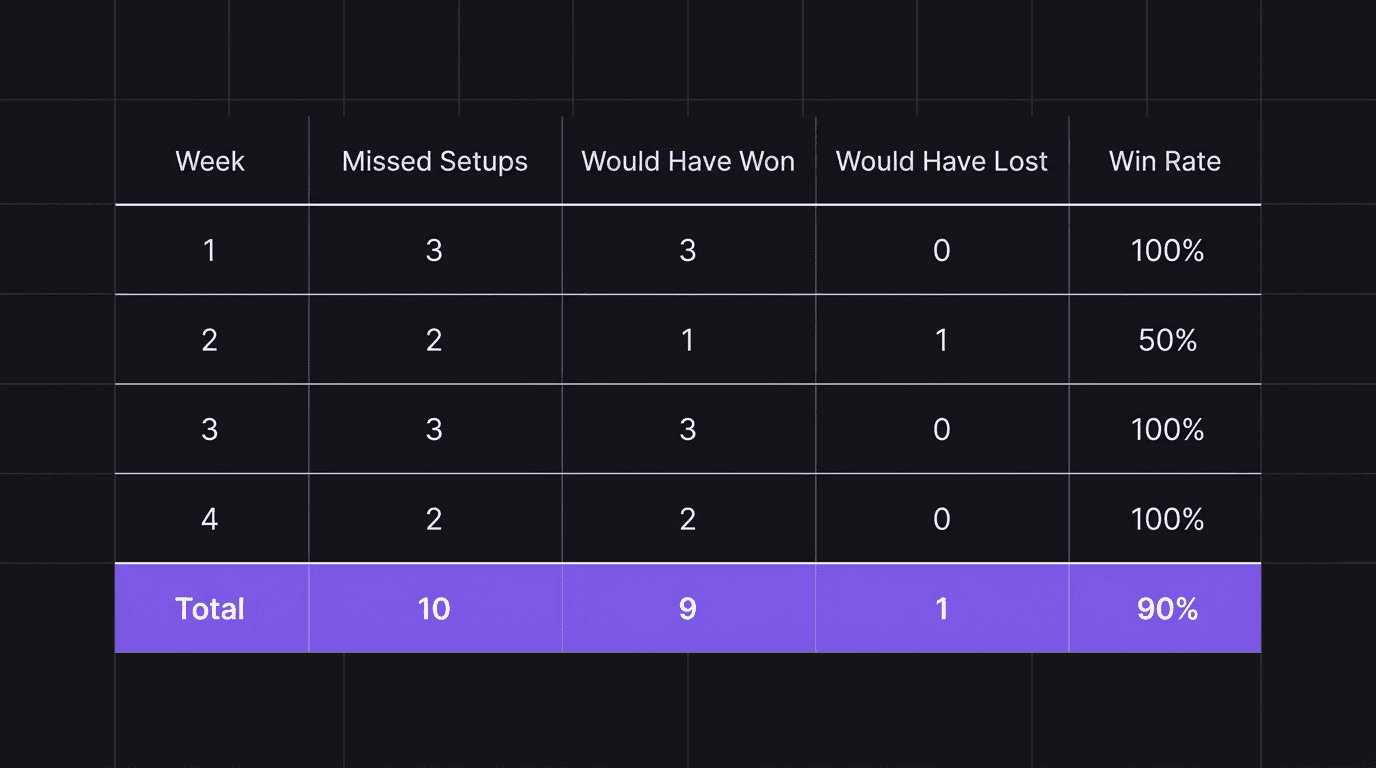
After four weeks, she has hard data: 9 out of 10 valid missed setups would have been winners. Her system works. She knows this not because someone told her, but because she tracked the proof herself.
That data does something motivation cannot. It makes the next entry feel less like a gamble and more like following a process with a known outcome distribution.
Math Check
Week 1: 3 missed, 3 wins, 0 losses. Week 2: 2 missed, 1 win, 1 loss (1 setup never triggered, excluded). Week 3: 4 missed, 3 wins, 0 losses (1 setup never triggered, excluded). Week 4: 2 missed, 2 wins, 0 losses. Total valid: 10 setups. 9 wins. 1 loss. 9 / 10 = 90% win rate on missed entries.
What to Do During Your Weekly Review
Set aside 15 minutes at the end of each week to review your missed trade log. This is separate from your regular post-trade review. Here is the process.
Step 1: Sort by reason. Group your skipped trades by the reason you gave. Fear? Perfectionism? Distraction? Away from charts? You are looking for the most common reason.
Step 2: Check outcomes. For each missed trade, mark whether price hit your target or your stop. Tally the numbers. If 7 out of 10 missed trades would have been winners, that is your conviction fuel.
Step 3: Identify the pattern. Maybe you only freeze after a losing day. Maybe you skip every third setup in a row because you feel like "the streak has to end." Maybe you hesitate specifically on GBP pairs. The pattern is always there. You just need enough data to see it.
Step 4: Write one action item. Not five. One. "Next week, if my checklist is green after a losing day, I enter. Period." Give yourself one concrete rule to test against the following week.
This is how you build a real journaling habit. Not by writing essays, but by collecting small, specific data points and acting on them.
Why It Must Be Separate From Your Regular Journal
Mixing missed trades into your main journal creates noise. Your regular journal tracks execution quality, risk management, and strategy performance across trades you actually took. Those metrics need clean data.
If you dump missed trades into the same spreadsheet, your win rate calculation gets confused. Your average R gets skewed by theoretical results. And your review process becomes muddy because you are comparing real outcomes with hypothetical ones.
Keep them apart. Your executed trades go in one place. Your missed trades go in another. Review them separately, at different times if possible.
Some traders use a physical notebook for missed trades specifically because it feels different from their main journal app. The format does not matter. The separation does.
Walkthrough: When Skipping Was the Right Call
Not every missed trade is a mistake. Sometimes your gut saves you from a setup that looked valid on the surface but had a flaw your subconscious spotted.
Example: USD/JPY, New York Session
A trader identifies a bearish setup on USD/JPY during the New York open. Liquidity sweep above the Asian session high, bearish engulfing on the 15-minute chart, and a supply zone retest. All criteria met.
He skips the trade because "something felt off." He logs it in his missed trade journal.
Result: price drops 15 pips, then reverses hard through his would-be stop loss. A key Fed speaker made unscheduled comments 20 minutes after his planned entry. The skip saved him 1% of his account.
Lesson: "News risk was elevated. My plan does not account for unscheduled Fed commentary. Add a pre-entry news check to my process."
This is why the missed trade journal is not about guilt. It is about data. Sometimes the data says "you were right to sit out." And that information is just as valuable as discovering that your system works when you trust it.
Common Mistakes With Missed Trade Journals
Logging every setup you glanced at. Only log setups where your plan criteria were fully met. Random chart observations are not missed trades.
Not recording the outcome. The journal is useless if you skip field four. You need to know what price did after you froze. That is the whole point.
Reviewing too infrequently. Once a month is not enough. Weekly reviews catch patterns before they calcify into habits. By the time you review monthly, you have already reinforced the hesitation loop dozens of times.
Using the journal to beat yourself up. This is not a guilt tool. Some entries will show that skipping was correct. Others will show that your system works and you need to trust it. Both conclusions are productive. Neither requires self-punishment.
How EdgeFlo Supports a Missed Trade Practice
EdgeFlo's journal supports custom tags, so you can tag entries as "missed" and filter them separately from executed trades during review. The auto-import feature handles your executed trades, which means your missed trade log stays clean and focused on the setups you sat out.
Over time, FloAI (Plus) surfaces patterns from your journal data. If your missed trade tags cluster around specific sessions, pairs, or emotional states, those patterns become visible without manual spreadsheet analysis. That feedback loop turns raw hesitation data into actionable insight.
The Edge Brief
Receive Insights on trading psychology, discipline, and the behavioral patterns that create consistent traders from our Founder and the EdgeFlo team, delivered to your inbox.
Think different. Trade different.
What is a missed trade journal?
Should I put missed trades in my regular trading journal?
How many missed trades should I log per week?
Will a missed trade journal help me take more trades?

Turn discipline on.
Every session.
EdgeFlo is the environment serious traders operate inside.
Start 7-Day Free Trial
Cancel anytime.
No long-term commitment.

Think Different, Trade Different.