

Market Imbalance: Why Price Returns to Fill the Gap
Sharp V-shaped moves leave imbalances that price comes back to fill. Learn how to identify imbalances and use them for take-profit placement and re-entry timing.
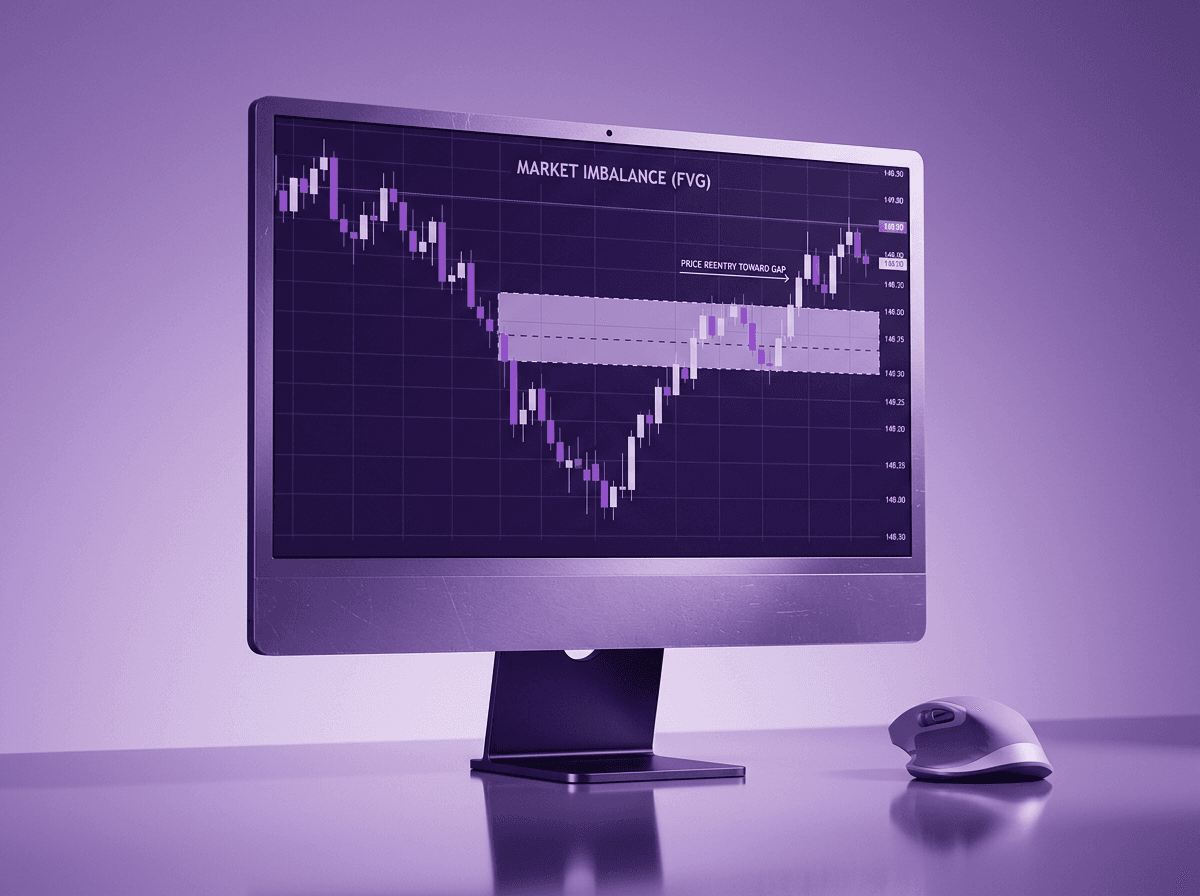
You take a solid short entry. Price drops 80 pips in two hours, a sharp, clean V-shaped move. You set your take profit at the next demand zone, but price stalls 30 pips above it, reverses, and starts crawling back up.
Why? Because the move down left unfinished business. That is an imbalance.
Understanding where imbalances form and why price revisits them changes how you set take profits, time re-entries, and avoid getting trapped by incomplete moves.
TL;DR
An imbalance is a price gap where aggressive one-sided momentum left candle bodies that do not overlap.
Price tends to return to these zones because unfilled orders and inefficiency attract price back.
Use imbalances to place conservative take profits rather than reaching for distant targets.
Imbalances on higher timeframes are stronger magnets than those on lower timeframes.
Combine imbalance reads with market structure for context, not as standalone signals.
What an Imbalance Actually Is
Pull up any chart and find a sharp move. Three or more large candles in one direction, barely any wicks, bodies stacked on top of each other. That is aggressive momentum.
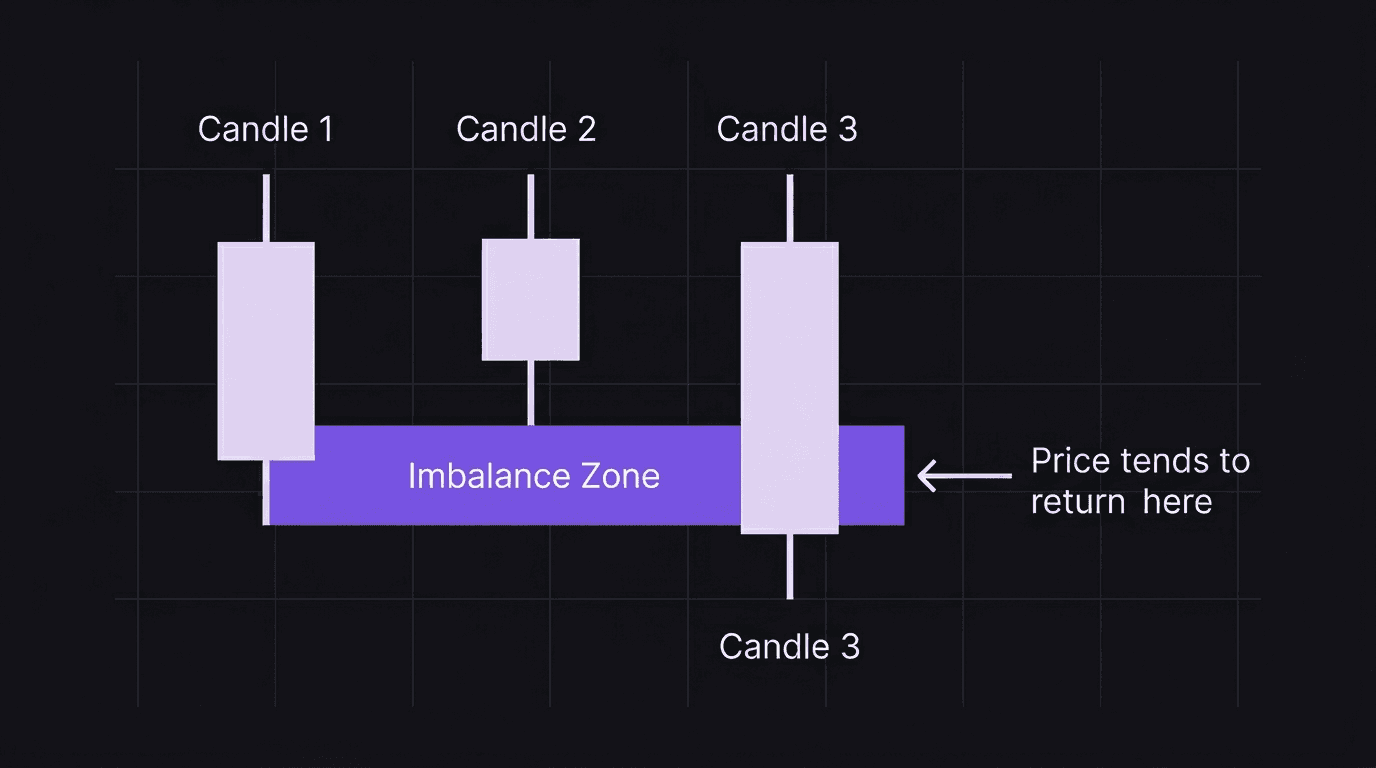
Now look closely at the space between the candle bodies. In a clean imbalance, the wick of the first candle does not reach the body of the third candle. There is a gap, a zone where price blew through so fast that there was almost no trading activity.
This gap is the imbalance. Some traders call it a fair value gap (FVG). Others call it an inefficiency. The concept is the same: the market moved too fast for supply and demand to balance, and that unfinished business pulls price back.
Think of it like a conversation where one side did all the talking. The market left a zone where only buyers (or only sellers) were active. Price tends to come back so the other side can participate.
How to Identify Imbalances
The three-candle method is the simplest and most reliable way to spot them.
Step 1: Find a strong directional move (three or more candles in the same direction).
Step 2: Take the first candle of the move. Note where its wick ends.
Step 3: Take the third candle. Note where its wick begins (on the opposite end from the move direction).
Step 4: If there is a gap between the first candle's wick and the third candle's wick, that space is your imbalance zone.
For a bullish imbalance (price moving up), the gap sits between the high of candle one's wick and the low of candle three's wick. For a bearish imbalance (price moving down), it is the reverse.
Mark the zone on your chart. That is where price has unfinished business.
Why Price Returns to Fill Imbalances
The mechanical reason is straightforward. When price moves sharply in one direction, unfilled limit orders and resting liquidity sit in the zone it blew through. Market makers and institutional participants have an interest in seeing price return to those levels so their orders get filled.
Additionally, these zones represent inefficiency. In efficient markets, price eventually fills gaps. It does not always happen immediately, and it does not always fill completely. But the tendency is strong enough to build trade management rules around it.
Here is what matters for your trading: the sharper the move, the higher the probability of a revisit. A slow, grinding trend creates small, shallow imbalances that may never fill. A sudden V-shaped spike creates a large imbalance that acts like a magnet.
Using Imbalances for Take Profit Placement
This is where imbalances become immediately practical.
You enter a short trade. The nearest demand zone is 100 pips away. But between your entry and that demand, there is a bullish imbalance sitting 60 pips below.
Which target do you use?
If you are conservative, the imbalance is your TP. Price is likely to stall or reverse at that zone because demand-side orders sitting in the imbalance will absorb selling pressure. The 100-pip target requires price to push through the imbalance without stopping. It might happen, but the probability drops.
Setting your TP at or just above the imbalance gives you a higher hit rate. You leave some potential profit on the table, but you actually collect the gain instead of watching price reverse 10 pips from your dream target.
Walkthrough: Imbalance TP on EUR/USD
You are short EUR/USD from 1.0920 after a supply zone mitigation and market shift on the 15-minute chart. Your stop loss is at 1.0950 (30 pips). The next demand zone on the 15-minute sits at 1.0830 (90 pips below entry).
But at 1.0870, there is a bullish imbalance from a previous sharp move up. Three candles pushed price from 1.0865 to 1.0895 with a clear gap between the first and third candle wicks. The imbalance zone spans from 1.0868 to 1.0878.
Conservative TP: 1.0878 (the top of the imbalance zone). That gives you 42 pips of profit on 30 pips of risk, a 1.4R trade.
Aggressive TP: 1.0830 (the demand zone). That gives you 90 pips on 30 pips of risk, a 3R trade, but price must push through the imbalance to get there.
Price drops, stalls at 1.0875 (inside the imbalance), bounces 20 pips, then eventually continues down to the demand zone hours later. The conservative TP filled. The aggressive TP also filled, but only after a drawdown that tested your patience and nearly trailed you out.
The lesson: imbalances give you a logical, structure-based reason to take profit early. Not out of fear, but because the market has unfinished business at that level.
Imbalances as Re-Entry Zones
When price fills an imbalance during a pullback, it often resumes the original trend afterward. This creates a re-entry opportunity.
Say the higher timeframe is bearish. Price drops sharply, leaving a bearish imbalance on the 15-minute chart. Price then pulls back and fills that imbalance.
If the fill happens with weak bullish candles (small bodies, long wicks), and the imbalance sits inside a premium zone, it is a potential re-entry for a short. The imbalance fill plus liquidity sweep above recent swing highs gives you confluence for a high-probability setup.
This is not a standalone signal. You still need structure alignment and confirmation. But an imbalance fill as part of a larger narrative is one of the cleanest re-entry setups in price action trading.
Common Imbalance Mistakes
Treating every imbalance as a trade signal. Small imbalances on the 1-minute chart fill constantly and mean almost nothing. Focus on 15-minute and above for imbalances worth acting on.
Ignoring the trend. A bearish imbalance in a strong bullish trend may fill quickly and then get destroyed. Always read imbalances in the context of the dominant order flow.
Placing TP at the exact edge of the imbalance. Price often fills partially. Place your TP a few pips inside the zone, not at the exact boundary, to increase fill probability.
Confusing imbalances with regular gaps. Weekend gaps in forex are different. An imbalance is a mid-session phenomenon created by aggressive momentum, not an overnight market close.
How EdgeFlo Supports Imbalance-Based Trading
The Edge plan in EdgeFlo lets you document your imbalance criteria as part of your trade plan. When you define rules like "take profit at the nearest unfilled imbalance on the 15-minute," that rule stays visible beside your chart during execution so you do not abandon it under pressure.
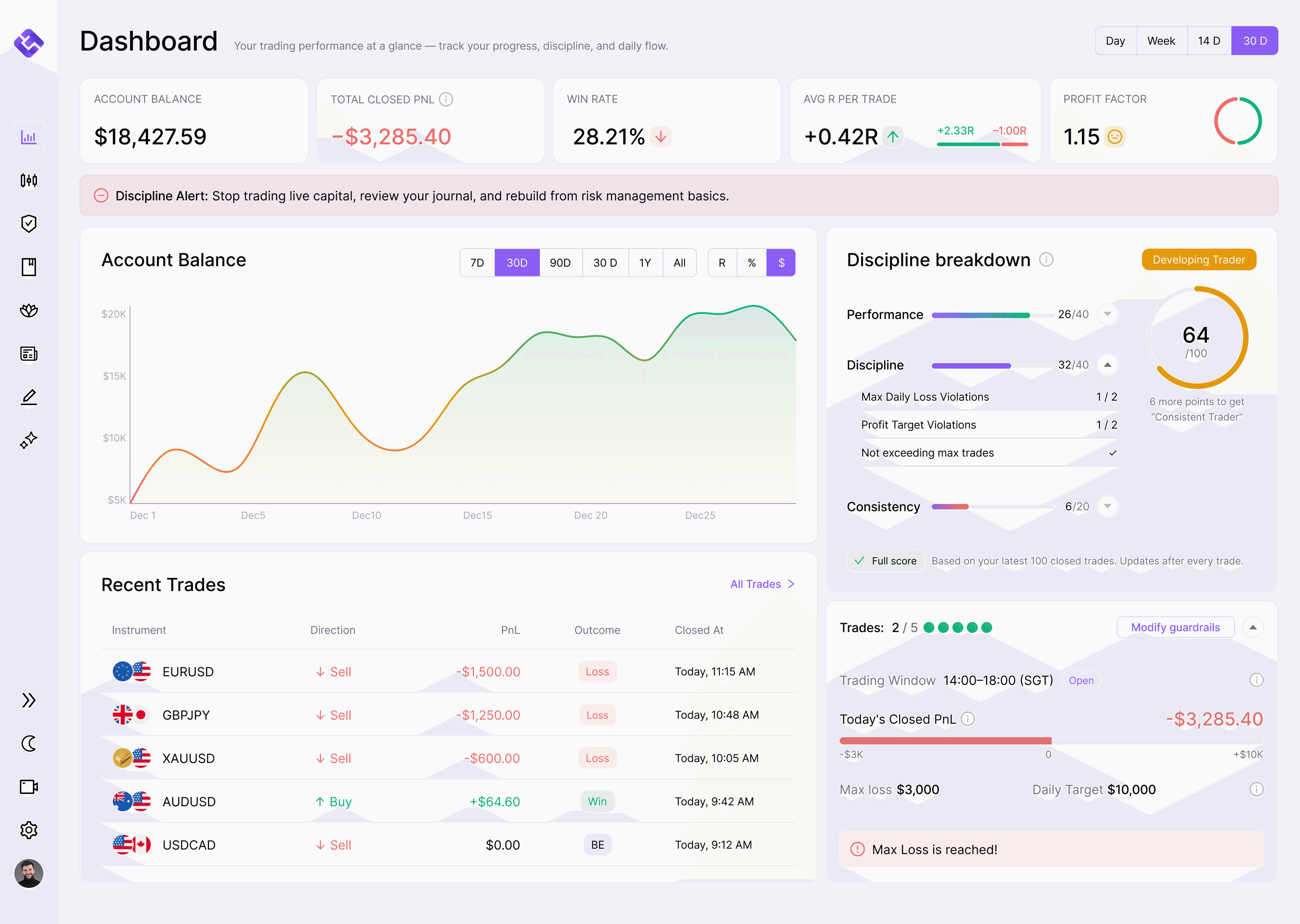
After each trade, the journal auto-imports your entry, exit, and R multiple. Over time, your dashboard shows whether imbalance-based TP placement actually improves your average R compared to reaching for further targets.
That kind of data turns a concept into a tested rule. You stop guessing whether imbalances matter for your trading and start knowing.
The Edge Brief
Receive Insights on trading psychology, discipline, and the behavioral patterns that create consistent traders from our Founder and the EdgeFlo team, delivered to your inbox.
Think different. Trade different.
What is a market imbalance in forex?
Do all imbalances get filled?
How do I find imbalances on a chart?
Should I enter trades at imbalance zones?

Turn discipline on.
Every session.
EdgeFlo is the environment serious traders operate inside.
Start 7-Day Free Trial
Cancel anytime.
No long-term commitment.

Think Different, Trade Different.