

The Emotional Cycle Behind Every Drawdown
Drawdowns follow a predictable emotional pattern: pride, comfort, disgust, anger, repeat. Map each stage to intervene before hitting bottom.
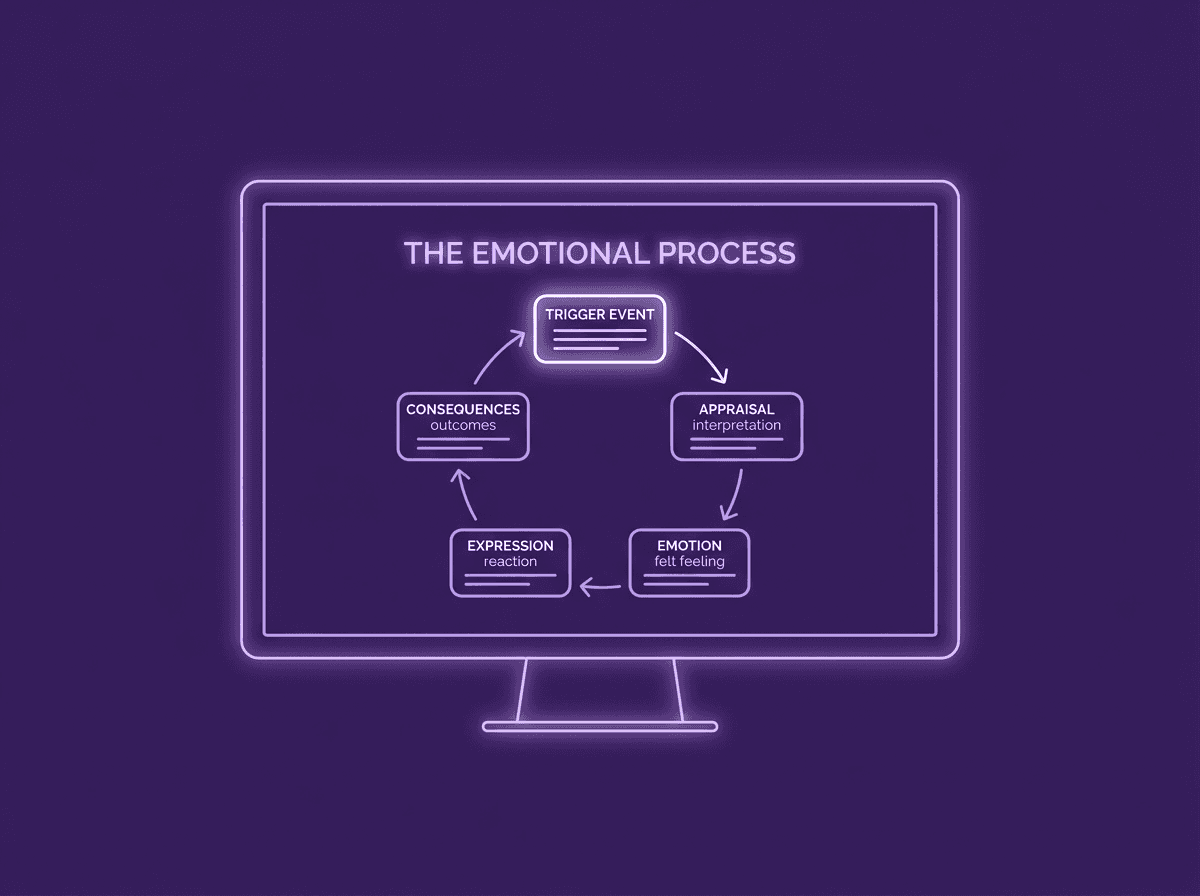
Every drawdown feels unique when you are in it. The market turned on you, the setup failed, the timing was off. But if you step back and look at the pattern across multiple drawdowns, the same emotional sequence shows up every time. Pride, comfort, complacency, disgust, anger, motivation. Then it loops.
Understanding this cycle does not make drawdowns disappear. But it does give you a map. When you know which stage you are in, you can intervene before the cycle drags you all the way to rock bottom.
TL;DR
Drawdowns follow a predictable five-stage emotional cycle, not a random pattern.
The cycle runs: pride (climbing), comfort (peak), disgust (falling), anger (floor), motivation (recovery).
The comfort stage is where all the damage starts, because zero emotional pain means zero vigilance.
Recognizing your current stage lets you intervene early instead of waiting for rock bottom.
Emotion tagging in your journal turns the cycle from invisible to obvious.
The Five Emotional Stages of a Drawdown
Every drawdown follows this path. The details change. The emotional architecture does not.
Stage 1: Pride (pain level: 3/10). You are doing the work. Following your plan, journaling, respecting risk. Wins are accumulating. You feel a legitimate sense of accomplishment. This is the healthy zone. You are climbing toward your ceiling.
This stage feels good for the right reasons. You are keeping promises to yourself. The discomfort is low but present: you still feel the effort of preparation, the tension of each entry, the discipline of sticking to criteria when a marginal setup tempts you.
Stage 2: Comfort (pain level: 0/10). You hit the peak. Account is at a high-water mark. You feel like you have figured it out. The effort that characterized the pride stage dissolves into ease. Everything feels automatic.
This is the stage that kills accounts. Zero pain means zero motivation to maintain the habits that produced the results. The pre-session routine gets shorter. The journal entries get thinner. The position sizes creep upward. And it all feels perfectly justified, because you are winning.
Stage 3: Disgust (pain level: 8 to 12/10). The losses arrive, amplified by the compromised risk management from the comfort stage. You look at your equity curve and your journal (if you kept one), and you are disgusted with what you see. The gap between who you want to be and who you have been acting like is unbearable.
This is where self-sabotage peaks. Some traders double down in desperation. Others freeze and stop trading entirely. Both reactions extend the drawdown.
Stage 4: Anger (pain level: 10/10). Rock bottom. You are furious at yourself, at the market, at your broker, at everything. The anger is painful, but it serves a purpose: it breaks through the inertia. You are sick and tired of being in this position.
Stage 5: Motivation (pain level: 8/10). The anger crystallizes into determination. You recommit to your rules, your process, your standards. You start doing the right things again. Pain is still high, but it is now fuel instead of poison.
And then the cycle repeats. The motivation carries you back to pride. Pride reaches the ceiling. The ceiling tips into comfort. Comfort leads to the next drawdown.
Where Most Traders Lose Control in the Cycle
Most traders believe they lose control during the anger or disgust stages. Those feel the worst, so they seem like the problem. But the actual loss of control happens during the comfort stage.
Here is why. During comfort, your decisions feel reasonable. "I will take one extra trade" is not a crisis. "I will increase my size slightly" is not a red flag when you have been winning. "I will skip the journal today" seems harmless because today was easy.
Each of those micro-decisions is invisible in isolation. Together, they completely change your risk profile. By the time the losses arrive, you are operating with a fundamentally different risk setup than the one that produced your winning streak.
The disgust and anger stages are painful, but they are actually self-correcting. The pain is so intense that it forces action. Comfort is dangerous precisely because nothing forces anything. You drift.
Walkthrough: The Invisible Drift During Comfort
A trader on USD/JPY has a $20,000 account. During the pride stage, he follows his plan precisely: 1% risk per trade ($200), 3 trades per day, journal every entry.
He hits the comfort stage after a +6% month. Account at $21,200. He feels great.
Week 1 of comfort: He stops journaling 2 out of 5 days. Still winning. He does not notice.
Week 2: He bumps his lot size from 0.3 to 0.4 on USD/JPY with a 50-pip stop.
Math check: 0.3 lots on USD/JPY = approximately $1.98/pip (using $6.60/pip per standard lot). $1.98 times 50 pips = $99 risk. That is 0.5% of $20,000. His original plan was conservative.
Math check on drift: 0.4 lots = approximately $2.64/pip. $2.64 times 50 pips = $132 risk. That is 0.66% of $20,000. Not a crisis, but a 33% increase that happened without a plan update.
Week 3: He takes 5 trades in a session because "the setups are everywhere." Two extra trades at $132 risk each = $264 additional exposure. Three of the five trades lose.
Math check: 3 losses at $132 each = $396. That is nearly 2% gone in one session from a plan that was designed for 0.5% per trade and 3 trades per day.
The drift from comfort to overexposure happened in small, "reasonable" steps. Each step felt justified. The damage accumulated invisibly until the losses revealed it.
How to Recognize Which Stage You Are In Right Now
Knowing the cycle exists is not enough. You need to locate yourself in it, right now, today, so you can apply the right intervention.
Check 1: What is your pain level? Rate your emotional discomfort on a 1 to 10 scale. If it is 0 to 2, you are likely in the comfort zone. That is the danger zone.
Check 2: What does your recent journal look like? If entries are getting thinner, shorter, or missing entirely, you are drifting from pride toward comfort.
Check 3: Has your behavior changed in the last 2 weeks? More trades per day? Bigger lot sizes? Skipped preparation? New pairs you have not back-tested? Any of these signal the comfort-to-complacency transition.
Check 4: How do you feel about your trading fear? In the pride stage, you feel a healthy respect for risk. In the comfort stage, the fear is gone. In the disgust stage, it is overwhelming. In the anger stage, it transforms into defiance.
Pull up your post-trade reviews from the last 2 weeks. The emotion tags and notes will tell you exactly where you are.
Breaking the Loop Before Disgust Sets In
The goal is not to eliminate the cycle. It is to catch it at the comfort stage and intervene before it reaches disgust.
Intervention at comfort: Schedule friction. When you notice zero emotional discomfort, add friction back in. Force yourself to write a detailed journal entry for every trade, even if it feels pointless. Do a full pre-session review, even if you think you already know what the market looks like.
Intervention at early complacency: Check the numbers. Pull your last 10 trades. Compare lot sizes, trade count, and win rate to your 3-month average. If anything has drifted more than 15%, you have your answer.
Intervention at disgust: Do not make decisions. When disgust hits, the worst thing you can do is try to "fix" everything at once. Do not overhaul your strategy. Do not delete your broker account. Walk away for 24 hours, then return to your existing plan with renewed commitment.
Intervention at anger: Channel it into standards. Anger is energy. Use it to write (or rewrite) your trading standards. "I will never again risk more than 1% per trade" carries more weight when written in genuine anger at yourself for breaking that rule. Knowing when to stop trading is a standard that prevents anger from turning into revenge.
Walkthrough: Catching It at Comfort
A trader checks her weekly review and rates her emotional discomfort at 1/10. She has been winning steadily for 3 weeks. She pulls her data: average trade count has gone from 2.8 per day to 3.6. Lot size drifted from 0.1 to 0.12.
She recognizes the comfort stage. She resets: back to 0.1 lots, journal every single trade, and adds a rule: "If my trade count exceeds 3 in a session, I must write a one-paragraph justification for each extra trade before the next day."
Two weeks later, her drawdown was -1.2% instead of the -5% to -8% drawdowns she has experienced in past cycles. The intervention saved her weeks of recovery time.
How EdgeFlo Tracks Emotional Patterns Across Trades
EdgeFlo's AI-powered trading journal with emotion tagging captures your emotional state alongside every trade. Over time, the data reveals your personal version of the cycle: which emotions precede your best streaks, which emotions precede your worst drawdowns, and where the transition points live.
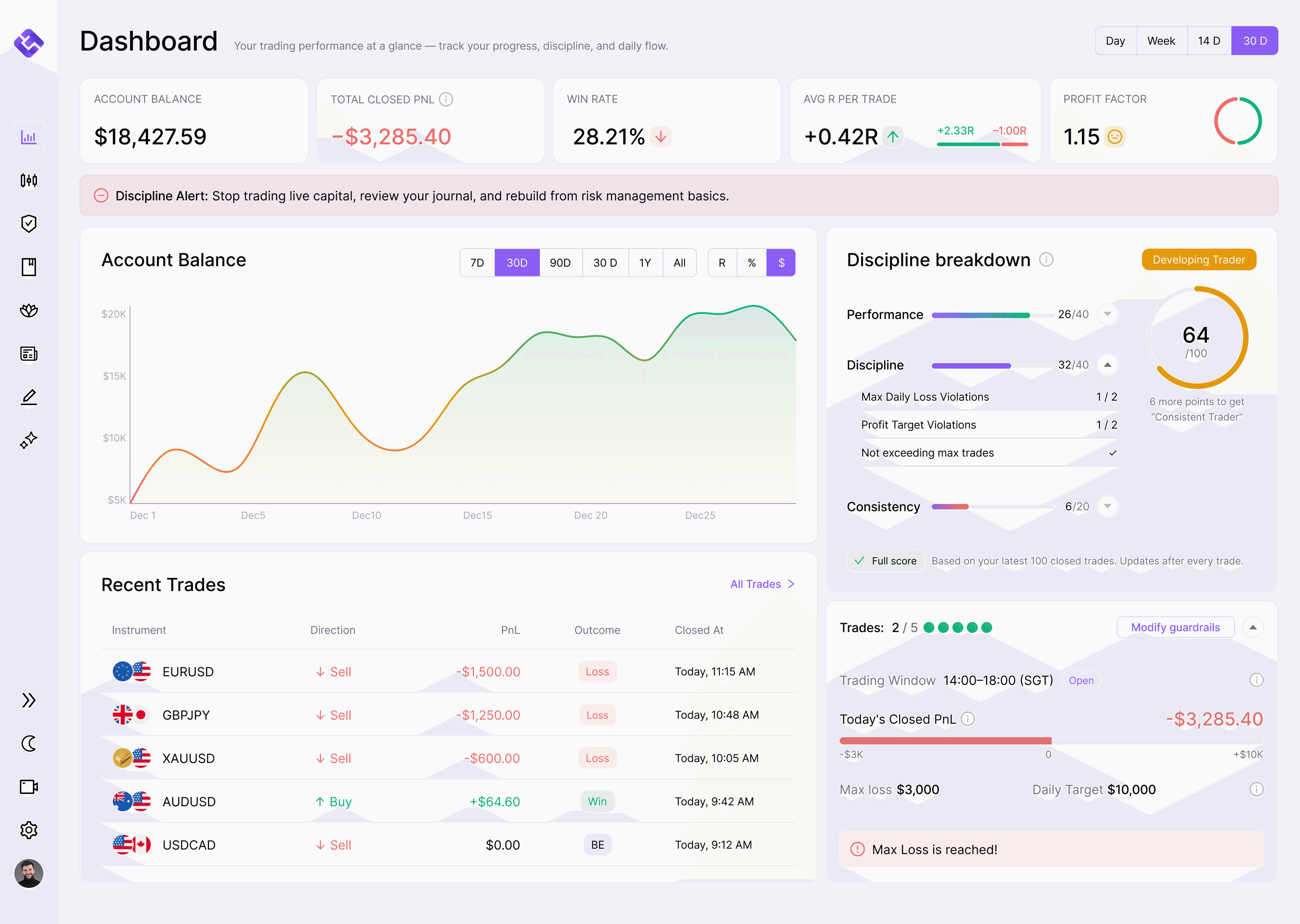
The trading dashboard aggregates this data into performance metrics, including win rate, profit factor, and edge score, so you can correlate emotional patterns with actual results. When you can see that your last three comfort-tagged weeks all ended in drawdowns, the pattern becomes undeniable.
That visibility transforms the emotional cycle from a hidden force into a trackable, predictable pattern. You stop being surprised by drawdowns and start preparing for them.
The Edge Brief
Receive Insights on trading psychology, discipline, and the behavioral patterns that create consistent traders from our Founder and the EdgeFlo team, delivered to your inbox.
Think different. Trade different.
What is the emotional cycle behind trading drawdowns?
Which stage of the emotional cycle is the most dangerous?
Can you skip stages in the emotional cycle?
How do I break out of the emotional cycle?

Turn discipline on.
Every session.
EdgeFlo is the environment serious traders operate inside.
Start 7-Day Free Trial
Cancel anytime.
No long-term commitment.

Think Different, Trade Different.