

Edge Over Luck: Why Systems Beat Instinct Every Time
Luck wins single trades. Systems win over hundreds. Learn why a rules-based approach always beats gut instinct and how to prove your system has real edge.

A rules-based trading system beats gut instinct over any meaningful sample of trades. That is the short answer. Luck can win you a single trade, sometimes even a string of five. But luck cannot survive 100 trades, 200 trades, or 1,000 trades. Only a system with a genuine statistical edge can do that.
The difference between a lucky trader and a profitable one is simple: the profitable trader can explain exactly why they entered, where they placed their stop, and what their target was, on every single trade. The lucky trader just "felt it."
TL;DR
Luck produces random outcomes that vanish over large sample sizes. Systems produce repeatable outcomes that compound.
A system with even a small positive expectancy (like 5%) generates consistent profits over hundreds of trades.
Gut instinct traders change their approach after every loss. System traders trust their rules through losing streaks.
Proving edge requires a minimum of 100 trades under identical rules, tracked with real data.
The fastest way to separate luck from skill is to backtest your strategy against historical price action.
Why Luck Disappears Over Time
Think about a roulette wheel. Most players assume they have a 50/50 shot when they bet on red or black. They do not. An American roulette wheel has 18 red slots, 18 black slots, and 2 green slots. That is 38 total. If you bet on black, your odds are 18 out of 38, which equals 47.3%. The house sits at 52.7%.
That 5.4% gap looks like nothing on a single spin. On one bet of $100, the casino's mathematical advantage is $5.40. Barely worth mentioning.
Now stretch that across 1,000 spins at $1,000 each.
The players collectively win 47.3% of the time: $473,000 returned. The house wins 52.7%: $527,000 collected. Net profit for the house: $54,000. Every single time. Not because the house wins every spin. Because the house wins over enough spins.
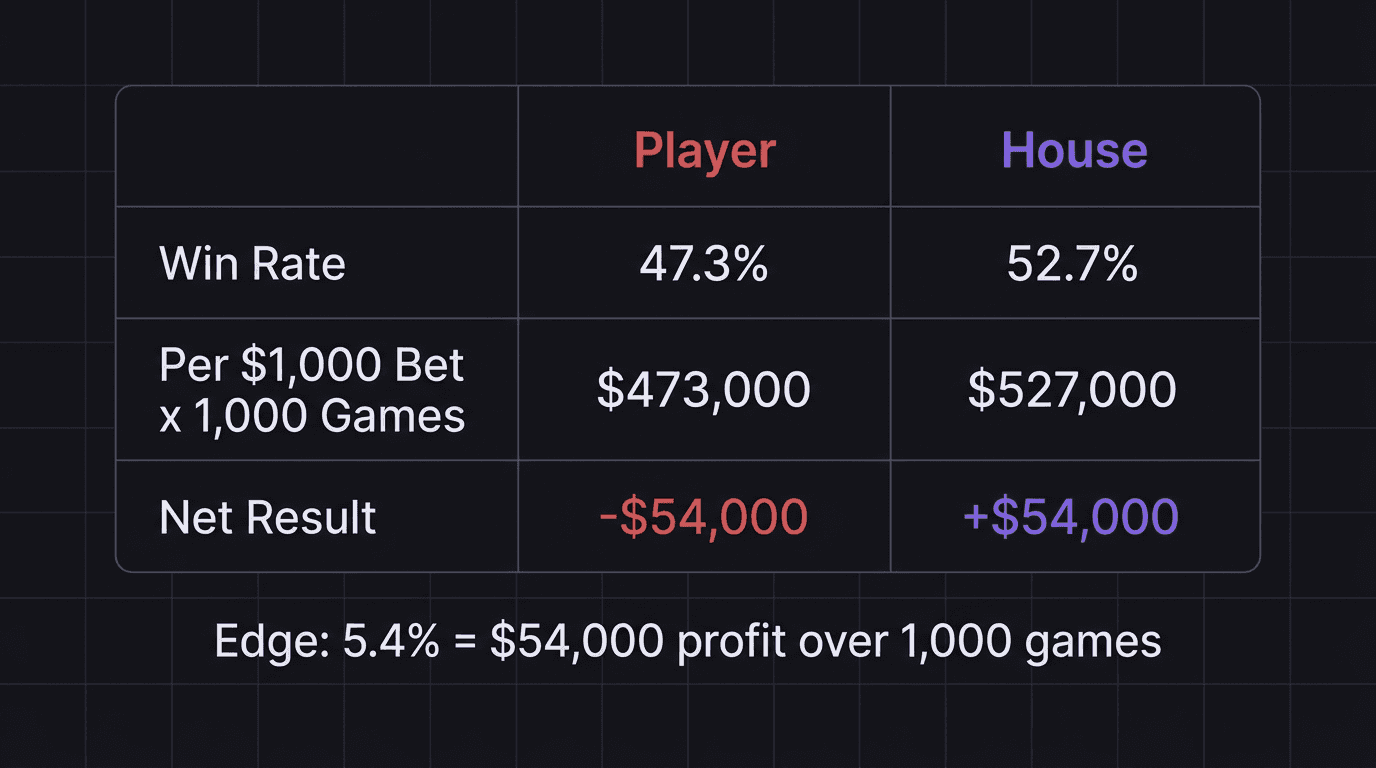
This is the law of large numbers at work. Over a small sample (5 spins, 10 spins), anything can happen. The player might walk away up $5,000. Over a large enough sample, the edge always shows up. Casinos know this, which is why they never panic after a bad night. They just keep the doors open.
Trading works exactly the same way.
The Gambler vs. the System Trader
A gambler and a system trader can take the exact same trade on the same pair at the same time. From the outside, the two look identical. But their decision process is completely different, and that difference determines who survives.
The gambler enters because they "feel" the market is going up. Maybe GBP/USD looked bullish after a quick glance. Maybe they heard something on a forum. Maybe they just want to make back yesterday's loss. There is no written plan, no predefined stop, no calculated position size. When the trade goes against them, they move their stop or remove it entirely. When it goes their way, they close early because they are afraid of giving back the profit.
Sound familiar?
The system trader enters because the setup matches their documented trading plan. The criteria are specific: trend direction confirmed on the higher timeframe, price in the discount zone, a break of structure on the lower timeframe. The stop goes below the recent swing low. The target sits at the next supply zone. Position size follows a fixed risk percentage.
When the trade goes against the system trader, they take the loss. No negotiation. When it goes their way, they follow the exit rules. No improvising.
The gambler might win more often this week. But over the next quarter, the system trader pulls ahead because their approach has positive expectancy and the gambler's does not.
Walkthrough: The Instinct Trader Who Won, Then Lost Everything
Picture a trader (call them Trader A) who catches a big move on EUR/USD during London session. They had no plan, no checklist, just a feeling that price was heading up after a strong candle. They enter long at 1.0850 with 1 standard lot, no stop loss.
Price runs to 1.0920. That is 70 pips, or $700 on a standard lot. Trader A feels unstoppable.
The next day, Trader A does the same thing. Enters long on a feeling. Price drops 40 pips. No stop loss, so they hold. It drops another 30 pips. Now they are down 70 pips ($700), and the previous day's gain is gone. They double down, adding another lot. Price falls another 50 pips. That second lot alone costs $500. Total damage: $1,200 across both positions.
Two days of instinct trading. Net result: negative $500. The big win from Day 1 did not just disappear. It was erased by the exact behavior that produced it: no rules, no stops, no system.
Walkthrough: The System Trader Who Lost, Then Won
Now picture Trader B. Same pair, EUR/USD. Trader B has a tested strategy with a 40% win rate and a 3:1 reward to risk ratio. They risk 1% of a $10,000 account per trade ($100 risk per trade).
Over the past two weeks, Trader B has taken 10 trades. Six losses and four wins.
6 losses at $100 each = $600 lost
4 wins at $300 each (3:1 ratio) = $1,200 gained
Net result: +$600
Trader B lost 60% of their trades and still made $600. That is what a system with positive expectancy looks like. The losses are part of the plan. They are the cost of doing business, not a sign that something is broken.
Trader A won their first trade but has no idea whether it will work next time. Trader B knows exactly what their numbers look like after the next 100 trades.
How to Prove Your System Has Real Edge
Claiming you have edge means nothing without proof. And proof means data, not stories.
Here is the minimum standard: take 100 trades using the exact same rules. Same entry criteria. Same stop placement method. Same position sizing. Same exit rules. No exceptions, no "well, this one looked different so I adjusted."
After 100 trades, calculate your expectancy:
Expectancy = (Win Rate x Average Win) minus (Loss Rate x Average Loss)
If that number is positive, your system has edge. If it is negative, it does not. If you only have 20 or 30 trades, you cannot draw conclusions yet because the sample is too small. Variance will trick you into believing a losing system works or a winning system is broken.
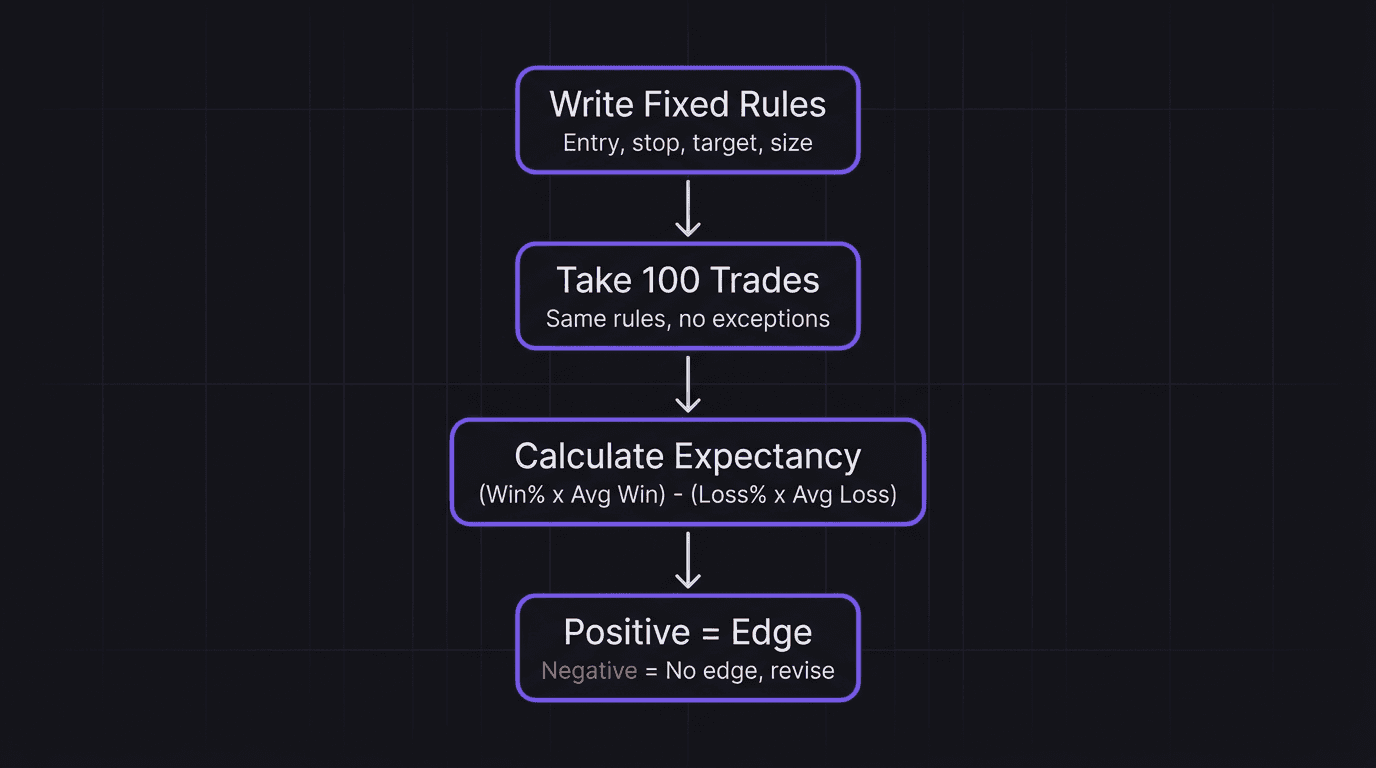
This is why backtesting matters so much. You can run your rules against hundreds of historical setups before risking real money. If the numbers hold up in backtesting and then hold up in forward testing with small size, you have genuine evidence of edge. Not a feeling. Not a hope. Evidence.
Why Instinct Traders Keep Changing Their Rules
Here is the trap. A trader enters based on instinct, loses three trades in a row, and concludes their "strategy" is broken. So they switch to a new approach. A different indicator, a different timeframe, maybe a completely different market.
They take a few trades with the new method. One works, two do not. They switch again. This cycle can go on for months, sometimes years. They never accumulate enough trades with any single approach to know whether it actually has edge.
The casino does not change the rules of roulette after a bad night. It does not replace the 2 green slots with 4 green slots because a player won big. The rules stay the same because the casino knows the math works over time.
The same principle applies to your trading plan. If you have backtested it over a meaningful sample and the expectancy is positive, three losses in a row are not a signal to change everything. They are a normal part of any system with less than 100% accuracy (which is every system).
Refine your plan once per quarter, based on data from your journal. Not after every losing trade.
The Boring Truth About Profitable Trading
Nobody wants to hear this, but profitable trading is repetitive. You run the same pre-market checklist. You scan for the same setup. You enter when the criteria line up. You manage the trade the same way. You journal it. You do it again tomorrow.
There is no dramatic moment where you outread the market with your gut. There is no "I just knew it" story. There is just a process that grinds out small gains, trade after trade, week after week.
This is why the best traders are often described as boring. They are not bored because they lack skill. They are boring because they found something that works and they refuse to deviate from it for entertainment or excitement.
The casino analogy holds here too. Casinos do not get creative with roulette. They do not add new colors to the wheel for fun. They run the same game, the same rules, the same odds, thousands of times per day. The edge does the work. The consistency does the compounding.
Your job as a trader is the same: find the edge, document it, execute it without variation, and let the law of large numbers do the rest.
How EdgeFlo Helps You Trade Like the House
EdgeFlo's Edge plan builder lets you define and store your strategy so it stays visible during every session. Your entry criteria, stop rules, and exit conditions sit right next to your charts, not buried in a notebook you forgot at home. You can reference your documented plan before every trade and then self-report whether you followed it afterward.
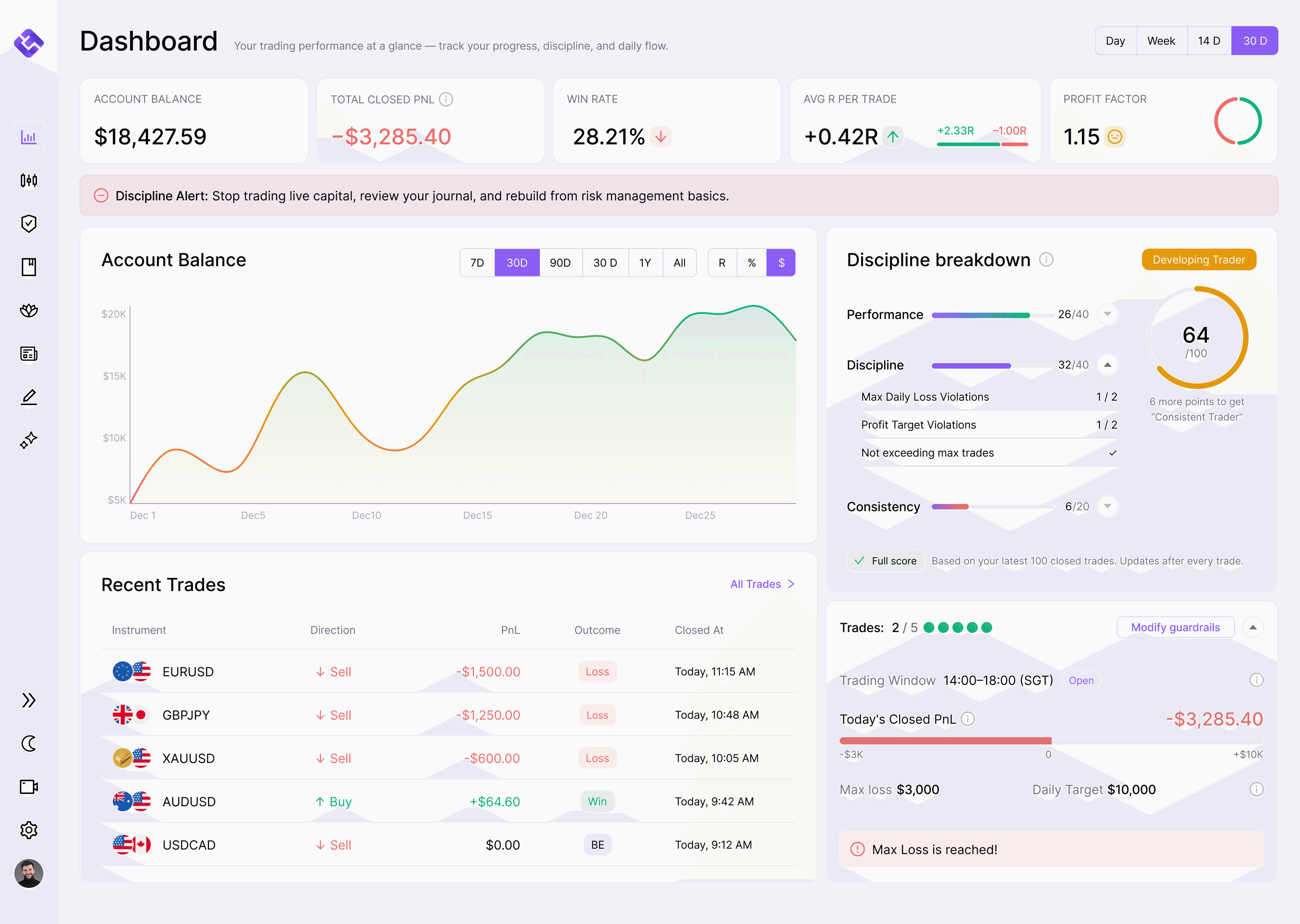
The dashboard tracks your win rate, average R, and EdgeScore over time, giving you the data to calculate expectancy from real trades. Instead of guessing whether you have edge, you see the numbers build across 50 trades, then 100, then 200. That is how you stop relying on instinct and start trusting your system.
The Edge Brief
Receive Insights on trading psychology, discipline, and the behavioral patterns that create consistent traders from our Founder and the EdgeFlo team, delivered to your inbox.
Think different. Trade different.
How do I know if my trading results are edge or luck?
Can gut instinct ever work in trading?
How many trades do I need to prove my system works?
What is positive expectancy in trading?

Turn discipline on.
Every session.
EdgeFlo is the environment serious traders operate inside.
Start 7-Day Free Trial
Cancel anytime.
No long-term commitment.

Think Different, Trade Different.