

Daily Loss Limits: Your Safety Net for Bad Days
Daily loss limits do more than protect capital. They reveal whether your trading style fits your emotional capacity. Use limits as diagnostic data.
A daily loss limit is not just a kill switch that protects your capital. It is a diagnostic tool that reveals whether your trading style actually fits your emotional capacity. If you hit your limit once a month, bad luck happens. If you hit it every week, the style is wrong, not just the execution. The limit exposes the mismatch before it drains your account.
TL;DR
Daily loss limits protect capital on bad days, but their real value is diagnostic.
Hitting your limit occasionally is normal. Hitting it weekly signals a style or risk mismatch.
Limits should match your trading timeframe: scalpers need tighter limits than swing traders.
After hitting a limit, review the trades that triggered it, not just the dollar amount.
Use limits as data to refine your style, not as punishment for having a bad day.
Loss Limits Are Not Just a Kill Switch
Most traders think of daily loss limits as a simple off switch. Lose X amount, stop trading. That is the surface-level function. But the real value is in what the limit tells you over time.
A loss limit forces a pause. That pause creates a gap between the emotional reaction ("I need to make it back") and the next decision. Without that gap, losing traders spiral. Three losses become six. Six become ten. The session ends with a hole so deep it takes a week to recover.
But beyond the immediate protection, your loss limit data creates a feedback loop. How often do you hit it? What triggers the losing streaks that reach it? Are the losses from your planned setups failing, or from impulsive off-plan trades?
The answers to those questions tell you more about your trading style fit than any personality quiz ever will.
What Hitting Your Limit Every Week Actually Means
One hit per month: normal variance. Every strategy has losing days. You took your stops, the setups did not work out, and the limit caught you before emotions took over. No problem.
One hit per week: a pattern worth investigating. Pull up the trades that triggered each limit hit. Were they plan-compliant trades that simply lost? Or were they revenge trades stacked on top of initial losses?
If the limit-triggering trades are mostly plan-compliant, your risk per trade might be too large for your style. A scalper risking 1% per trade who takes 5 trades per session has 5% of capital at risk. Three bad sessions and the account is down 15%. The math does not work for the frequency.
If the limit-triggering trades are mostly off-plan, the issue is emotional, not structural. You are taking impulsive trades when the plan says stop. That points to a style mismatch: the pace of your current timeframe generates more emotional triggers than you can handle.
Either way, weekly limit hits are a signal. Do not ignore them.
How Limits Expose a Style Mismatch
Here is how the diagnostic works:
Walkthrough: The Scalper Who Kept Hitting His Limit
A trader sets a daily loss limit of 3% ($300 on a $10,000 account). He risks 1% ($100) per scalp on the 1-minute chart. He takes 5 to 8 trades per session. In Week 1, he hits his limit on Tuesday and Thursday. In Week 2, he hits it on Monday, Wednesday, and Friday. That is 5 limit hits in 10 trading days.
He reviews the trades. On limit-hit days, the first 2 trades are plan-compliant losses. Trades 3 through 5 are revenge trades, bigger lots, no setup. The initial losses are the cost of doing business. The revenge trades are the style mismatch.
Scalping puts him in front of a new opportunity every 60 seconds after a loss. That is not enough cooling-off time for his emotional profile. Moving to the 4-hour chart gives him hours between decisions. After switching, his limit hits drop to once in three weeks. Same trader, same market, different style.
Walkthrough: When the Limit Is Set Wrong
A swing trader sets the same 3% daily limit. She risks 1% per trade and takes 1 to 2 trades per day. She almost never hits her limit because 2 trades at 1% risk only exposes 2% per day. The limit exists but adds no practical protection for her style. She adjusts her daily limit down to 1.5% ($150), which triggers if both trades lose. Now the limit is relevant to her actual trading frequency. The tighter limit catches bad days earlier and forces a review that the 3% limit never triggered.
Setting Limits That Match Your Timeframe
Your daily loss limit should scale with your trading frequency:
Style | Trades/Day | Risk/Trade | Suggested Daily Limit |
|---|---|---|---|
Scalping | 5 to 15 | 0.5% | 1.5% to 2% |
Day trading | 2 to 5 | 1% | 2% to 3% |
Swing trading | 0 to 2 | 1% | 1% to 2% |
The logic: if you scalp 10 trades at 0.5% risk each, a 3-loss streak costs 1.5%. A 2% daily limit catches you before the 4th loss, which is exactly when revenge trading tends to start.
If you day trade 3 positions at 1% risk, a 3% limit catches a full wipeout session. That is aggressive but workable if your trades are plan-compliant.
The three-loss rule is a simpler version: three consecutive losses, you are done for the day regardless of the dollar amount. It works well for traders who struggle with the "one more trade to make it back" urge.
Knowing when to stop trading is the skill that separates surviving traders from blown accounts. Your limit automates that decision when emotions make it impossible to choose rationally.
How EdgeFlo Guardrails Enforce Limits and Surface the Pattern
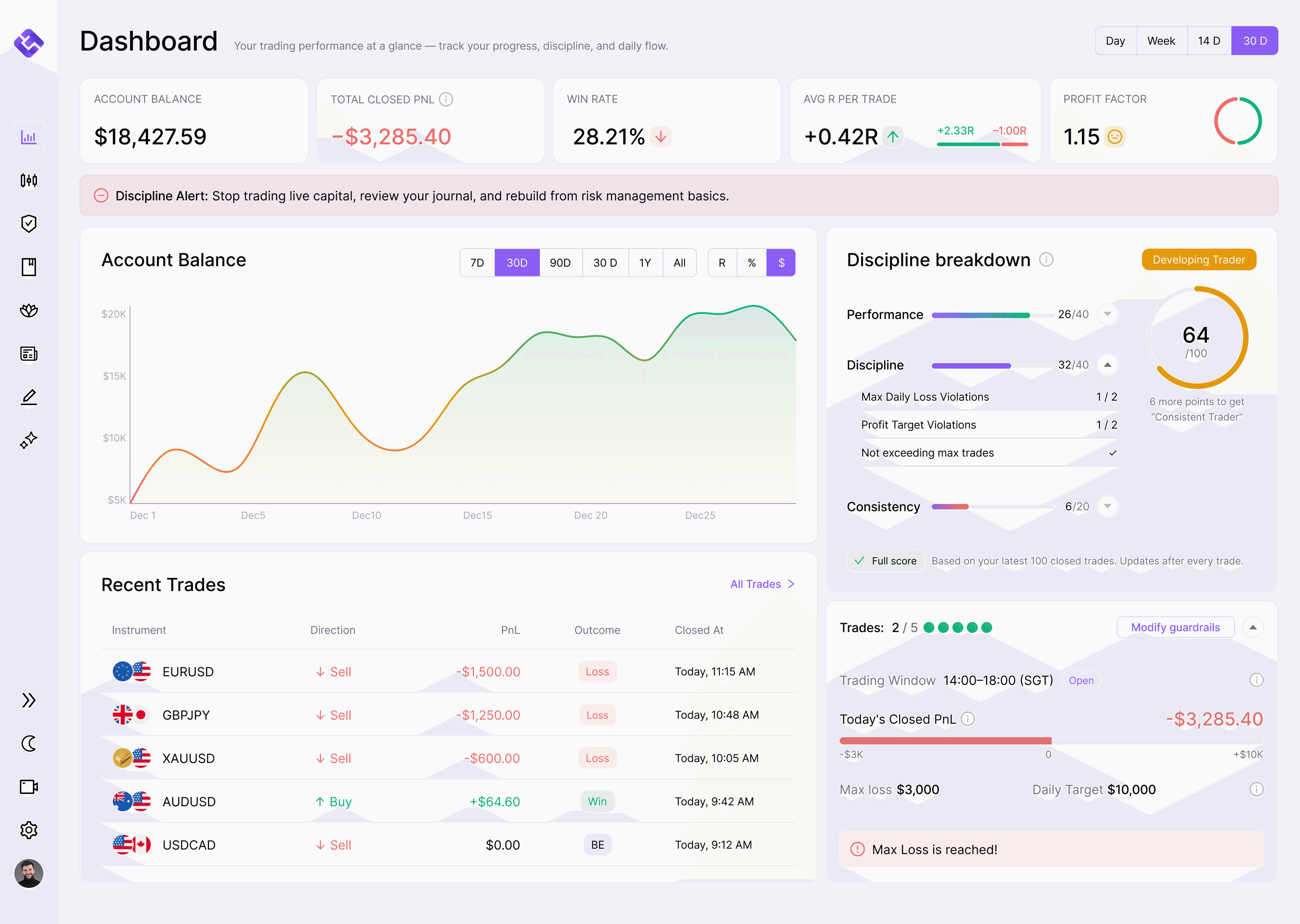
EdgeFlo's guardrail system lets you set daily loss limits and trade caps directly in your account settings. When you hit your limit, EdgeFlo restricts the trade button. You can override it (the system never locks you out permanently), but you have to make a conscious choice to continue.
That conscious override is the key design. On your worst days, the default is "stop." You have to actively decide to keep going. Most traders, when forced to pause and think, choose to stop. The ones who override and continue see the result in their journal data, which makes the next override harder to justify.
Over time, the guardrail logs show your limit-hit frequency. If you see the pattern increasing, that is your signal to investigate the style mismatch. If the frequency decreases, your execution is improving. The data does not judge. It just shows you the truth.
Risk per trade and daily loss limits work together as a system. Set one without the other and you leave a gap that bad days will exploit.
The Edge Brief
Receive Insights on trading psychology, discipline, and the behavioral patterns that create consistent traders from our Founder and the EdgeFlo team, delivered to your inbox.
Think different. Trade different.
What is a daily loss limit in trading?
How do I set my daily loss limit?
Does hitting my daily loss limit mean I am a bad trader?
Can I override my daily loss limit?

Turn discipline on.
Every session.
EdgeFlo is the environment serious traders operate inside.
Start 7-Day Free Trial
Cancel anytime.
No long-term commitment.

Think Different, Trade Different.