

Trading Journal: What to Record, Review, and Why It Works
Mar 1, 2026
A trading journal is the feedback loop that turns losses into lessons. Learn what to record, how to review, and why 100 trades changes everything.

A trading journal is a structured record of your trades: what you took, why you took it, and what happened. But the real value is not the record itself. A trading journal is a feedback loop. It connects your decisions to their outcomes so you can see what actually works, what does not, and where your process breaks down. Without one, every loss feels the same. Every win feels earned. You have no way to separate good decisions from lucky ones. Most traders who quit journaling treat it like homework. The ones who stick with it treat it like a mirror, the only tool that shows you what your trading actually looks like, not what you think it looks like.
What a Trading Journal Actually Does
A trading journal does one thing: it closes the gap between what you planned and what you did.
Most traders think they follow their rules. When you journal consistently for a month, you discover you follow your rules maybe 60-70% of the time. That gap, between perceived discipline and actual discipline, is invisible without a journal.
A journal reveals what nothing else can:
Pattern recognition across trades. One bad trade is noise. Twenty bad trades with the same entry mistake is a pattern. You cannot see patterns without records.
The difference between good losses and bad losses. A good loss is a trade where you followed your plan and the market said no. A bad loss is a trade where you broke your rules. Without a journal, every loss feels like failure. With a journal, you can separate the losses that teach from the losses that hurt.
Emotional triggers. You might discover that you overtrade on Mondays, or that you revenge trade after two consecutive losses. These patterns only emerge from data.
Whether your strategy actually has an edge. Win rate, average R, and profit factor are just numbers on a dashboard. Your journal gives those numbers context: the why behind the what.
A journal is not a diary. It is a diagnostic tool. Treat it like one.
What to Record in Your Trading Journal
The biggest mistake traders make with journaling is recording too much or too little. Too much creates friction, and you stop doing it. Too little gives you nothing to review.
If you are looking for a trading journal template, the structure below is your baseline. A template gives you the fields, but the real value comes from filling them consistently and reviewing them weekly. Whether you use a trading journal app, a trading journal in Excel, or a free trading journal in a notebook, these are the sections that matter for every trade:
The Setup
Instrument and timeframe. What did you trade and on what chart?
Entry confluences. Why did you take this trade? List the specific factors, not "it looked good," but "daily level support + bullish engulfing on the 1H + London session open." If you cannot list your confluences, you did not have a plan for the trade.
Screenshots. Capture your chart at the moment of entry. Include the higher timeframe for context, the execution timeframe for the entry, and the lower timeframe if you used one for timing. Screenshots are proof; they prevent your memory from editing the story after the fact.
The Execution
Entry and exit prices. The raw data.
Stop loss and take profit levels. Where was your risk defined?
Trade management decisions. Did you move your stop? Take partials? Trail? Close early? Record what you did and why.
Risk per trade. How much of your account was on the line? This ties directly to your position sizing rules.
The Outcome
Result in R-multiples. Not just dollars. A 1R win on a disciplined trade matters more than a 3R win on a gamble.
Whether you followed your plan. This is the most important field. Yes or no. If no, what did you deviate on?
The execution data (prices, lot sizes, P&L) is mechanical. It should not be the hard part. Auto-importing trades from your broker eliminates this friction so you can focus on the analysis: the why, the context, the decision quality. That is where the value lives.
The Emotion Tagging Method
Recording your emotional state is what separates useful journaling from data entry.
Emotion tagging means noting how you felt at three points during a trade:
Before entry. Were you calm, anxious, bored, frustrated, excited, or numb? Boredom and frustration are the two emotional states most likely to produce bad trades. Excitement often means you are chasing.
During the trade. Did your emotional state change? Did you feel the urge to move your stop, close early, or add to a losing position?
After exit. Regardless of the result, how did you feel? Relief, anger, indifference, vindication?
Over 20-30 trades, emotion tags reveal patterns that are invisible in the moment:
You might find that trades entered during frustration have a win rate 15 points lower than trades entered when calm.
You might discover that after a winning streak of 3+, you start overtrading, taking setups you would normally skip.
You might realize that your worst losses are not from bad analysis but from emotional states that distort your judgment.
This is not soft psychology. This is data. When you tag emotions consistently, you build a dataset that connects feeling to outcome. That dataset becomes the basis for rules, like "do not trade within 30 minutes of hitting a loss limit" or "if emotional state is frustrated, wait for the next session."
If typing feels like too much friction, use voice-to-text. Speak your post-trade notes instead of writing them. The goal is to capture the information while it is fresh. Reduce every barrier that might stop you from doing it.
How to Review Your Journal
Recording trades is half the work. The other half, the half most traders skip, is review.
A journal you never review is just an archive. It does not change your trading. The review is where learning happens. For a step-by-step system that covers weekly, monthly, and quarterly review cadences, see how to journal trades.
Weekly Review (30 Minutes)
At the end of each week, go through every trade and ask three questions:
Did I follow my trading plan? Count the trades where you did versus the ones where you did not. Your plan adherence percentage is the most important metric you can track, more important than P&L.
What patterns do I see? Look for repeated mistakes, repeated setups, repeated emotional states. One occurrence is an event. Three occurrences is a pattern.
What is one thing I will adjust next week? Not five things. One. Pick the highest-impact change and commit to it.
Monthly Review (60 Minutes)
Once a month, zoom out:
How has your plan adherence changed over 4 weeks?
Are the same mistakes repeating, or are they evolving?
Is your average R improving, declining, or flat?
What does your equity curve look like, and does it match your discipline data?
The monthly review is where you decide whether to keep your current rules, adjust them, or overhaul your approach entirely.
The Review Rule
Review without judgment. You are not grading yourself. You are gathering information. A loss where you followed your plan is a better trade than a win where you gambled. If your review sessions turn into self-criticism, you will stop doing them. Treat the journal like a flight recorder, not a report card.
The Rule of 100: Why Volume Matters
You need 100 recorded and reviewed trades before you can judge whether a strategy works.
Not 10. Not 20. Not 50. One hundred.
Most traders abandon strategies after 10-20 trades. They hit a losing streak of 3-4 trades and conclude the strategy is broken. But 10 trades tells you nothing about a strategy's edge. The sample size is too small. A strategy with a genuine 55% win rate can easily produce 6-7 losses in a row within a 100-trade sample. At 10 trades, that losing streak looks like failure. At 100 trades, it looks like normal variance.
The Rule of 100 works because:
It forces patience. You cannot judge a strategy on feeling. You need data, and data requires volume.
It exposes real patterns. At 100 trades, you have enough data to calculate meaningful win rate, average R, profit factor, and maximum drawdown. Below 100, these numbers are unreliable.
It rewards process over outcome. If you are focused on reaching 100 reviewed trades, your attention shifts from "am I making money?" to "am I executing well?" That shift in focus is where improvement happens.
The journal is the mechanism that makes the Rule of 100 possible. Without a journal, you cannot track 100 trades in any meaningful way. You cannot tag emotions, note confluences, or compare plan adherence across a large sample. The journal is the infrastructure.
A faster feedback loop means faster improvement. If you trade once a week, reaching 100 trades takes two years. If you trade daily, you can get there in a few months. The speed of your improvement is directly tied to how quickly you can complete and review 100 trades.
How EdgeFlo Helps
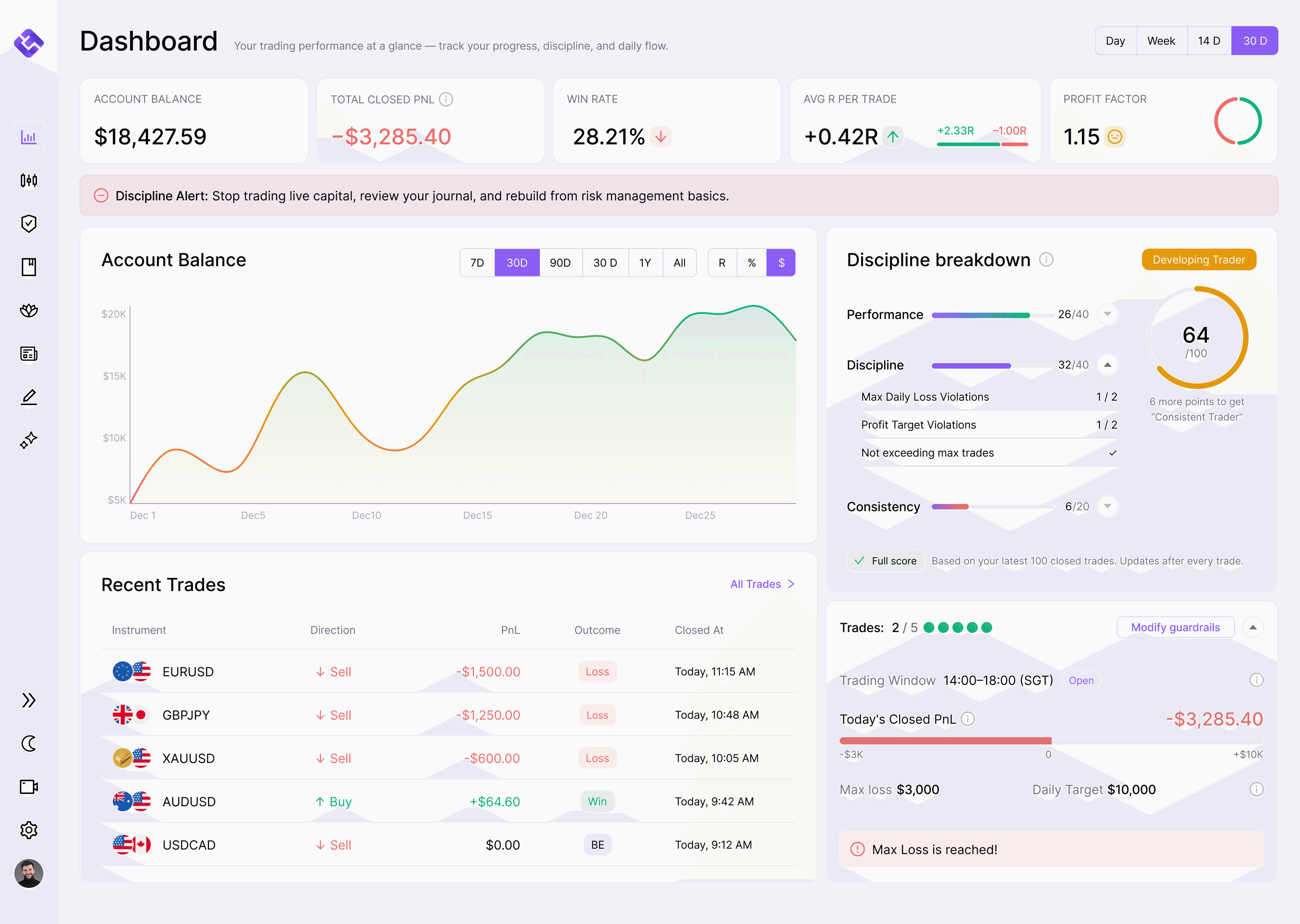
EdgeFlo's AI-Powered Journal auto-imports trades from your broker so you skip manual data entry and focus on what matters: the why behind each trade, your emotional state, and whether you followed your plan. Emotion tagging lets you tag your state before and after every trade, and over time it surfaces the patterns between your emotions and your outcomes so you can build rules around them.
The Weekly AI Report (Plus) automates part of your review by summarizing patterns, highlighting recurring behaviors, and flagging areas that need attention. And EdgeScore, a composite metric combining performance, discipline, and consistency, is gated by 100 trades for exactly this reason: below 100, the data is not reliable enough to produce a meaningful score.
Start the Feedback Loop
Most traders who fail at journaling do not fail because they lack discipline. They fail because the process has too much friction. Manual entry of execution data, switching between apps, opening spreadsheets: every step is a reason to skip it.
You can start a trading journal for free with a spreadsheet or a basic notes app. A trading journal in Excel works for the first 20-30 trades. It is flexible, customizable, and costs nothing. But manual entry creates friction that compounds over time. Excel cannot tag emotions automatically, auto-import trades, or generate pattern-recognition reports. The format matters less at the start and more as your volume grows toward that 100-trade threshold.
The fix is structural. Remove the friction. Automate what can be automated. Focus your effort on the parts that require your brain: the analysis, the emotion tags, the review. Every trade, win or loss, becomes a data point that moves you forward.

Turn discipline on.
Every session.
EdgeFlo is the environment serious traders operate inside.
Start 7-Day Trial — $7
Cancel anytime.
No long-term commitment.

Think Different, Trade Different.