

Waiting Is a Position: How to Stop Forcing Trades
Not every market move is an opportunity. Learn how to define objective setups, trade within your best session windows, and use clear limits to stop boredom, impatience, and FOMO from driving your decisions.

Quick answer: To stop forcing trades, treat waiting as a deliberate position, not a failure. Define objective entry rules before the session, mark your levels and set price alerts, trade only inside a fixed session window, and preset hard limits such as max trades per day and max daily loss so your rules still hold when emotions run high.
Every time you look at a chart, you have three choices: buy, sell, or wait. Most traders only ever consider the first two.
Waiting feels like doing nothing. It doesn’t show up on your P&L, it doesn’t feel productive, and when the market is moving, it feels like you’re missing out. So you take a trade. Then another. By the end of the session you’ve taken five trades when your plan called for one, and most of them didn’t meet your criteria.
If that sounds familiar, the problem usually isn’t your strategy. The problem is that you’re treating waiting as a failure instead of what it really is: a position. Waiting is a deliberate decision to keep your capital out of trades that don’t meet your rules. Learning how to stop forcing trades starts with that shift.
Why Does Everything Start to Look Like a Setup?
Everything starts to look like a setup because staring at charts for too long makes your brain invent signals. If you sit in front of the charts long enough, something will look interesting. That isn’t a sign of opportunity. It’s a sign you’ve been staring for too long.
Markets move constantly. Every move creates a pattern, a level, or a candle that could be read as a signal if you squint. When you don’t have a firm picture of what you’re waiting for, your brain fills in the gaps. A random pullback becomes “a retest.” A wick becomes “a liquidity grab.” A slow afternoon becomes “a breakout about to happen.”
This is how starts. Overtrading, meaning taking more trades than your plan allows or trades that don’t meet your criteria, rarely begins with one reckless decision. It begins with a series of small justifications that each feel reasonable in the moment.
Is Impatience in Trading a Willpower Problem?
Usually not. Impatience in trading is more often a clarity problem than a willpower problem.
When you don’t know exactly what you’re looking for, every move looks like a potential opportunity. When you do know, most moves are easy to ignore because they don’t match.
That’s why clear, objective trading rules matter so much, especially early in your trading journey. A good set of rules answers questions like these:
Which market and timeframes am I trading today?
Where is my, and what has to happen for price to reach it?
What specific confirmation do I need before I enter?
What would invalidate the idea?
The more objective your answers, the less room your emotions have to negotiate. Subjective criteria like “it looks strong” give you endless reasons to enter. Objective criteria like “price must close above this level on the 15-minute chart” give you one. Writing these down as a makes them easy to check in the moment.
A useful habit: alerts, then step away. Map your levels before the session and set price alerts at them. Then step away from the screen. If no alert fires, price hasn’t reached your area and there’s nothing to do. When an alert does fire, you check whether your confirmation is there. You’re reacting to your plan, not to whatever the market happens to be doing.
How Do You Know if a Trade Setup Is Valid? The “Obvious” Test
A valid setup usually looks obvious on the timeframes your plan uses. When you look back at the trades that worked cleanly, they tend to jump off the chart. You didn’t need to argue yourself into them.
Compare that to the trades you force. You flip from the 1-hour chart to the 5-minute chart and back again. You redraw your levels. You look for one more reason to say yes. If you have to work that hard to find the trade, the trade probably isn’t there.
Run two quick checks before any entry:
Is this setup obvious on the timeframes my plan uses? If you need to hunt across extra timeframes to justify it, pass. ( is one of the clearest signs of a forced trade.)
Could I explain this trade out loud without cringing? Say the reason for the entry in one or two sentences. If it sounds weak when you say it, it is weak.
Passing on a trade that later works feels bad for an hour. Taking trades that don’t meet your criteria damages your results, and your trust in your own process, for much longer.
When Should You Trade? At the Right Time, Not All the Time
You should trade only during the hours when your strategy historically performs best. Even a valid setup can underperform when the timing is wrong. A good trade idea is only one piece of the puzzle. Liquidity, volatility and session timing matter too.
Many intraday traders get their cleanest moves around the, such as London and New York, when liquidity flows into the market. Outside those windows, price often drifts sideways. That’s when traders get bored, start looking for something to do, and take setups they would normally skip.
Defining a trading window protects you here. Decide in advance when you trade, based on when your strategy performs best. Outside that window, you’re not looking for trades, no matter how interesting the chart looks.
Should You Trade During High-Impact News?
Only if news trading is part of your plan. High-impact releases such as US CPI (the Consumer Price Index, a key inflation report) or NFP (Non-Farm Payrolls, the monthly US jobs report) can move price further in one minute than it moved all morning. Spreads can widen and stops can slip during these releases. If trading the news isn’t part of your plan, stay out of new positions around them and avoid the.
The Pain of Boredom or the Pain of Blowing Up
There’s no pain-free path in trading. You’re going to feel something uncomfortable either way. The question is which discomfort you choose.
Patience is boring. Trading patiently means sitting through quiet sessions, letting setups go, and ending some days with zero trades. Overtrading is exciting in the moment, but it brings a different kind of pain: drawdowns, failed funding challenges, and the frustration of knowing you broke your own rules again.
If you don’t consciously choose the pain of boredom, you’ll end up with the pain of blowing up. Many traders overtrade because part of them is trading for excitement rather than results. Recognising that is the first step. Accepting that good trading is often boring is the second.
Why Willpower Alone Won’t Stop You From Forcing Trades
Willpower fails because it’s weakest exactly when you need it most. Knowing you should wait and actually waiting are two different things. You might be very disciplined at 8am with a fresh plan. After two losses and a missed move, that same discipline can disappear.
The rules you set while calm need to be built into your trading environment, so they still hold when you aren’t calm. These are the most useful limits to set in advance:
Limit | What it prevents |
|---|---|
Max trades per day | Caps how many attempts you get, which forces you to be selective. |
Max daily loss | Stops a bad day from turning into a disastrous one. |
Fixed risk per trade | Prevents you from doubling your size to “win it back.” |
Trading window | Keeps you out of the market outside your best hours. |
News blocking | Keeps you out around high-impact releases. |
The key is that you set these limits before the session, when you’re thinking clearly. During the session, the limits do the work your willpower can’t. If you’re unsure where to start, our guide on walks through choosing a number that fits your strategy.
How EdgeFlo Helps You Wait
EdgeFlo is a trading discipline platform built around one idea: you define your rules while you’re rational, and EdgeFlo helps enforce them while you’re emotional. EdgeFlo is not a broker and does not give financial advice.
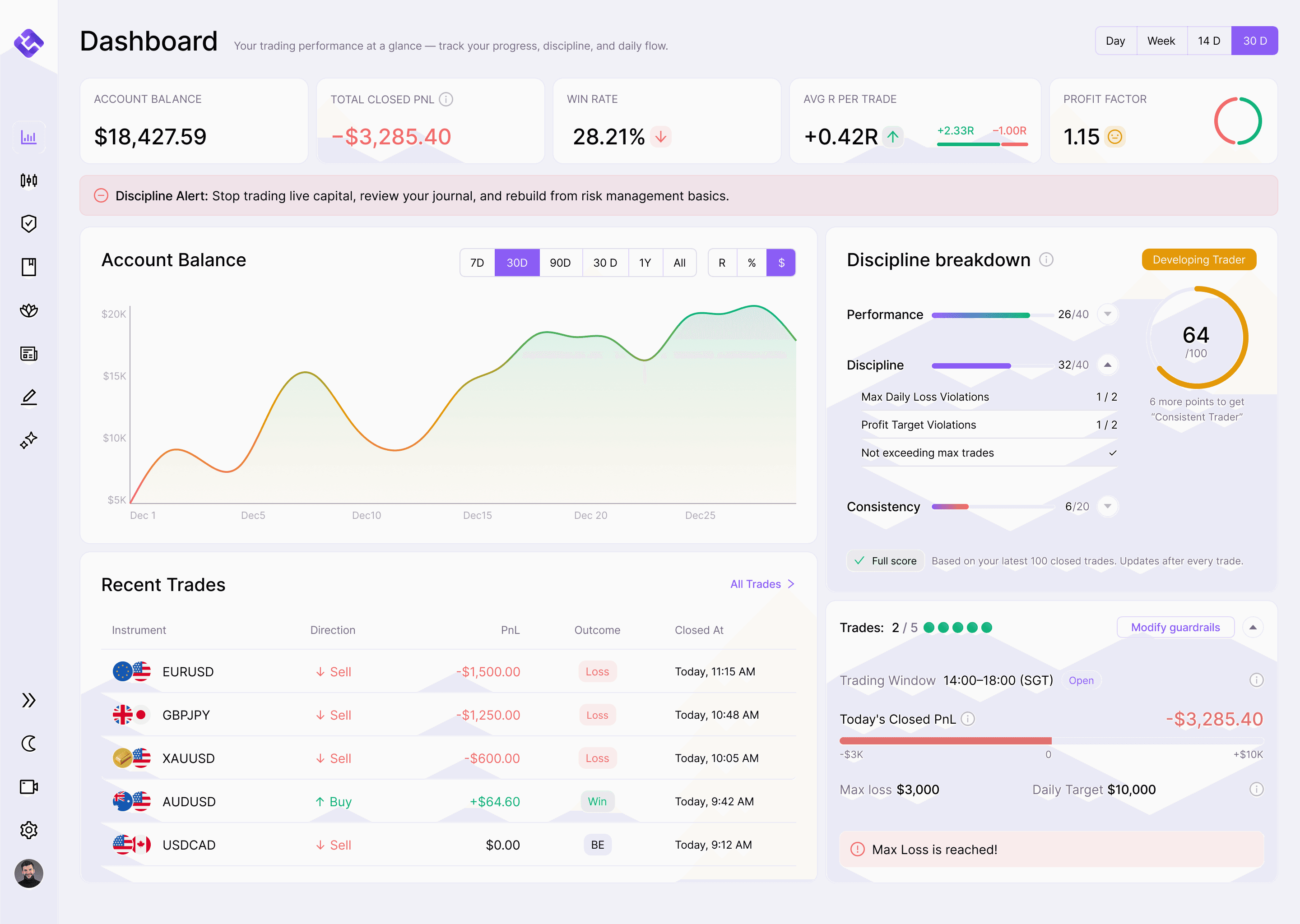
With EdgeFlo Guardrails, you set your max trades per day, max daily loss, risk per trade and trading window before you start. When you hit one of those limits, the trade button greys out and EdgeFlo shows you which rule you’ve reached. Try to take a sixth trade on a five-trade day, or enter outside your trading hours, and the trade doesn’t go through.
You can still override a block if you choose to. But you have to enter a reason, and the override is logged in your journal as a rule break. That moment of friction is often enough to make you stop and ask whether this trade is part of your plan or a reaction.
A few other EdgeFlo tools support the same habit:
Pre-Market Routine: a checklist you complete before trading, with the option to block trading until it’s done.
Active Trade Plan: your entry criteria sit beside the chart, so every setup gets checked against your rules.
Price Alerts: set them at your levels and step away until price reaches your area.
News Block Guardrail (Plus plan): blocks trading around high-impact economic events.
The show how to set up each Guardrail step by step.
Survive First, Then Thrive
Before you can thrive in the markets, you have to survive in them. Every trade you take outside your rules puts that survival at risk for no good reason.
Waiting isn’t a lack of action. Waiting is a decision to protect your capital until the market offers a trade that meets your criteria. And every time you follow your plan, whether the trade wins or loses, you reinforce the habits of the trader you’re trying to become.
You don’t need another strategy. You need to stop breaking the one you already have. The simplest way to stop forcing trades is to make waiting part of the plan.
Key Takeaways
Waiting is a position: a deliberate choice to keep capital out of trades that don’t meet your rules.
Impatience is usually a clarity problem. Objective entry criteria leave emotions less room to negotiate.
If a setup isn’t obvious on your plan’s timeframes, or sounds weak when you explain it, skip it.
Trade inside a defined session window and stay out around high-impact news unless news trading is in your plan.
Set hard limits (max trades, max daily loss, fixed risk) before the session, because willpower fades after losses.
The Edge Brief
Receive Insights on trading psychology, discipline, and the behavioral patterns that create consistent traders from our Founder and the EdgeFlo team, delivered to your inbox.
Think different. Trade different.
Why do I keep forcing trades?
How do I know if a trade setup is valid?
How many trades should I take per day?
Should I trade during CPI or NFP releases?

Turn discipline on.
Every session.
EdgeFlo is the environment serious traders operate inside.
Start 7-Day Free Trial
Cancel anytime.
No long-term commitment.

Think Different, Trade Different.