

Stopped Out Right Before the Move? Why Price Hits Your Stop Loss Then Reverses
Find out why price can hit your stop and then reverse, how liquidity sweeps and inducement work, and when to use aggressive or conservative entry models.

Quick answer: Price often hits your stop loss and then reverses because your stop sat in a pool of liquidity. Price travels to obvious highs and lows to trigger resting orders before making its real move. This usually happens when you enter before the final liquidity sweep, or when you trade against the internal structure.
Two of the most frustrating moments in trading look like opposites. In the first, price takes your stop, then runs exactly where you said it would. In the second, you wait for one more confirmation and watch the trade leave without you.
Both usually come down to the same skill: reading liquidity. This article explains why price hits your stop loss then reverses, how liquidity sweeps work, and how to pick an entry model that fits the context.
What is liquidity in trading?
Liquidity is where orders sit. Above obvious highs, you'll find buy stops from short sellers and breakout buyers. Below obvious lows, you'll find sell stops from buyers and breakout sellers.
Price needs those orders to move, so it often travels to these pools before making its real move. EdgeFlo's guide to covers where these pools form.
What is a liquidity sweep?
A liquidity sweep is when price pushes through a high or low, triggers the orders resting there, and then reverses. Many traders call this a.
What is inducement in trading?
Inducement is liquidity placed in front of your point of interest (POI). A POI is the zone where you plan to enter, usually a supply or demand zone.
Inducement is the minor high or low that tempts traders into entering early. When price sweeps the inducement and then reaches the POI, the zone has the fuel it needs. When price reaches the POI without sweeping anything, the setup is weaker. Read more about how.
Extreme zone vs. flip zone: which one will price reach?
After a market shift, you'll usually have two POIs: the extreme zone and the flip zone. A market shift is a break of the internal high or low that signals a short-term change in direction.
Extreme zone: sits at the origin of the move, at the most extreme point.
Flip zone: the zone that caused the shift itself.
Price often only needs to reach one of them before continuing. If enough liquidity has been taken on the way to the flip zone, price may never reach the extreme. If it hasn't, price may push through the flip zone to the extreme. See EdgeFlo's breakdown of.
Why did you get stopped out right before the move?
When this keeps happening, there are usually two causes: an early entry or the wrong context.
1. You entered before the final sweep
The first sweep wasn't enough. Price needed more liquidity before reversing, so it pushed further, and your stop was part of that liquidity. You'll get better at spotting this as you study where the remaining liquidity sits.
2. You traded against the context
Say you short after a sweep, but internal structure is still bullish. A small market shift lower tells you price is pulling back in the short term. It doesn't mean the trend has turned.
Until the internal low breaks, price is still bullish, and your short is a counter-trend trade. A textbook entry in the wrong location still fails.
Aggressive vs. conservative entry: which should you use?
Neither model is better. What matters is that you choose one for each scenario in advance.
Aggressive entry | Conservative entry | |
|---|---|---|
When you enter | After a liquidity sweep at your POI, before a market shift confirms it | After the market shift, when price pulls back to mitigate (revisit) the flip zone |
Price | Better | Less favourable |
Reward relative to stop | Bigger | Smaller |
Hit rate | Lower, because you act on less confirmation | Higher confirmation, fewer trades |
Best used when | Context is strong and the sweep is clear | You want confirmation behind each trade |
Typical stop | Below the swept low | Below the low that protects the zone |
For a full comparison, see.
The over-confirmation trap
Once your entry criteria are met, waiting for extra confirmation usually costs you the trade. Here's where many traders miss good trades.
Once the market shift is confirmed and price mitigates the POI with a liquidity sweep, your conditions are met. You don't need a second market shift. Waiting for one often means watching price leave without a pullback, because the liquidity it needed was already taken.
If your checklist is complete, the extra confirmation you're waiting for is usually.
Where should you place your stop loss and target?
Place your stop where your idea is proven wrong, not where the dollar amount feels comfortable. In practice, that means below the low that protects your POI, or below the swept low itself.
Target the next opposing supply or demand zone. EdgeFlo's guide to goes deeper.
How EdgeFlo helps you execute the entry you planned
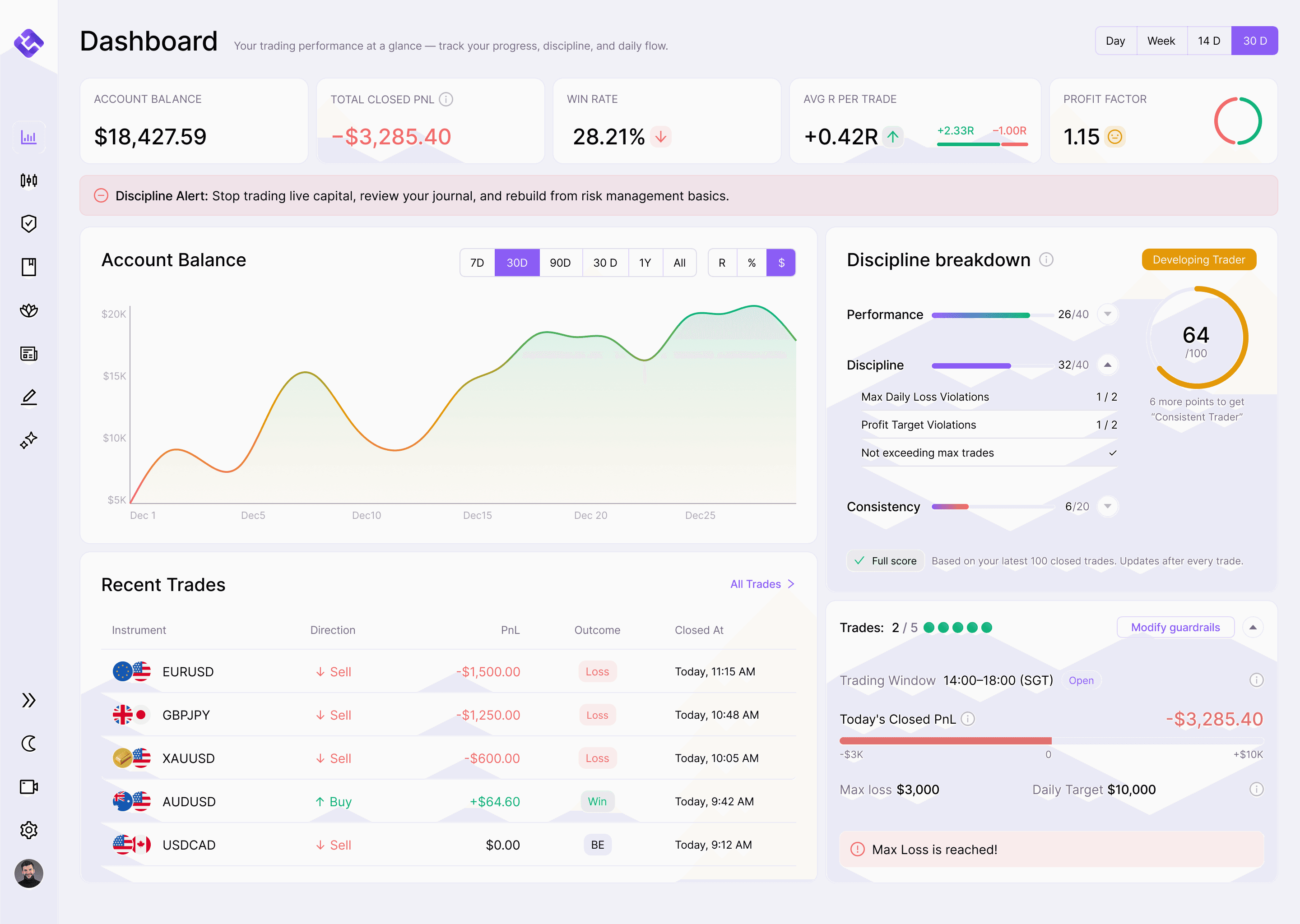
In EdgeFlo, add screenshots of your aggressive and conservative entry models to your Trade Plan, along with an. The plan sits beside your chart while you trade. When the checklist is complete, you take the trade. No extra confirmation.
After each trade, attach your chart screenshots and tag your emotion at entry in the Journal. Over time you'll see which costs you more: early entries or hesitation.
To learn liquidity and entry models in depth, the free covers both.
Key takeaways
Price moves toward liquidity, and your stop can be that liquidity.
Getting stopped before the move usually means an early entry or the wrong context.
Inducement swept before your POI makes the zone stronger.
Choose your entry model, aggressive or conservative, before the session.
When your criteria are met, enter.
Final thoughts
Read the liquidity, respect the context and define exactly what triggers your entry before the session starts. When price hits your stop loss then reverses, check your journal: was it an early entry or the wrong context? Then execute your plan the same way every time.
Want your entry checklist beside every trade?.
Risk warning: Trading forex, CFDs and other leveraged products involves significant risk and may not be suitable for all investors. Leveraged products can result in losses that exceed your initial deposit. Past performance is not indicative of future results. This content is for educational purposes only and is not financial advice. EdgeFlo is not a broker.
The Edge Brief
Receive Insights on trading psychology, discipline, and the behavioral patterns that create consistent traders from our Founder and the EdgeFlo team, delivered to your inbox.
Think different. Trade different.
Why does price hit my stop loss and then go my way?
What is a liquidity sweep in trading?
What is inducement in trading?
Is an aggressive or conservative entry better?

Turn discipline on.
Every session.
EdgeFlo is the environment serious traders operate inside.
Start 7-Day Free Trial
Cancel anytime.
No long-term commitment.

Think Different, Trade Different.