

How to Overcome Fear in Trading: What Are You Actually Afraid Of?
Trading fear can come from being wrong or from losing money, and each needs a different response. Learn how to identify your trigger, set risk you can live with, and use your own trading data to make fear more manageable.

Quick answer: To overcome fear in trading, first identify what you are actually afraid of: being wrong (a threat to your identity) or losing money (a threat to your account). Each needs a different fix. Then use your win rate to predict realistic losing streaks, and size your risk per trade so those streaks stay survivable.
Fear in trading shows up in a lot of disguises. You hesitate on a valid setup. You find yourself while they are in profit. You hold a loser because closing it would make the loss real. You skip the next trade after two losses, and that is the one that works.
Most trading psychology advice treats fear as the enemy. Breathe. Size down. Stop being emotional. But fear is not the problem. Fear is a signal that something is happening beneath the surface. Until you know what that something is, generic fixes won’t hold.
This guide explains where trading fear comes from, why the same advice works for one trader and fails for another, and how to use your own trading data to bring fear down to a level you can trade through.
Why Do Traders Feel Fear? Your Brain Wasn’t Built for Trading
Traders feel fear because the human brain evolved to keep you alive, not to make money in the markets. When it senses a threat, it triggers a survival response, even if the “threat” is a floating loss on a screen.
Survival depends on certainty, safety and comfort. When your brain senses potential pain, it switches into survival mode. The kicks in, the stress hormone cortisol rises, and you become reactive. That response was useful for avoiding predators. It is not useful when you are watching a position move against you.
Your brain does not distinguish well between physical danger and a red number on a screen. A floating loss can trigger the same alarm. That is why you can know exactly what your trading plan says and still feel an overwhelming urge to do something else.
The first step is to expect this. Under pressure, the mind will naturally work against good trading decisions for most traders. That is not a personal weakness. It is wiring, and wiring can be managed once you understand it.
Fear of Being Wrong vs Fear of Losing Money: Which One Drives You?
Trading fear usually falls into one of two categories: fear of being wrong or fear of losing money. Some traders carry both. They produce similar behaviour on the chart, but they need different solutions.
Fear of being wrong
Fear of being wrong is about identity. A loss feels like proof that you are not good enough, that your strategy doesn’t work, or that you have wasted months learning to trade.
Traders driven by this fear often avoid closing losing trades, because closing them means admitting they were wrong. This is a common root of. These traders also tend to move stops or argue with the market.
Fear of losing money
Fear of losing money is about the amount itself. The dollar figure at risk feels significant, whether because of your account size, your financial situation, or a funded challenge you can’t afford to fail.
Traders driven by this fear often hesitate on entries, cut winners short, and feel physically tense while a trade is open.
Behaviour | Fear of being wrong | Fear of losing money |
|---|---|---|
Root | Identity and self-worth | The amount at risk |
Typical behaviour | Holding losers, moving stops, arguing with the market | Hesitating on entries, cutting winners short, physical tension |
Does sizing down help? | Rarely | Usually |
Better fix | Accept losses as a normal part of a probability game | Lower risk per trade until a loss feels manageable |
Before you try to fix your fear, ask yourself honestly which one is driving your decisions. Where you are in your trading journey will often shape the answer.
Why Doesn’t Sizing Down Fix Trading Fear for Everyone?
Sizing down only fixes fear of losing money. It does little for fear of being wrong, because the amount was never the issue.
“Lower your position size” is one of the most common pieces of trading psychology advice. Good works well if your fear is about the money. Risk less, and the loss means less to you.
But if your fear is about being wrong, you could risk $10 a trade and still feel it. You would still hesitate, still hold losers, and still feel a loss as a judgement on you as a trader.
The same goes for breathing exercises and “stay calm” advice. These techniques help with the symptoms in the moment, which has value. They don’t change the root cause, so the fear comes back the next time the trigger appears.
This is why trading psychology is personal. There is no one-size-fits-all fix. You have to look beneath the surface and ask: what am I actually afraid of? Once you know the root, you can work on the right thing. Either the fear fades, or it drops to a level you can execute through.
How to Overcome Fear in Trading: Play the Fear Out to Its End
One practical way to overcome fear in trading is to follow the fear to its realistic conclusion. The imagined outcome is almost always worse than the real one.
The Stoic philosopher Seneca observed, in his Letters to Lucilius, that we suffer more in imagination than in reality. Traders do this constantly. One losing trade becomes, in your head, a blown account, a failed challenge, and proof that you will never make it.
Before you place a trade, ask yourself:
If this trade hits my stop, what actually happens?
How much of my account does that represent?
What happens the day after?
If you follow sound rules, the honest answer is usually small. You lose around 1% of your account. You take the next valid setup. Nothing about your life changes.
Some traders find it useful to think of FEAR as “false evidence appearing real.” The story your mind tells you feels true, but the evidence doesn’t support it. Writing the realistic outcome down before you trade gives you something concrete to return to when the story starts.
How Many Losses in a Row Should You Expect? Use Your Data
Your win rate tells you roughly how long your losing streaks will be. Knowing this in advance stops normal outcomes from feeling like a crisis.
A lot of trading fear comes from being surprised by normal outcomes. Over a large sample of trades, your win rate shows how many consecutive losses to expect. With a 50% win rate, a run of around eight losses in a row is normal over 500 trades, and ten or more is entirely possible. With a lower win rate, the streaks get longer.
Win rate | Approx. longest losing streak to expect over 500 trades |
|---|---|
40% | ~10 losses |
50% | ~8 losses |
60% | ~6 losses |
Now apply that to your risk. Using the 50% example of eight losses in a row:
If you risk $100 per trade, eight losses in a row costs $800.
If you risk $250 per trade, eight losses in a row costs $2,000.
Ask yourself honestly whether you could sit through that and keep following your plan. If the answer is no, your position size is setting you up for a breakdown. Maybe not today, but at some point the streak will come. When it does, your behaviour will break before your strategy does.
Sizing your risk so that a realistic losing streak is uncomfortable but survivable takes a lot of fear out of each individual trade. One loss stops feeling like a crisis because you already expected it.
Don’t Carry the Last Trade Into This One
Sometimes the fear you feel in a trade has nothing to do with that trade. It is left over from the previous one.
Imagine you lost $500 on your last position. Now you are up $700 on this one, and you feel a strong urge to close it early. On the surface, this looks like a trade management problem. Underneath, you are trying to make back the last loss. The previous trade is managing the current one.
You can’t fix that in the moment by forcing yourself to hold. The fix is upstream. Ask why the $500 loss mattered so much:
Have you accepted that losses are a normal part of?
Or was $500 more than you are comfortable losing?
If it is the second, lower your risk. If losing $250 doesn’t sting the way $500 does, you will walk into the next trade without that baggage, and the emotion never shows up.
Many traders resist this because smaller size means smaller wins. But a bigger win means little if you can’t execute well enough to keep it. Smaller size brings more consistency, and consistency is what lets you scale up later.
Common Mistakes When Dealing With Trading Fear
Treating fear as the enemy. Fear is information about your risk or your beliefs. Ignoring it means ignoring the cause.
Using generic fixes for a specific fear. Sizing down won’t solve fear of being wrong.
Mistaking symptom relief for a cure. Breathing exercises calm the moment but leave the root cause in place.
Sizing for your best case, not your worst streak. Your risk per trade should survive a realistic run of losses.
Fixing trade management in the moment. If the last loss is driving this trade, the fix is your risk level, not willpower.
How EdgeFlo Helps You Work With Fear
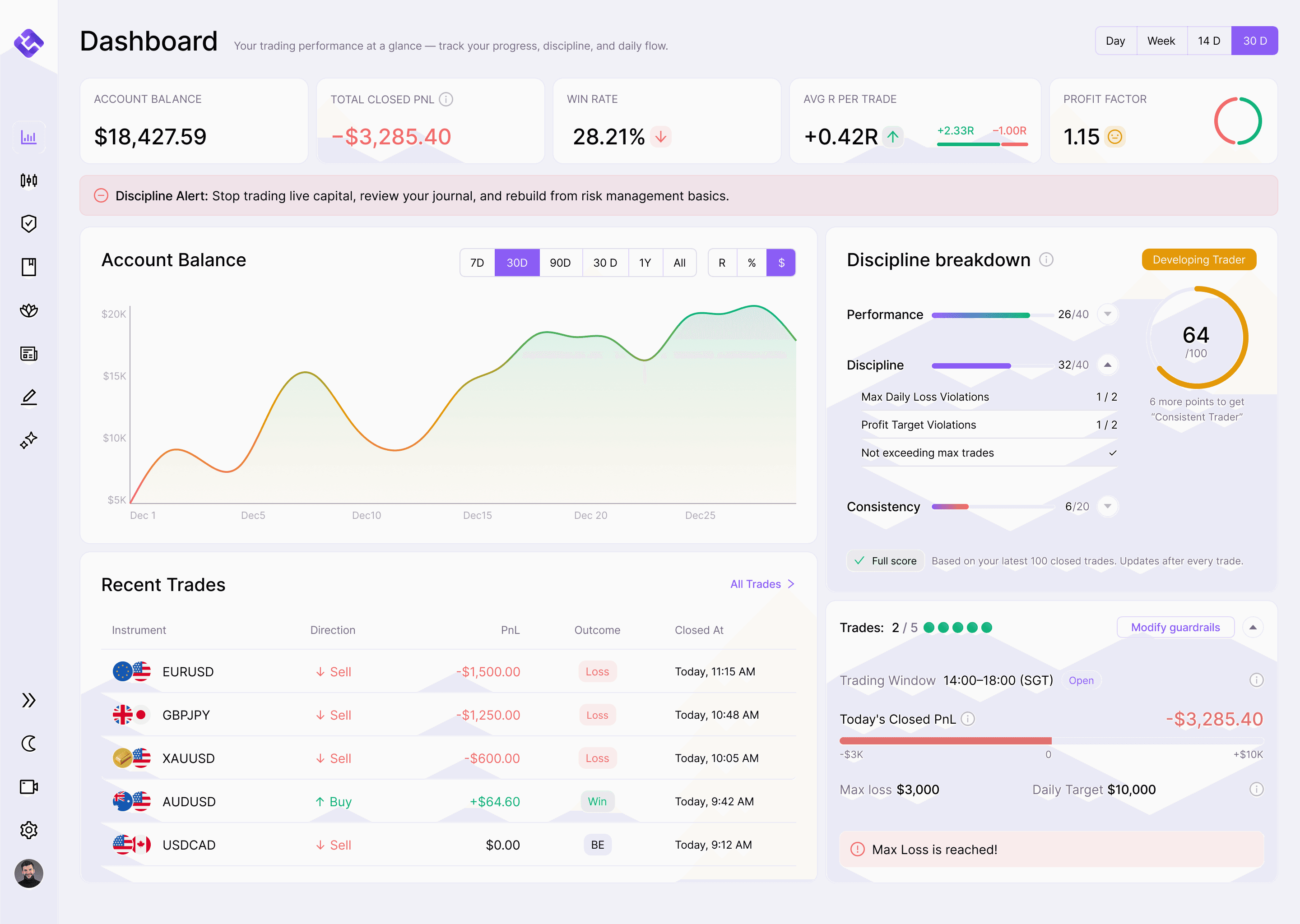
EdgeFlo is a trading discipline platform built to help you follow your rules when emotions take over. It is not a broker and does not give financial advice. You can see how each feature is set up in the. Several features support the work in this article:
Emotion tagging at entry and exit. Tag fear, greed, boredom or confidence on every trade. Over time, shows which emotions show up before your worst decisions.
Fixed risk per trade. Set your risk once, and the always-on calculator sizes every position to match, so fear of the money doesn’t push you to size down or up on impulse.
Max daily loss. A hard limit on how much a bad day can cost, so one losing streak can’t turn into a disaster.
Sanctuary. Guided quick reset, recovery and rewire tools for tilt, anxiety and the urge to win it back, plus a meditation timer for before or after a session.
Journal with AI reflection prompts. Post-trade questions that help you look past the outcome to what was going on underneath.
Weekly AI report (Plus plan). A summary of your discipline issues and emotional patterns, with one focus for the week ahead.
The Goal Isn’t Zero Fear
The goal is not to eliminate fear in trading. The goal is to bring fear to a level you can trade through while you keep growing.
If you trade at a level where you feel no fear at all, you are probably leaving potential untapped. If fear is too high, you will be too anxious to execute.
Get there in order:
Find out what you are actually afraid of: being wrong, or losing money.
Work on that root cause.
Use your data to set expectations, and size your risk so a realistic losing streak won’t break you.
What you resist tends to persist. Treat fear as information, and it stops running your trades.
Key Takeaways
Fear in trading is a signal, not the enemy. It points to a root cause you can work on.
Most trading fear is either fear of being wrong (identity) or fear of losing money (amount). Each needs a different fix.
Sizing down helps fear of losing money but rarely fixes fear of being wrong.
Your win rate predicts your losing streaks. At a 50% win rate, around eight losses in a row is normal over 500 trades.
Size risk so a realistic losing streak is uncomfortable but survivable, and one loss stops feeling like a crisis.
The Edge Brief
Receive Insights on trading psychology, discipline, and the behavioral patterns that create consistent traders from our Founder and the EdgeFlo team, delivered to your inbox.
Think different. Trade different.
Why do I feel fear when trading?
What is the difference between fear of being wrong and fear of losing money?
Does lowering position size reduce fear in trading?
How many losing trades in a row are normal?

Turn discipline on.
Every session.
EdgeFlo is the environment serious traders operate inside.
Start 7-Day Free Trial
Cancel anytime.
No long-term commitment.

Think Different, Trade Different.