

How to Manage a Trade After You Click Buy (Without Sabotaging It)
The hardest decisions often happen after you enter a trade. Learn how to plan exits before emotions take over, use price alerts, manage drawdowns, and let your trading data guide stop adjustments and profit-taking.

Quick answer: To manage a trade well, decide your stop loss, take-profit target and minimum risk-reward before you enter, then follow those rules instead of reacting to live P&L. Use price alerts instead of watching every tick, zoom out to a higher timeframe in drawdown, and only change stops or take partial profits when your written plan allows it.
Most trading education stops at the entry. You learn how to read market structure, find a zone, and time your confirmation. Then you click buy, and you’re on your own.
But the entry is the easy part. The hardest decisions happen while the trade is open, with real money on the line and your profit and loss (P&L) moving every second. This is where traders close good trades too early, hold bad trades too long, and move stops they shouldn’t. A solid plan turns into a messy outcome.
If you already have a strategy you trust, learning how to manage a trade is often the fastest way to improve your results. This guide covers the stretch between entry and exit, and how to get through it without letting emotions take over.
Decide Your Exits Before Emotions Arrive
The best time to decide how a trade ends is before it starts. Once you’re in a position, fear and greed get a vote in every decision. Before you enter, they don’t. That’s why experienced traders.
Before every trade, you should know three things:
Where you’re wrong. Your stop loss is the price where you exit automatically if the trade fails. It belongs at a level that invalidates the idea, such as beyond a protected high or low. It should not sit at a random distance that “feels safe.” (See.)
Where you’re taking profit. Your target should come from your plan, not from how the trade feels once it’s moving.
Your minimum reward for the risk. If the trade doesn’t offer enough reward relative to your stop, it isn’t worth taking. This is your.
Once those are set, many traders do best with a set-and-forget approach. You place the stop and target, then step away from the screen. If the stop gets hit, it is what it is. If the target gets hit, it is what it is. Detaching from the outcome means you don’t get pulled into every small pullback on the way to your target.
Should You Watch Your Trades All Day? Use Price Alerts Instead
No. Watching every tick rarely helps, and price alerts are a better tool. Most traders check open positions because they feel uncertain, not because anything has changed. Every check is a chance for emotion to sneak back in, and that’s how traders end up that didn’t need touching.
Set an alert at a level that matters structurally. That might be the level that would signal your idea is weakening, or the level where you’d consider securing partial profits. Then close the chart.
The benefit is psychological as much as practical. If no alert has fired, price is still somewhere between your important levels. Nothing significant has happened, so there’s no reason to look. When an alert does fire, you come back to the chart with a specific question to answer, rather than staring at the P&L hoping it moves your way.
Alerts let you stay detached from the trade while still being there when something meaningful happens.
How to Manage a Trade When It Goes Red: Zoom Out
When a trade moves against you, move up to a higher timeframe instead of staring at your entry chart. Every trade goes against you at some point. How you react in that moment decides whether you stick to your plan or abandon it.
If you entered on the 1-minute chart, switch to the 15-minute or 1-hour chart once you’re in. Price moves more slowly on higher timeframes. That gives you more time to think, and you feel calmer as a result.
There’s a reason this works. In Thinking, Fast and Slow (2011), psychologist Daniel Kahneman describes two modes of thinking. System 1 is fast, impulsive and emotional. System 2 is slow, logical and deliberate. In trading, what separates them is often time.
On a 1-minute chart with a live P&L, fear and adrenaline in your system, and decisions arriving every few seconds, you’re operating almost entirely in System 1. Zooming out gives System 2 the time it needs to make a rational call. You already accepted the downside when you set your stop. Most of what happens in between is noise.
The One Question to Ask When a Trade Is in Drawdown
When a trade is moving towards your stop, ask yourself:
“If I weren’t already in this trade, would I enter right here?”
If the answer is yes, the setup is still valid. Price is offering a better entry than the one you took. That’s a sign to stay with the idea, not a reason to add to it.
If the answer is no, ask why you’re still in. If the trade idea no longer makes sense, the only thing keeping you there is ego and the need to be right. That’s the moment to look for an exit: close the trade, tighten your stop, or reduce size.
This question works because it strips out the money. Most traders lose objectivity the moment a position is open, and that’s how becomes a habit. Imagining you’re flat forces you to judge the chart on its merits, the same way you did before you entered.
Stay in the market only while the market is confirming your idea. When it stops confirming it, your job is to protect your capital.
Should You Move Your Stop Loss?
For most traders, most of the time, no. The standard advice is never to move your stop loss further away. If your stop sits at a level that invalidates the idea, it should stay there.
Some experienced traders allow themselves limited discretion, for example when new information changes the picture. If you at all, it has to be a rule you wrote in advance, not a decision you make in the heat of a losing trade. Two conditions matter:
It’s part of your written plan. Before entering, you’ve defined the specific situations where you’d adjust and by how much. If it isn’t in the plan, you don’t do it.
It stays inside your maximum risk. Separate the risk you open a trade with from the most you’re willing to lose on it. If your limit is $1,000 per trade and you open with $500 at risk, any adjustment stays within that $1,000. If you open at your full limit, there’s no room to move anything.
If you notice yourself moving stops without those conditions in place, treat it as a rule break, not an exception. Unplanned stop moves are one of the fastest ways a small loss turns into a large one.
Why You Close Winning Trades Too Early (and How to Fix It)
Traders usually close winners early because of uncertainty or leftover emotions from a previous trade. Picture it: you’re in profit, price is a few pips from your target, and you close early to lock it in. Then price runs straight through your target without you.
Here’s how the previous trade gets involved. If your last trade lost $500 and this one is up $700, part of you wants to bank it and “make back” the loss. That’s the last trade managing this one.
Instead of relying on gut feel, use data. After each trade, record how far price moved in your favour after you exited, measured to the end of the session or the week. A related metric, maximum favourable excursion (MFE), measures the furthest price moved in your favour while the trade was open. Tracking both over a meaningful sample shows whether you consistently leave money on the table, and roughly how much.
If the data shows a gap, test a change gradually with rather than overhauling your plan:
Take 90% off at your usual target and leave 10% running to a further target.
If that works over a solid sample, move to 80/20.
Keep adjusting until your exits match what your data supports, for example 50% at the first target and 50% left to run.
This takes you out of your comfort zone in small, measured steps. You’re not gambling on a feeling. You’re testing a hypothesis your own trades have raised.
Common Trade Management Mistakes (and the Planned Fix)
Emotional reaction during the trade | Planned response |
|---|---|
Setting a stop that “feels safe” | Place the stop where the trade idea is invalidated |
Watching every tick of the P&L | Set price alerts at structural levels and close the chart |
Panicking on a 1-minute pullback | Zoom out to the 15-minute or 1-hour chart |
Holding a loser out of hope | Ask: “Would I enter here if I were flat?” |
Moving the stop further away | Only adjust under written rules, within max risk |
Banking a winner to “make back” a loss | Track post-exit movement and MFE, then test partials |
How EdgeFlo Helps You Manage Trades
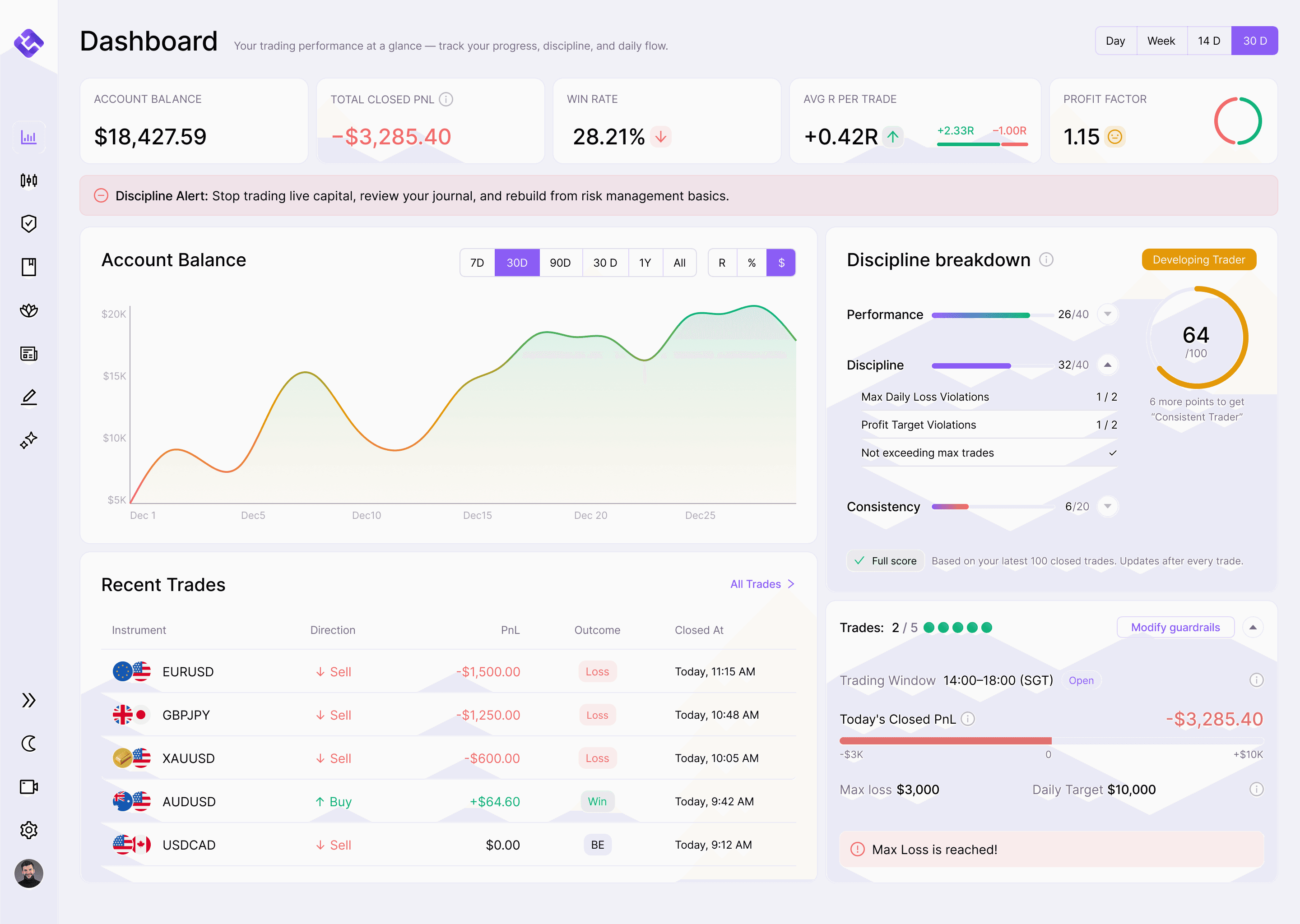
EdgeFlo is a trading discipline platform built to close the gap between what you plan to do and what you do when money is on the line. EdgeFlo is not a broker. It connects to your broker account. Several features support the habits in this article:
Always-on risk calculator. Position size is calculated from your account size, risk percentage and stop distance, so every trade starts with the risk you planned.
Active Trade Plan beside the chart. Your entry criteria and trade management rules stay visible while you trade, including any rules about stops and partials.
Position management. Set breakeven, take partial profits, and adjust stop loss (SL) and take profit (TP) from the same screen you trade on.
Price alerts. Set alerts at your key structural levels so you can step away from the chart.
Emotion tagging at entry and exit. Tag how you felt at both ends of the trade to see the patterns behind early exits and held losers.
Automatic journaling. Trades sync from your connected broker, and you can add notes and screenshots to each entry, such as how far price ran after you closed.
Guardrails. Fixed risk per trade and a max daily loss limit protect you if a bad trade starts to turn into a bad day.
To set these up step by step, see the.
Key Takeaways
Decide your stop, target and minimum risk-reward before you enter. Emotions can’t vote on decisions you’ve already made.
Use price alerts at structural levels instead of watching every tick.
When a trade goes red, zoom out to a higher timeframe to give yourself time to think rationally.
In drawdown, ask: “If I weren’t in this trade, would I enter here?” If the answer is no, look for an exit.
Treat stop moves and partial profits as written rules, not live reactions, and let your own trade data decide how long to hold winners.
The Edge Brief
Receive Insights on trading psychology, discipline, and the behavioral patterns that create consistent traders from our Founder and the EdgeFlo team, delivered to your inbox.
Think different. Trade different.
What does it mean to manage a trade?
Should I move my stop loss when a trade goes against me?
Why do I keep closing winning trades too early?
Is it bad to watch my open trades constantly?

Turn discipline on.
Every session.
EdgeFlo is the environment serious traders operate inside.
Start 7-Day Free Trial
Cancel anytime.
No long-term commitment.

Think Different, Trade Different.