

How to Become a Disciplined Trader: Why Knowing the Rules Isn’t Enough
Knowing your trading rules isn’t the same as following them. Learn how to build disciplined habits, spot behavioural blind spots, protect your capital, and turn your trading plan into a consistent daily process.

Quick answer: You become a disciplined trader by closing the gap between what you know and what you do. Most traders don’t need another strategy. They need a consistent process: decide who they want to be as a trader, follow their plan on every trade, review their data for blind spots, and protect their capital long enough for skill to compound.
You know you shouldn’t revenge trade. You know you shouldn’t take six trades after losing two. You know you shouldn’t double your risk to win it back, or enter outside your setup because the chart “looks like it’s going up.”
And yet you do. Then you close the platform and think: I knew better the entire time.
If that’s you, this guide explains how to become a disciplined trader when knowledge alone hasn’t worked.
Why Do Traders Break Rules They Already Know?
Traders break rules they already know because the problem is behaviour, not knowledge. Most intermediate traders already know enough to trade. Another course, indicator or strategy won’t close the gap between what they know and what they do.
is a good example. Revenge trading means taking impulsive trades to win back a recent loss. Almost every trader can define it, yet many still do it. What closes the gap is a change in how you approach the work, and in who you’re becoming as a trader.
Be, Do, Have: Why Most Traders Have Trading Discipline Backwards
The Be-Do-Have model says identity comes first, actions second and results last. Most traders reverse it. They think: once I have the profits, I’ll do what professionals do, and then I’ll be a professional trader.
It works the other way round. First you be the trader you want to become: someone who follows their plan, respects their risk and reviews their work. Then you do what that trader does every day, such as preparing before the session, journaling every trade and reviewing every week. Only then do you have the results.
This isn’t motivational wordplay. It changes what you focus on. A trader chasing results first feels every losing day as failure and keeps hunting for a better strategy. A trader focused on counts a losing day where they followed every rule as a good day’s work.
Why Every Trade Is a Vote for the Trader You’re Becoming
Every trade is a vote for the kind of trader you’re becoming. No trade is wasted.
When you take a trade that follows your plan, you cast a vote for being a disciplined trader. It might win. It might lose. Either way, you’ve reinforced the behaviour and the identity you want.
When you take a trade outside your rules, you cast a vote the other way, even if it wins. A lucky revenge trade that pays off is arguably worse than one that loses, because it teaches you that breaking your rules works. This is why deserve as much scrutiny as losses.
Over hundreds of trades, those votes add up. The outcome of any single trade matters far less than whether you followed your process to take it.
Why Is It So Hard to Change Your Trading Habits?
Changing trading habits is hard because change is uncomfortable, and the brain is wired to avoid discomfort. Staying the same, even when it’s costing you money, feels safer than the unknown.
Nothing will change until the discomfort of where you are outweighs the discomfort of changing. You can use that deliberately. Try this three-step exercise:
Look honestly at how you trade today: the rule breaks, the revenge trades, the profitable days you gave back.
Project the path forward: ask where you’ll be in 1 year, 5 years and 10 years if nothing changes.
Decide: if you don’t like the trader at the end of that road, something has to change today.
There’s pain on every path. You can choose the pain of discipline: patience, boredom and sticking to rules when you don’t feel like it. Or you can get the pain of regret: blown accounts, failed challenges and years of going in circles. If you don’t consciously choose the first, you’ll end up with the second.
How to Grow Outside Your Comfort Zone Without Taking Reckless Risks
Growth as a trader means stepping outside your comfort zone in small, data-tested steps. The trap isn’t only for struggling traders. Traders who are doing reasonably well often get stuck too. Their approach works, so they stop questioning it, and stalls their growth.
Your comfort zone is designed to be comfortable. You don’t grow inside it. The version of you from three years ago couldn’t trade the way you trade today. If you want to be a different trader three years from now, you’ll need to do things today’s version of you isn’t yet willing to do.
That doesn’t mean taking reckless risks. You can test ideas against your own data first:
Review past trades to see where you consistently exit too early or hold too long.
Test one small change, such as leaving 10% of a position running past your usual target.
Expand the change only when your results over a support it.
Markets change, and so should you. A trading plan that never evolves eventually stops working.
How to Find Your Trading Blind Spots
Trading blind spots are repeated patterns in your own behaviour that you can’t see in the moment. We’re all most blind to our own patterns. You might spot a friend’s revenge trading instantly, while missing that you close every winner early after a losing day.
Often you don’t need to be taught something new. You need to be reminded of what you already know, at the moment it matters, by something outside your own head.
That outside view can come from a coach, a trading community, or a peer you trust to be honest with you. It can also come from your own data. A trading journal is a record of every trade, including the setup, the result and your state of mind. A well-kept journal, especially one that uses, shows patterns you’d never admit to in the moment:
The time of day you break rules
The emotion you felt before your worst trades
The setups you take that aren’t in your plan
The key is being open to what you find. Feedback only helps if you’re willing to act on it.
Survive First, Then Thrive: Why Capital Preservation Comes First
Capital preservation comes first because you can’t improve as a trader if your account is gone. Most traders who fail aren’t failing because they lack talent. They’re failing because they’re trying to speed up a process that can’t be rushed.
Think about any other serious skill. A doctor, a lawyer or an engineer spends years building a foundation before anyone expects results. Trading is no different. Part of that foundation is strategic and part is psychological, and you have to know which one is your weak point. If it’s the strategic side, the free covers market structure, liquidity and building a trading plan.
Before you can thrive in the markets, you have to survive in them. If you lose all your chips, you can’t keep playing. isn’t a cautious extra. It’s what gives your skills, and your results, enough time to compound.
Progress in trading is rarely linear. It often looks like years of slow improvement followed by a period where everything starts to click. You only get there if you’re still in the game.
How to Stop Breaking Your Trading Rules: A Simple Daily Process
The most reliable way to stop breaking your trading rules is to make your rules automatic, visible and reviewed. Willpower alone fades under pressure, so the process has to do the work:
Before the session: review your trading plan and decide your limits in advance, including max trades, max daily loss and risk per trade.
During the session: take only trades that match your written setup. Treat each one as a vote.
After each trade: journal it, including how you felt before you entered.
Every week: review your journal for rule breaks and blind spots, then pick one thing to improve.
How EdgeFlo Helps You Become a Disciplined Trader
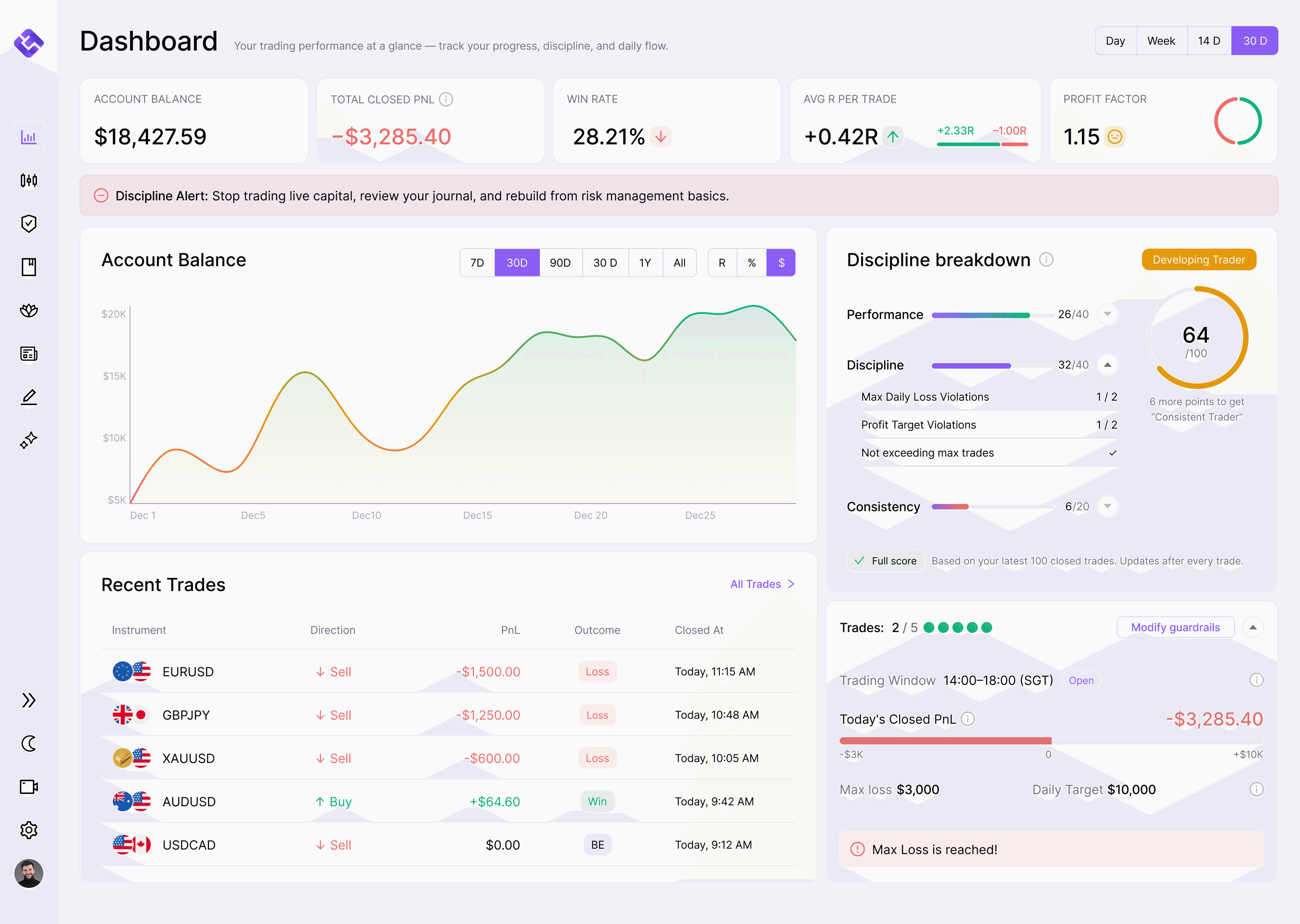
EdgeFlo is a trading discipline platform built for traders who know what to do but struggle to do it consistently. It acts as the discipline layer between your strategy and your execution. EdgeFlo is not a broker and does not give financial advice.
Before you trade: a Pre-Market Routine and an active Trade Plan help you start every session prepared.
During the trade: Guardrails enforce your max trades, max daily loss, risk per trade and trading window, so the votes you cast are the ones you planned. Overrides are logged as rule breaks.
After the trade: automatic journaling, emotion tagging and AI reflection prompts show you the blind spots you can’t see in the moment.
Over time: EdgeScore tracks your performance, discipline and consistency together, and the weekly AI report (Plus plan) gives you one focus for the week ahead.
The point isn’t more data. It’s a daily process that makes being a disciplined trader the default, not the exception. The walk through setting up Guardrails and your Trade Plan step by step.
Close the Gap Between Knowing and Doing
You don’t need another strategy. You need to stop breaking the one you already have.
Becoming a disciplined trader starts with deciding who you want to be, then acting like that trader one session at a time. Treat every trade as a vote. Get honest about where your current path leads. Step outside your comfort zone with data, not guesses. Look for the blind spots you can’t see alone. And protect your capital long enough for all of it to compound.
It doesn’t have to happen overnight. Improve a little every session, keep a long-term view, and you give yourself the best chance of getting where you want to go.
Ready to make discipline your default? and set up your first Guardrails today.
Key Takeaways
Most intermediate traders don’t lack knowledge. They lack a process that turns knowledge into consistent action.
Be, Do, Have: build the identity of a disciplined trader first, then the habits, then the results.
Every trade is a vote. A winning trade that broke your rules still reinforces the wrong behaviour.
Test changes against your own data over a meaningful sample before you adopt them.
Capital preservation buys the time your skills need to compound.
The Edge Brief
Receive Insights on trading psychology, discipline, and the behavioral patterns that create consistent traders from our Founder and the EdgeFlo team, delivered to your inbox.
Think different. Trade different.
Why do traders break rules they already know?
How do I stop revenge trading?
Can a winning trade be a bad trade?
How long does it take to become a consistent trader?

Turn discipline on.
Every session.
EdgeFlo is the environment serious traders operate inside.
Start 7-Day Free Trial
Cancel anytime.
No long-term commitment.

Think Different, Trade Different.