

How Much Should You Risk Per Trade? Prop Firm vs. Personal Account Risk Explained
Compare risk approaches for prop firm and personal accounts, understand the 0.5%–1% baseline and tiered risk, and set limits before emotions take over.

Quick answer: Most traders should risk 0.5% to 1% of their account per trade, whether the account is $5,000 or $500,000. On prop firm accounts, funded traders usually risk 0.25% to 1% to stay inside drawdown limits. More aggressive traders can use a tiered model, risking up to 2% only on pre-defined A+ setups.
On a prop firm account, the rules decide your risk for you. On your own account, nobody does. That freedom sounds like an advantage, and sometimes it is. But no drawdown limit and no rulebook also means one bad afternoon can undo months of work.
This article covers how much to risk per trade in both account types, why the standard numbers exist, and how to scale risk with setup quality without putting your account in danger.
Why does risk per trade matter so much?
Your risk per trade decides how many losing trades your account can survive. Every strategy has losing streaks. The question is whether your account survives them.
Your risk per trade decides how many mistakes and bad runs you can absorb while your edge plays out. EdgeFlo's breakdown of shows how quickly the odds change as risk rises.
How much do prop firm traders risk per trade?
Most funded traders risk somewhere between 0.25% and 1% per trade. Prop firm accounts come with daily drawdown limits, maximum drawdown limits and profit targets. Break a drawdown rule and you lose the account, regardless of how good your last month was.
The goal is to give yourself enough room to survive a losing streak without touching the daily or overall limits. A prop account rewards conservative, consistent risk more than anything else. If you're new to funded trading, start with and the typical.
How much should you risk on a personal account?
On your own capital, nobody sets the limit, so you need your own rules. There are no drawdown rules, no profit targets and no one to stop you. You can risk whatever you want.
That cuts both ways. The upside is flexibility. The downside is that under pressure, after two losses or a frustrating session, you will do whatever you want. Without your own rules, your risk is decided by your mood.
The standard: 0.5% to 1% per trade
For most traders, risking 0.5% to 1% of the account per trade is the right default. That applies whether the account is $5,000 or $500,000. It keeps losing streaks survivable, keeps emotions in check and gives your strategy enough trades to prove itself.
If you're not sure where to start, start at the lower end. The is a common starting point. You can increase risk later once your results justify it. You can't undo a blown account.
What is a tiered risk model?
A tiered risk model sizes up only on your best setups, without raising risk across the board. It suits more risk-seeking traders. For example:
Setup grade | Risk per trade |
|---|---|
A+ | 2% |
A | 1% |
B | 0.5% |
C | Skip it |
The logic is that your highest-quality setups get the most capital, and your weakest ones get none.
Define your tiers before the session
A tiered model only works if the grades are defined in advance. What makes a setup A+ instead of A? Higher-timeframe alignment, a clear liquidity sweep, a fresh zone, a clean market shift? Write the criteria down. EdgeFlo's guide to the can help you define the top tier.
If you grade setups in the moment, every setup starts to look like an A+, especially after a loss when you want to win it back.
Where does risk management go wrong?
Most blown accounts come from a few predictable decisions:
Doubling size after a loss to recover faster.
The "one big trade" that's meant to get you back to breakeven.
Raising risk to 5% or 10% because you feel confident about a setup.
Each of these feels reasonable in the moment. Each one is. If you're already in a hole, read about before you size up.
How do you match risk to your tolerance?
Use the ten-loss test. Pick the amount you could lose ten times in a row without changing how you trade. If ten losses at your current risk would make you anxious, angry or desperate, your risk is too high.
How EdgeFlo keeps your risk where you set it
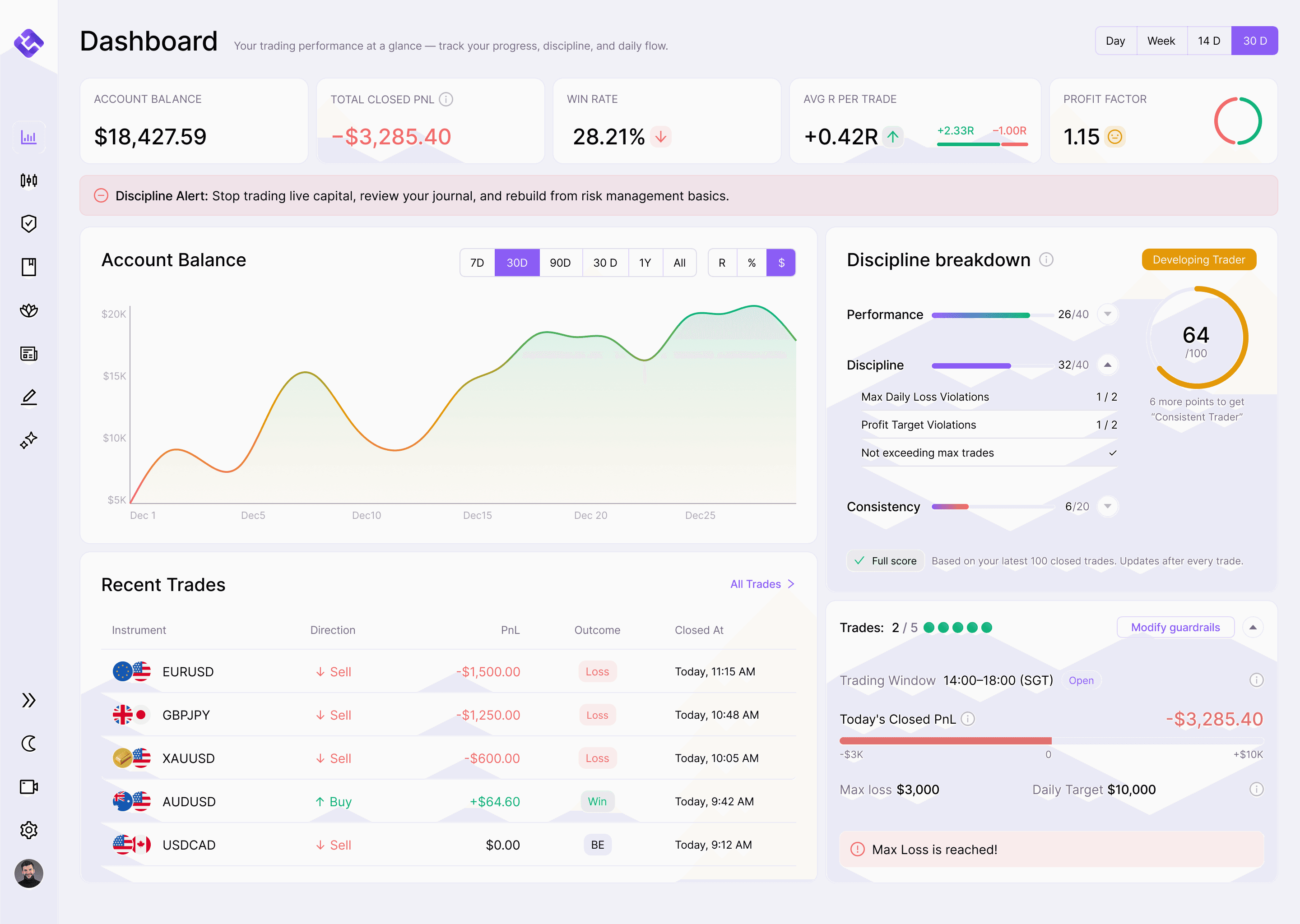
In EdgeFlo, you set Fixed Risk Per Trade and Max Daily Loss in Guardrails while you're thinking rationally. When emotions push you to size up after a loss, the limit is already in place, and EdgeFlo blocks trades that break it. A hard is one of the simplest protections you can add.
If you trade a funded account, match your Guardrails to your prop firm's drawdown rules so EdgeFlo stops the trade before the firm stops your account. Write your A+, A and B criteria into your Trade Plan so tiered risk stays a rule, not a feeling. The walk through setting up Guardrails.
Key takeaways
Prop accounts: risk is set by the firm's rules, usually 0.25% to 1% per trade.
Personal accounts: no rules means you need your own.
0.5% to 1% is the standard; a tiered model can go up to 2% on A+ setups.
Define your tiers before the session, never during it.
Use the ten-loss test to check your risk fits your tolerance.
Final thoughts
How much to risk per trade isn't only about the number you pick. It's about whether you stick to it after two losses in a row. Choose your risk, write your tiers and build the limits into your trading environment so you don't have to rely on willpower.
Want limits that hold when emotions don't?.
Risk warning: Trading forex, cryptocurrencies, indices, gold and CFDs involves significant risk and may not be suitable for all investors. Leveraged products can result in losses that exceed your initial deposit. Past performance is not indicative of future results. This content is for educational purposes only and is not financial advice. EdgeFlo is not a broker.
The Edge Brief
Receive Insights on trading psychology, discipline, and the behavioral patterns that create consistent traders from our Founder and the EdgeFlo team, delivered to your inbox.
Think different. Trade different.
How much should I risk per trade as a beginner?
Is 1% risk per trade too much?
How much do funded traders risk per trade?
What is a tiered risk model in trading?

Turn discipline on.
Every session.
EdgeFlo is the environment serious traders operate inside.
Start 7-Day Free Trial
Cancel anytime.
No long-term commitment.

Think Different, Trade Different.