

Fixed Take Profit vs. Letting Winners Run: Pick One Exit Strategy and Stick to It
Compare fixed take-profit targets with letting winners run, understand the trade-offs, and test exit rules consistently instead of switching based on emotion.

Quick answer: Both a fixed take profit and letting winners run can work. A fixed R target is mechanical and easy to measure but leaves money on the table. Letting winners run captures outsized trades but gives some open profit back. What damages results is switching between the two based on how you feel.
You close a trade at 3R and watch price run to 8R without you. So next time, you let it run. Price reverses and you close at breakeven. Both outcomes feel like mistakes, so you keep switching between the two approaches, hoping to get it right next time.
The real mistake is the switching. This article compares a fixed take profit vs letting winners run, explains the cost of each, and shows you how to commit to one.
What does R mean in trading?
R is your risk on a trade. If you risk $100, 1R is $100. A 3R target means you aim to make $300, three times what you risked.
Measuring results in R instead of dollars lets you compare trades fairly, regardless of position size or account size. EdgeFlo's guide to covers how to track it.
Fixed R targets vs. letting winners run at a glance
Fixed R target | Letting winners run | |
|---|---|---|
How it works | Exit decided before entry (e.g., 3R on every trade) | Hold beyond a fixed target, often to a higher-timeframe level or until trailing rules close you out |
Main advantage | Mechanical, measurable, less emotional interference | Captures outsized 8R–10R trades that can make your month |
The cost | Leaves money on the table when price keeps running | Some open profit disappears; big winners can become small ones |
What it requires | Being at peace with missed upside | Conviction to hold through pullbacks |
Fixed R targets: the advantages
A fixed target means you decide your exit before entry, for example 3R on every trade, and you close when price gets there.
It's mechanical. There are no decisions to make once the trade is live.
It's measurable. Your win rate and average R are clean and easy to analyze.
It reduces emotional interference. You're not staring at open profit, wondering whether to close.
Fixed R targets: the price you pay
Some trades will keep going long after you've closed them. You'll take 3R on a move that went to 10R. You'll make $5,000 on a trade that could have made $10,000.
If you use fixed targets, you have to be at peace with leaving money on the table. It's not a flaw in the approach. It's the cost of the consistency it gives you. If that feels painful, read about the habit of.
Letting winners run: the advantages
Letting winners run means you hold beyond a fixed target, often until price reaches a higher-timeframe level or your close you out.
The main advantage is capturing outsized trades. A single 8R or 10R winner can make your month, and over time these trades can lift your average R significantly.
Letting winners run: the price you pay
Some of that open profit will disappear. You'll be up $8,000 and watch price reverse until you close for much less, or for nothing.
Letting winners run requires the conviction to hold through pullbacks and the acceptance that some big winners will turn into small ones. If you choose this approach, that's the cost you agree to pay for the big trades.
Why does switching between exit strategies cost the most?
Switching gives you the downside of both approaches and the upside of neither. Both approaches can work. What doesn't work is switching between them based on how you feel.
Traders who switch take 3R on the trades that would have run, then hold the trades that should have been closed. On top of that, their statistics become impossible to read, because there's no consistent rule to evaluate. The balance between only means something when the exit rule stays the same.
The approach you can execute consistently is the right one for you.
How to test an exit change properly
Change one variable and measure it over a defined sample. If you want to move from fixed targets toward letting winners run, do it deliberately:
Start with a fixed target, such as 3R, until your execution is consistent.
Pick one change to test, such as a 5R target or a partial close at 3R.
Apply it to a defined sample, for example your next 30 trades.
Compare average R, win rate and drawdown against your previous sample.
One big missed move isn't data. Thirty trades under the same rule is. EdgeFlo's guide to goes deeper.
Are partials and breakeven a good middle ground?
They can be, as long as the rule is written into your plan before the trade. Some traders split the difference: take at a fixed R, move the stop to and let the rest run to the next opposing supply or demand zone.
Deciding to take partials in the middle of a trade because you're nervous is switching under another name.
How EdgeFlo helps you exit the way you planned
The moment you're most likely to change your exit rules is when a trade is open and money is moving. In EdgeFlo, your Trade Plan sits beside your chart, so your exit rules are in front of you at that exact moment.
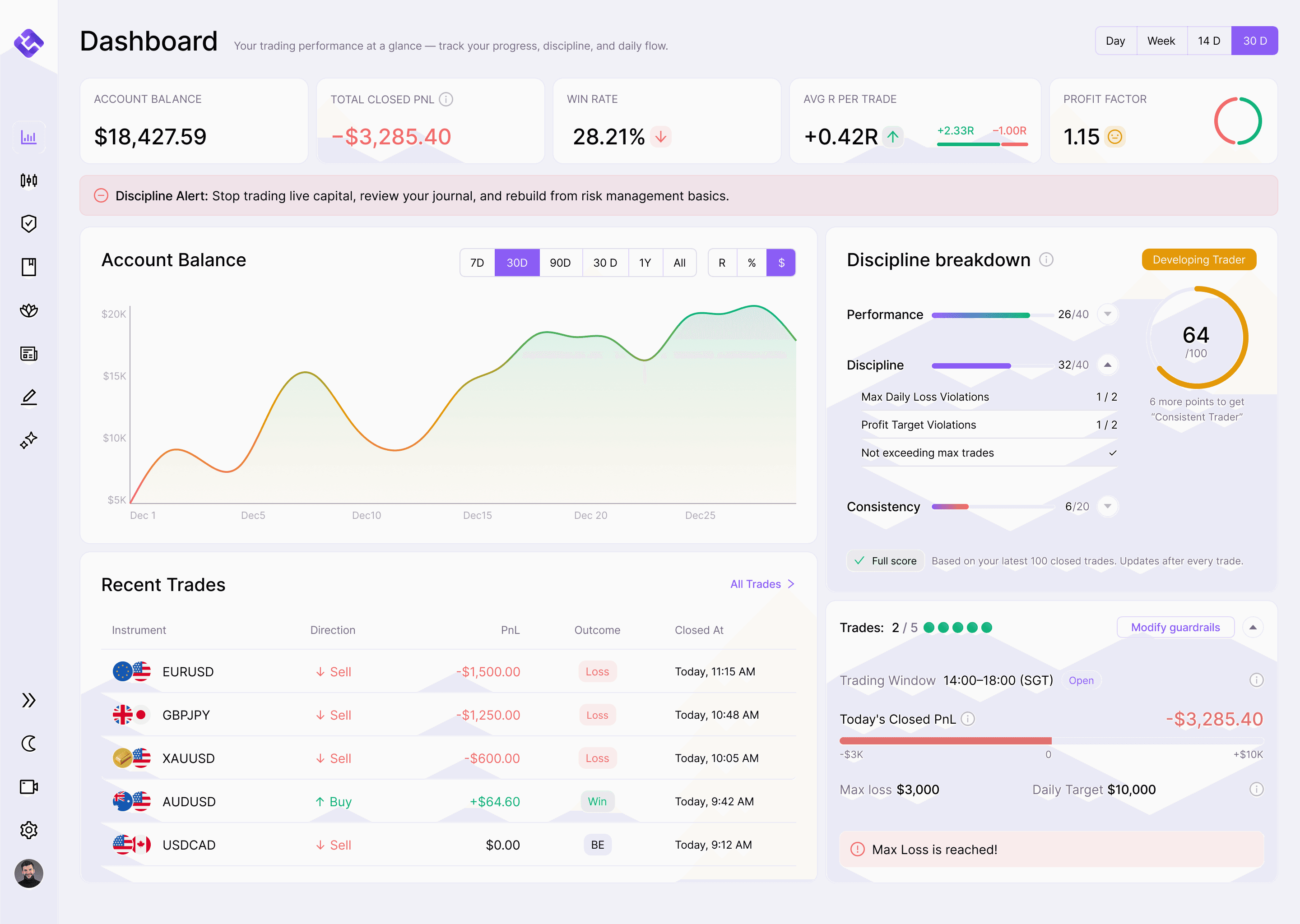
You can set breakeven and take partial profits from the same screen you trade on, so your plan is easy to follow. Then use the, with PnL shown in R and your average R over time, to compare approaches with data instead of the memory of your last big miss.
Key takeaways
Fixed targets leave money on the table; running winners gives some profit back.
Both approaches work. Switching between them doesn't.
Test any change over a defined number of trades, one variable at a time.
Partials and breakeven only work when written into the plan in advance.
Decide your exit before you enter.
Final thoughts
There's no perfect exit. In the fixed take profit vs letting winners run debate, the winner is the exit you can execute consistently. Choose your approach, accept its cost and measure it long enough to know whether it's working.
Want your exit rules in front of you on every trade?.
Risk warning: Trading forex, cryptocurrencies, indices, gold and CFDs involves significant risk and may not be suitable for all investors. Leveraged products can result in losses that exceed your initial deposit. Past performance is not indicative of future results. This content is for educational purposes only and is not financial advice. EdgeFlo is not a broker.
The Edge Brief
Receive Insights on trading psychology, discipline, and the behavioral patterns that create consistent traders from our Founder and the EdgeFlo team, delivered to your inbox.
Think different. Trade different.
Should I use a fixed take profit or let winners run?
What does 3R mean in trading?
Is taking partial profits a good idea?
How many trades do I need to test an exit strategy?

Turn discipline on.
Every session.
EdgeFlo is the environment serious traders operate inside.
Start 7-Day Free Trial
Cancel anytime.
No long-term commitment.

Think Different, Trade Different.