

Trend, Pullback or Range? How to Identify Market Phases (And When to Sit Out)
Learn to identify trending, pulling-back, and consolidating markets so you can adapt your setup, define no-trade conditions, and avoid overtrading choppy sessions.

Quick answer: At any moment, price is trending, pulling back or consolidating. To identify the market phase, check where price sits against the strong high or low and the most recent break of structure. With-trend entries offer the highest probability, pullbacks are tradable with smaller targets, and consolidation is usually a reason to stay out.
The same setup can be a high-probability trade in one market phase and a coin flip in another. Most traders don't lose because their entries are bad. They lose because they use trend entries during pullbacks and pullback entries during ranges.
This article shows you how to identify market phases, what to do in each one, and the option most traders forget: doing nothing.
What are the three market phases?
Price is always doing one of three things: trending, pulling back or consolidating.
Phase | What price is doing | Best approach |
|---|---|---|
Trending | Moving with its swing structure, making new highs in an uptrend or new lows in a downtrend | Trade with the trend from the strong high or low |
Pulling back | Moving against the swing structure, usually toward a supply or demand zone, before the trend continues | Tradable with smaller targets and tighter management |
Consolidating | Moving sideways with no clear direction, often while building liquidity for the next move | Usually sit out |
Each phase calls for a different approach. Using the wrong one is where most frustration comes from.
How do you identify which market phase you're in?
Use your swing and internal structure. Start with where price sits relative to the strong high or low and the most recent break of structure. The strong high or low is the level that must break to confirm the trend has changed.
Trending: price has broken structure and is pushing on.
Pulling back: price has broken structure and is now moving back into the range, often after a on the internal structure.
Consolidating: price is stuck between two levels and keeps failing at both.
How to trade with the trend
The highest-probability trades come from trading with the trend. In a downtrend, that means waiting for price to pull back to the strong high area, create a market shift back to the downside, then entering short in the direction of the swing structure.
These trades take patience, because you're waiting for price to come to you. The reward is that the swing structure and your entry both point in the same direction.
Should you trade the pullback?
Yes, pullbacks are tradable, but they go against the swing structure, so treat them differently. Suppose price breaks structure to the downside, then starts pulling back. If you see a market shift on the internal structure before price reaches the strong high, that shift is tradable. It's also a useful signal that the pullback has begun.
Use smaller targets, usually the next zone or the strong high area, and manage pullback trades more tightly. EdgeFlo's guide covers the setup in more detail.
Timing matters: before vs. after the objective
Every pullback has an objective, usually a zone where price can gather liquidity before continuing the trend. Entering while the pullback is still heading toward that zone means trading with price's current objective.
Entering after the pullback has reached its zone is a different trade. At that point price has done what it needed to do. Its next move is likely back in the trend's direction, so a pullback entry here often meets a small bounce followed by a reversal against you.
Why is consolidation a trap?
Consolidation looks easy, but the turning points are hard to predict. Price is moving sideways, so the plan seems simple: buy the bottom of the range and sell the top. The problem is you don't know exactly when price will stop going up and start coming down, or the reverse.
In practice, that means entering too early or too late, over and over. Small losses stack up, and the range often ends with a breakout that catches traders on the wrong side. That pattern is why and why the.
Who can trade ranges?
Scalpers targeting 5 to 10 pips on low timeframes can work inside consolidation, because their trades are short enough that the bigger range matters less. Even then, the turning points are hard to predict consistently. See how differ.
If you're an intraday or swing trader, you're usually better off waiting for price to break the strong high or low and commit to a direction.
How to build a "no trade" rule
Define what consolidation looks like on your timeframe and write it down. For example: "If price has failed to break either side of a range in the last six candles on the 15-minute, I don't trade."
A written rule turns sitting out from a feeling into a decision. Add it to your other so it applies every session.
Common market phase mistakes
Using trend entries during pullbacks. You enter against price's current objective.
Taking pullback entries after the objective is reached. You meet a small bounce, then a reversal.
Trading the middle of a range. Small losses stack up before the breakout.
Re-entering after every small loss on choppy days. One loss becomes five.
How EdgeFlo helps on choppy days
Sideways markets are where happens. A small loss, a quick re-entry, another loss, and the day is red by lunch.
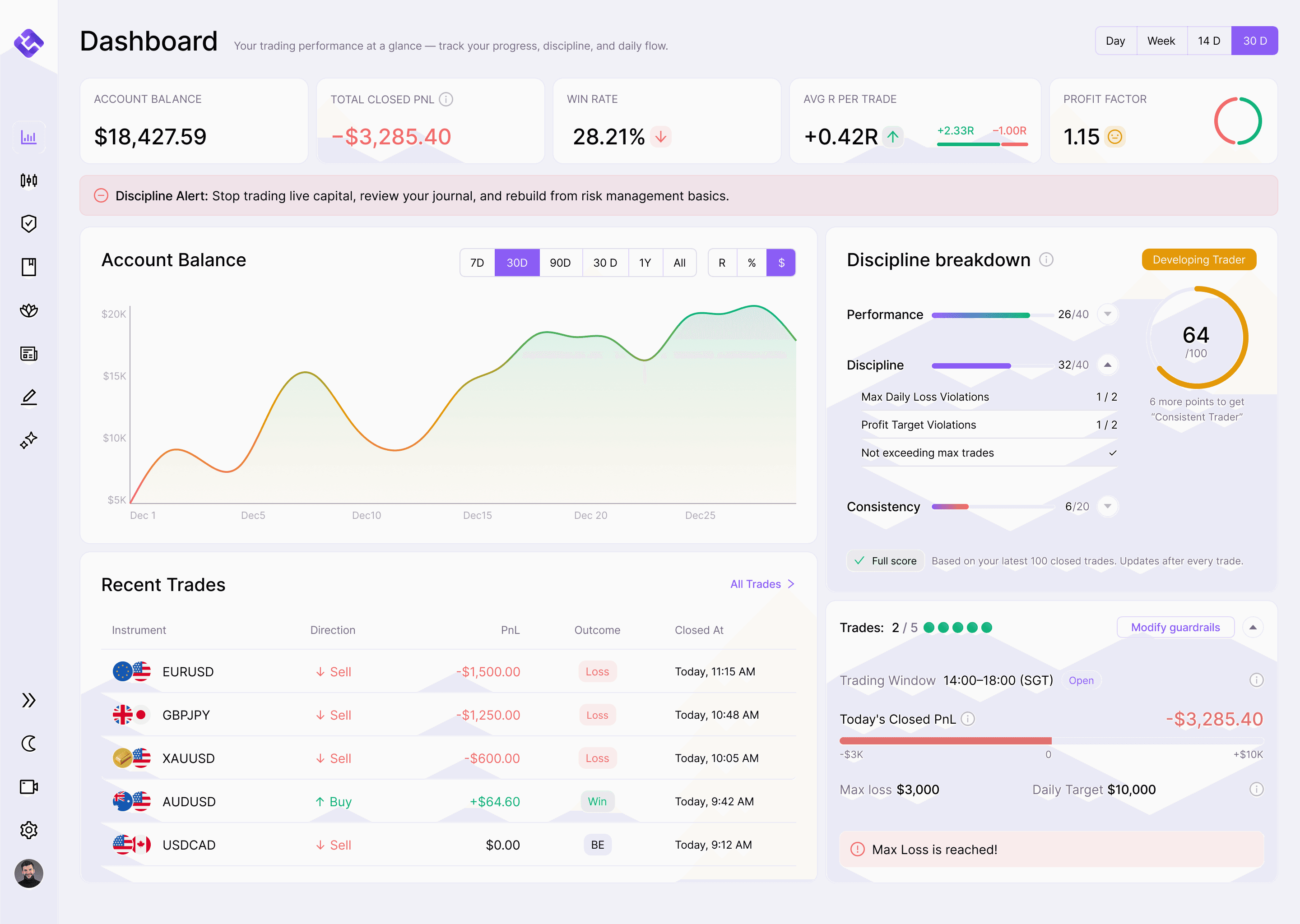
In EdgeFlo, set Guardrails for max trades per day and max daily loss before the session starts. When you hit a limit, EdgeFlo blocks the next trade, so a choppy market can't turn into a chain of.
Add "market phase identified" as a step in your Pre-Market Routine so you name the phase before you look for a setup. The show how to set Guardrails.
Key takeaways
Identify the market phase before you look for a setup.
With-trend entries from the strong high or low have the highest probability.
Pullbacks are tradable with smaller targets, but timing relative to the objective matters.
Consolidation is usually a reason to stay out unless you scalp small targets.
Write a no-trade rule so sitting out is a decision, not a feeling.
Final thoughts
Knowing when not to trade is a skill most traders never write down. Learn how to identify market phases, define your no-trade conditions and let your rules protect you on the days the market goes sideways.
Want hard limits on choppy days?.
Risk warning: Trading forex, CFDs and other leveraged products involves significant risk and may not be suitable for all investors. Leveraged products can result in losses that exceed your initial deposit. Past performance is not indicative of future results. This content is for educational purposes only and is not financial advice. EdgeFlo is not a broker.
The Edge Brief
Receive Insights on trading psychology, discipline, and the behavioral patterns that create consistent traders from our Founder and the EdgeFlo team, delivered to your inbox.
Think different. Trade different.
How do you know if the market is trending or ranging?
Is it safe to trade a pullback?
Should beginners trade ranging markets?
What is a no-trade rule?

Turn discipline on.
Every session.
EdgeFlo is the environment serious traders operate inside.
Start 7-Day Free Trial
Cancel anytime.
No long-term commitment.

Think Different, Trade Different.