

Revenge Trading: What It Is & How to Stop It (2026 Guide)
Feb 17, 2026
You took a loss. A clean setup, solid entry, stop loss in place. The market wicked you out by 5 pips, then ran exactly where you expected.

Now you're staring at a red number. Your chest tightens. Your hands are already moving. You're not thinking about your plan anymore. You're thinking about getting it back.
You size up. You skip your checklist. You enter on impulse. And before you even realize what happened, one bad trade has turned into five.
This is revenge trading. And if you've been trading for more than a few months, you already know exactly what it feels like.
What Is Revenge Trading?
Revenge trading is when a trader takes impulsive, unplanned trades immediately after a loss to recover the money. It's driven by emotion, not analysis, and the goal shifts from executing a strategy to "getting even" with the market. Research shows revenge trading is one of the top three reasons retail traders blow their accounts (Tradeciety, 2024).
It usually looks like this:
You take a loss that feels unfair or avoidable
An emotional surge hits: anger, frustration, injustice
You size up or abandon your stop loss to "make it back faster"
The loss gets deeper, and now you're chasing breakeven
The session ends with serious account damage
Revenge trading is not a strategy problem. It's a behavior problem. And it's one of the most common reasons traders blow accounts, fail funded challenges, and quit trading entirely.
Why Revenge Trading Happens
Revenge trading is triggered by a neurological stress response, not a lack of knowledge. When a trader takes a loss, especially one that feels unfair, the brain's amygdala overrides rational decision-making, producing impulsive behavior that escalates with each subsequent trade (Steenbarger, The Psychology of Trading, 2003). Understanding this pattern is the first step to breaking it.
Your Brain Treats Losses Like Threats
When you take a loss, your brain doesn't process it as a normal cost of business. It processes it as a threat. Your fight-or-flight response kicks in. Cortisol levels spike by up to 68% during losing trades (Coates & Herbert, Proceedings of the National Academy of Sciences, 2008). Logical thinking takes a backseat.
This isn't weakness. It's biology. Your prefrontal cortex, the part responsible for rational decision-making, gets overridden by your amygdala. You're not making trading decisions anymore. You're reacting.
The "Unfair Loss" Trigger
Not all losses trigger revenge trading equally. The ones that hit hardest are the ones that feel unfair:
Getting stopped out to the tick before the market moves in your direction
Missing an entry by a fraction, then watching the trade hit full take-profit without you
A news spike or liquidity grab that invalidates a clean setup
These feel personal. Like the market did it to you on purpose. And that sense of injustice is what makes the next trade about emotion instead of edge.
The Escalation Loop
Revenge trading almost never stops at one trade. It escalates:
First revenge trade: slightly bigger size, slightly worse entry
Second: no stop loss, holding and hoping
Third: full tilt, max leverage, zero logic
It starts with one bad trade. Then you increase your risk. Then you cancel your stop loss. Then you make every mistake you swore you'd never repeat. By the end of the session, one loss has turned into five.
Most traders who've lived this cycle already know the solution: something that cuts them off before the spiral takes over. They just don't have the tools to enforce it.
Why "Just Follow Your Plan" Doesn't Work
Willpower-based advice like "follow your plan" and "control your emotions" fails because revenge trading occurs precisely when self-regulation is at its lowest. Studies on decision fatigue show that cognitive self-control depletes under stress (Baumeister et al., Journal of Personality and Social Psychology, 1998), making rule-following nearly impossible after an emotional loss.
If you've searched for help with revenge trading before, you've seen the same advice recycled everywhere:
Follow your trading plan
Take a break
Journal your trades
Control your emotions
This advice isn't wrong. It's just useless in the moment. The problem with willpower-based solutions is that revenge trading happens precisely when willpower is at its lowest. You're emotional. You're frustrated. You're not in a state where "remember your plan" means anything.
Here's what actually makes sense when you think about it: you don't solve a behavior problem by asking someone to behave differently. You change the environment so the bad behavior becomes harder to do.
What Actually Stops Revenge Trading
The most effective way to stop revenge trading is to replace willpower with structural controls: hard loss limits, forced cooldowns, and automated position sizing. Behavioral research confirms that changing a person's environment is 3-5x more effective at changing behavior than relying on self-control alone (Thaler & Sunstein, Nudge, 2008). The traders who beat revenge trading built systems, not discipline.
Willpower vs. System-Based Approaches to Stopping Revenge Trading
Approach: "Follow your plan"
How it works: Relies on memory and self-control in the moment
Effectiveness: Low
Why: Self-control is depleted after a loss, the exact moment you need it most
Approach: Take a break
How it works: Suggests stepping away after a loss
Effectiveness: Medium
Why: Works if you actually do it, but nothing enforces it
Approach: Journaling (after the fact)
How it works: Review trades hours or days later
Effectiveness: Medium
Why: Builds awareness over time, but doesn't prevent the next revenge trade
Approach: Hard loss limits (enforced)
How it works: Platform or system blocks trading after max loss
Effectiveness: High
Why: Removes the decision entirely, you can't revenge trade if trading is blocked
Approach: Pre-trade checklist (enforced)
How it works: Must confirm criteria before every entry
Effectiveness: High
Why: Creates friction at the exact moment impulsivity kicks in
Approach: Real-time emotion tagging
How it works: Tag emotional state at entry and exit
Effectiveness: High
Why: Makes the pattern visible in data, not just in hindsight
Hard Limits That Actually Limit
The single most effective thing you can do is set rules that don't depend on your emotional state to enforce them:
Max trades per day. Once you hit your limit, you're done. Not "probably done," done.
Max daily loss. Define the dollar amount you're willing to lose in a session. When you hit it, trading stops.
Fixed risk per trade. Your position size should be calculated from your stop loss and risk percentage, not from how much you want to make back.
The key: these limits need teeth. Writing "max 3 trades per day" in your notebook means nothing when you're emotional. You need something that actually blocks the trade.
Brad Goh, 7-figure trader, founder of EdgeFlo, and trading educator with over 1.5 million YouTube subscribers, learned this the hard way. He blew multiple accounts before he figured out what was actually going wrong:
"The fastest way to blow up is to try to win faster."
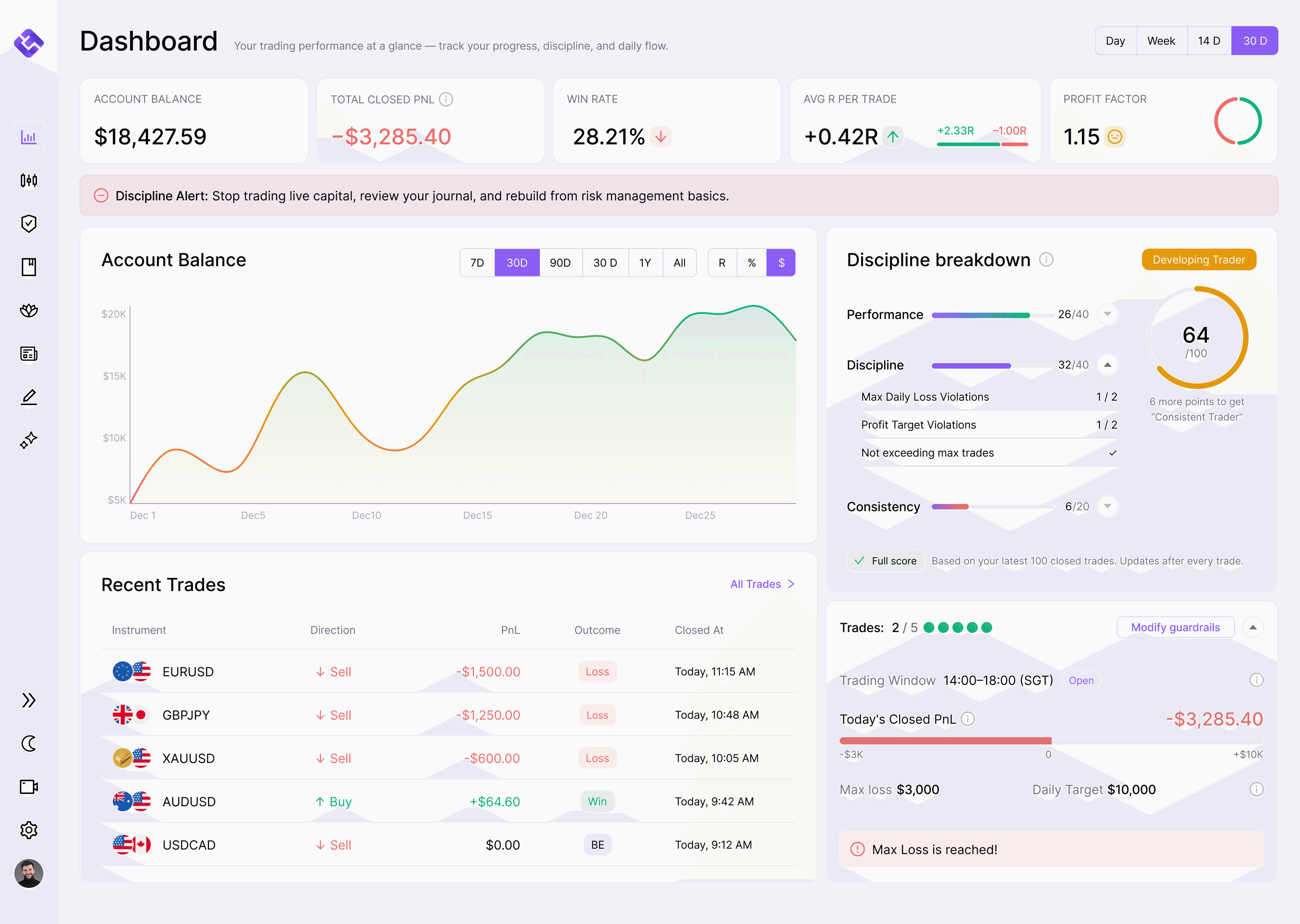
After losing over $10K and years of revenge trading spirals, he didn't find a better strategy. He built a system where the rules couldn't be ignored. That experience is what eventually led him to build EdgeFlo, a trading platform where discipline is baked into execution, not left to willpower.
Make Rule-Breaking a Conscious Choice
Here's the thing about most trading platforms: nothing stops you from clicking the button. You can size up, skip your stop, trade during news. The platform doesn't care. It's designed for speed and volume, not discipline.
What actually works is friction at the right moment. Not a permanent lockout, but a pause. Something that forces you to consciously choose to break your rules instead of doing it on autopilot.
Think about it like this: if you had to confirm "I am breaking my max daily loss rule, continue anyway?" before every revenge trade, how many of those trades would you still take?
Most of them wouldn't happen. Because revenge trading thrives on autopilot. The moment you're forced to acknowledge what you're doing, the spell breaks.
Track the Pattern, Not Just the P&L
One trader tracked every revenge trade he took for three months. What he found was revealing:
"73% of my losses came after my first red trade of the day. My win rate before 11am is almost double my win rate after 2pm. I basically give back my morning gains every afternoon because I'm bored and forcing trades."
He already knew revenge trading was a problem. But seeing the pattern in data, not just feeling it, was what actually changed his behavior.
This is why journaling matters. Not the "write three paragraphs about how you feel" kind. The kind where you tag your emotional state at entry and exit, track which trades followed your plan and which didn't, and review the data weekly.
When you can see that your revenge trades have a 15% win rate compared to 60% on your planned trades, the argument for discipline stops being theoretical. It becomes math.
Build a Pre-Trade Circuit Breaker
The moment between "I want to take this trade" and "I clicked the button" is where revenge trading lives. That gap is usually about two seconds. You need to make it longer.
Effective circuit breakers:
A pre-trade checklist. Before every trade, run through your criteria. If you can't check every box, you don't trade. Simple.
A mandatory cooldown after losses. Not "try to take a break," an actual timed pause. 15 minutes minimum. Walk away from the screen.
A reset routine. Some traders use breathing exercises. Some close the platform entirely and come back in 30 minutes. The method matters less than the consistency.
Design Your Environment, Not Your Willpower
This is the shift that separates traders who keep struggling from traders who actually break the cycle.
Most advice focuses on changing you: your mindset, your emotions, your discipline. But you're not the problem. Your environment is.
If your trading platform makes it equally easy to take a planned trade and a revenge trade, you're fighting human nature with nothing but good intentions. That's a losing trade.
The traders who stop revenge trading are the ones who change their setup:
They use platforms with built-in risk limits
They automate position sizing so they can't size up on impulse
They journal in real-time, not hours later when the details are fuzzy
They have their trading plan visible while they trade, not saved in a Notion doc they never open
The goal is to make disciplined trading the path of least resistance. Not the thing you have to remember to do, the thing that happens by default.
The Real Cost of Revenge Trading
Revenge trading costs more than money. Studies show that approximately 80% of day traders quit within two years (Barber et al., Review of Financial Studies, 2014), and emotional trading, particularly revenge trading and overtrading, is consistently cited as the primary driver of account failure. The damage compounds across confidence, mental health, and the ability to trust your own decisions.
If you've been trading for a while, you already know the financial cost. But the real damage goes deeper. Revenge trading doesn't just drain your account. It drains your confidence, your time, your relationships, and eventually your ability to trust yourself to make decisions under pressure.
And the worst part? Most traders who blow accounts from revenge trading already have a profitable strategy. They don't need a better setup. They need a better system around the setup.
A Framework for Breaking the Cycle
To stop revenge trading, implement a three-phase system: pre-session rules (set max trades, max loss, and risk per trade before you start), in-session circuit breakers (mandatory cooldowns after losses, enforced through your platform), and post-session review (tag every trade as planned or impulsive, then track the data weekly). Here's the full framework:
Before the session:
Set your max trades, max loss, and risk per trade. Write them down or set them in your platform.
Review your trading plan. Not skim it, actually read it.
Run through your pre-market checklist.
During the session:
Trade only setups that match your plan criteria.
After any loss, take a mandatory 15-minute break. Close the chart.
If you hit your max daily loss, the session is over. No exceptions.
After the session:
Review every trade. Tag which were planned and which were impulsive.
Note your emotional state at entry and exit.
Look at the data weekly. What percentage of your losses came from revenge trades?
The ongoing shift:
Stop relying on willpower. Build or find tools that enforce your rules.
Make your plan visible during execution, not hidden in a document.
Track your discipline separately from your P&L. You can have a losing day and still trade well.
Frequently Asked Questions
What is a revenge trade?
A revenge trade is an impulsive, unplanned trade taken immediately after a loss to recover the money. It's driven by emotion, not strategy, and typically involves larger position sizes, weaker setups, and higher risk than the trader's normal plan. Revenge trading is one of the most common causes of blown accounts.
What is the 90% rule in trading?
The 90% rule is the widely cited statistic that roughly 90% of retail traders lose money. Most fail not from bad strategy but from poor discipline: revenge trading, overtrading, and emotional decisions. The 10% who succeed typically use structured routines, strict risk limits, and systems that prevent impulsive behavior (Barber et al., Review of Financial Studies, 2014).
How do I stop revenge trading?
Set hard rules (max trades per day, max daily loss, fixed risk per trade) and use a platform that enforces them automatically. After any loss, take a mandatory 15-minute cooldown away from the screen. Track your emotional state at entry and exit to identify patterns. The key: build rules into your environment instead of relying on willpower.
The Bottom Line
Revenge trading isn't a character flaw. It's a predictable behavior pattern that happens when traders operate in environments designed for speed, not discipline.
You don't fix it by trying harder. You fix it by changing the conditions you trade in.
Set hard limits. Automate your risk. Journal in real-time. Make your plan impossible to ignore. And when you catch yourself reaching for that next trade after a loss, ask yourself one question:
"Am I trading my plan, or am I trading my emotions?"
If you can't honestly answer that, close the platform. The market will be there tomorrow.

Turn discipline on.
Every session.
EdgeFlo is the environment serious traders operate inside.
Start 7-Day Trial — $7
Cancel anytime.
No long-term commitment.

Think Different, Trade Different.